Home
Home
 About Us



Cashew SMEs in dire straits, most have closed down
28/10/2008 12:00
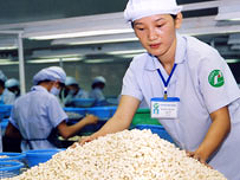
A worker piles up husked cashew nuts at a factory in southern Binh Phuoc Province. An acute shortage of cashew nuts and high production costs have forced a huge majority of small- and medium-sized cashew processing and exporting firms to close down, an industry official said.
“Most small- and medium-sized enterprises with low financial capacity in provinces like Binh Thuan, Binh Phuoc and Dong Nai have had to temporarily close, and only big firms are able to continue operating in the current situation,” acting chairman of the Vietnam Cashew Association (Vinacas) Nguyen Duc Thanh told Thanh Nien Daily last Friday.
Vietnam is now facing a shortage of 100,000 tons of raw cashew for the year for processing, he said, adding that firms do not want to import the nuts because of higher prices.
Vietnam, the largest cashew exporter in the world, has to import additional quantities over domestic production, mainly from Cambodia, Indonesia and Africa for processing and re-export.
Every year, it needs some 600,000 tons of raw cashew, of which local producers can meet some 60 percent.
Import prices of raw cashews with husk surged by 13.3-20 percent to US$1,200-1,500 per ton in August from earlier in the year,according to Vinacas.
Besides, high annual interest rates of about 17-20 percent a year have dealt another blow to local cashew processors. Up to 90 percent of the firms depend on bank loans, because only a few of them have sufficient capital to make their own investment, usually to meet half the demand for production, said Vinacas official Nguyen Van Lang.
Many firms have had to sell their products to pay banking interest rates at the year end, causing prices to slump. “Some cashew buyers have exploited the situation to force local exporters to decrease their selling price,” he said.
In addition, the world financial crisis has weakened consumption demand and buying power in Vietnam’s key cashew export markets like the US and Europe, causing export prices to fall, Thanh noted.
Over the last three months, the export prices of local cashew nuts have plummeted by up to 26 percent to $5,500-5,700 per ton.
“The difficulties will not affect this year’s export plan, but will impact next year’s,” Thanh said.
Vietnam will export around 170,000 tons of cashew nuts worth $940 million in 2008, exceeding the target of $680 million set by the Ministry of Industry and Trade early this year, he added.
For 2009, the country has targeted exports of 190,000 tons of cashew nuts valued at $1.05 billion.
The acting chairman was worried if firms and their workers will still be interested in the cashew industry.
The local industry is already faced with a labor shortage, as its employees are leaving for other industries with higher incomes, Lang said. To deal with the situation, Vinacas has proposed that the government and relevant agencies extend the deadline for payment of corporate income tax for its firms until next July, decrease lending interest rates, and extend loan terms.
This will lessen capital pressure faced by the firms, especially small-and medium-sized ones, so that they can wait and get good export prices.
Vinacas estimates that Vietnam’s cashew industry will need loans of VND8-8.5 trillion ($481.9-512 million) for development in 2009.
Vietnam, home to some 200 cashew processors, is expected to increase its cashew tree cultivation acreage to 500,000 hectares with an anticipated annual output of 500,000 tons of nuts in 2010, from 400,000 hectares and 350,000 tons of nuts at present, Lang said.
“Most small- and medium-sized enterprises with low financial capacity in provinces like Binh Thuan, Binh Phuoc and Dong Nai have had to temporarily close, and only big firms are able to continue operating in the current situation,” acting chairman of the Vietnam Cashew Association (Vinacas) Nguyen Duc Thanh told Thanh Nien Daily last Friday.
Vietnam is now facing a shortage of 100,000 tons of raw cashew for the year for processing, he said, adding that firms do not want to import the nuts because of higher prices.
Vietnam, the largest cashew exporter in the world, has to import additional quantities over domestic production, mainly from Cambodia, Indonesia and Africa for processing and re-export.
Every year, it needs some 600,000 tons of raw cashew, of which local producers can meet some 60 percent.
Import prices of raw cashews with husk surged by 13.3-20 percent to US$1,200-1,500 per ton in August from earlier in the year,according to Vinacas.
Besides, high annual interest rates of about 17-20 percent a year have dealt another blow to local cashew processors. Up to 90 percent of the firms depend on bank loans, because only a few of them have sufficient capital to make their own investment, usually to meet half the demand for production, said Vinacas official Nguyen Van Lang.
Many firms have had to sell their products to pay banking interest rates at the year end, causing prices to slump. “Some cashew buyers have exploited the situation to force local exporters to decrease their selling price,” he said.
In addition, the world financial crisis has weakened consumption demand and buying power in Vietnam’s key cashew export markets like the US and Europe, causing export prices to fall, Thanh noted.
Over the last three months, the export prices of local cashew nuts have plummeted by up to 26 percent to $5,500-5,700 per ton.
“The difficulties will not affect this year’s export plan, but will impact next year’s,” Thanh said.
Vietnam will export around 170,000 tons of cashew nuts worth $940 million in 2008, exceeding the target of $680 million set by the Ministry of Industry and Trade early this year, he added.
For 2009, the country has targeted exports of 190,000 tons of cashew nuts valued at $1.05 billion.
The acting chairman was worried if firms and their workers will still be interested in the cashew industry.
The local industry is already faced with a labor shortage, as its employees are leaving for other industries with higher incomes, Lang said. To deal with the situation, Vinacas has proposed that the government and relevant agencies extend the deadline for payment of corporate income tax for its firms until next July, decrease lending interest rates, and extend loan terms.
This will lessen capital pressure faced by the firms, especially small-and medium-sized ones, so that they can wait and get good export prices.
Vinacas estimates that Vietnam’s cashew industry will need loans of VND8-8.5 trillion ($481.9-512 million) for development in 2009.
Vietnam, home to some 200 cashew processors, is expected to increase its cashew tree cultivation acreage to 500,000 hectares with an anticipated annual output of 500,000 tons of nuts in 2010, from 400,000 hectares and 350,000 tons of nuts at present, Lang said.
Source: thanhniennews.com
Các tin khác
- Viet Nam flexibly overcomes trade barriers (24/06/2026)
- Thai canned pineapple exporters face five-year Mexico duty as Viet Nam and China gain ground (24/06/2026)
- The new US tariff strategy: Some laugh, some cry, and the unknowns remain (24/06/2026)
- Japan is imposing anti-dumping duties on imports of stainless steel from China and Taiwan (24/06/2026)
- India: Govt launches anti-dumping probe into electrical steel imports from China, Japan, Korea and Russia (24/06/2026)