Home
Home
 About Us



We need Doha more than ever, says Lamy
18/06/2015 10:22
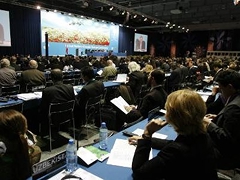
WTO head urges completion of trade round to fight rising threat of protectionism The state of the world economy means the value of the Doha Round as an insurance policy against protectionism has increased, WTO director-general Pascal Lamy says. ``Eighty per cent of the job is done so 20 per cent remains to be done,'' he said during a visit to Wellington yesterday. The change of administration in the United States and the need for the Senate to confirm senior trade officials had inevitably created a delay. ``As soon as they are up and running we will resume the political process, with the assumption by members of the WTO that we will resume from where we left off at the end of last year.'' Lamy, a former European trade commissioner, is unambiguously critical of the European Union's decision to reinstate export subsidies on dairy products. As part of the Doha negotiations Europe has offered to scrap export subsidies - which Trade Minister Tim Groser calls ``the most reviled trade policy instrument'' - and had stopped paying them. But in a world trade round nothing is agreed until everything is agreed, so the EU is within its legal rights to resume paying them. ``But it is still a negative development. It goes in the wrong direction,'' Lamy said. It is one of the areas where there is a space between what countries have been doing in practice and what they are entitled to do under their existing WTO commitments, known in the jargon as ``water in the tariff''. That water is the only asset whose value has grown in the past year, observed Lamy sardonically. The elimination of that gap is a key objective of the Doha Round. The WTO estimates that the tariff burden would double if its members pushed actual tariffs up to their bound levels, and cites research that it could shrink world trade by 8 per cent, at a time when the International Monetary Fund already expects it fall by 2 per cent as a result of the global recession. Lamy is also critical of the Buy America clause in the United States' recently passed US$1.5 trillion stimulus package - though it was qualified with a reference to the need to be consistent with the United States' obligations under the WTO agreement on government procurement. ``The good news on Buy America was that WTO disciplines worked,'' Lamy said. ``The bad news is that the pressure was there in the first place.'' The WTO's predecessor, the Gatt (General Agreement on Tariffs and Trade) arose from the ruins of World War II and reflected an understanding that the protectionism of the 1930 had contributed to that calamity. But while the kinds of measures adopted in the 1930s would generally be forbidden under WTO rules, ``the toolbox of trade-restrictive measures is much more sophisticated than it was in the 1930s'', he said. It includes subsidies, non-tariff barriers and anti-dumping procedures. ``We have to be very vigilant.''
Open trade best for NZ NICK CHURCHOUSE - BusinessDay 06/03/2009 New Zealand's bilateral trade efforts have little benefit compared to the eight-year-long Doha trade talks, the director-general of the WTO says. Pascal Lamy, on a 36-hour tour of New Zealand, talked up New Zealand's support for the seemingly never-ending talks, which started in 2001. He said New Zealand was right to be worried about the creep of protectionist policy eroding trade opportunities, but cautioned against changing tack. "[New Zealand] is one of the best examples of how you grow better with an open trade economy than otherwise. I would not advise you to change the strategy that has been in place for decades," Mr Lamy said. Ensuring ease of trade worldwide could grow more difficult as countries looked inward to protect their own industries in the economic crisis. Until Doha could be completed, only "peer pressure" would encourage governments to keep trade open and accessible. "What we can do is make sure this second layer is contained by peer pressure, which is why we now publish all trade policy development by our members. We put enough transparency into the system so that nobody feels cheated." He could not say when the trade talks would be completed, but that it would be "as soon as possible." More delays would occur until the two "elephants" around the Doha table - the United States and India - could put up mandated negotiating teams to move ahead with the round. New Zealand is in the preliminary stages of free-trade talks with India, Korea and Hong Kong and secured the first free-trade deal with a developed nation with China late last year. Last week, Trade Minister Tim Groser signed a free-trade agreement with Asean, a cluster of 12 south-east Asian countries. Other negotiations included Middle Eastern countries and an initiative to include the United States, Australia, Vietnam and Peru in the existing trans-Pacific agreement, commonly known as the P4 agreement. Mr Lamy said the two-party deals were only a stop-gap for international trade and would never achieve the optimal trade environment for New Zealand. He said the multilateral system provided New Zealand's "real" insurance policy. "
Lamy offers to mediate in drug seizure case ; In the escalating crisis over seizure of Indian generic drugs... D Ravi Kanth Geneva 6 March 2009 Business Standard In the escalating crisis over seizure of Indian generic drugs by the Dutch Customs authorities, WTO Chief Pascal Lamy has offered to mediate between Brazil and India on one side and the European Union on the other to find an amicable solution. On Wednesday evening, several global pressures groups, led by Medicines Sans Frontiers’ (MSF), joined Brazil and India at the WTO in upping the ante against the Dutch Customs authorities in particular and the EU in general. The Dutch Customs officials had detained several consignments of Indian generic medicines in transit to South American countries on the ground that these were counterfeit and sub-standard. The seizures of medicines in transit from India to Brazil constituted a grave threat to generic producers in India and other countries to provide medicines at reasonable prices to poor countries in dire need of medicines, the pressure groups maintained. “The European Union rules and the actions of the Dutch Customs officials are clearly designed to disrupt the supply of legitimate generic medicines to developing countries,” the pressure groups wrote to the WTO chief in a three-page letter.
Turkey, Egypt under fire for textile duties 6 Mar 2009 Amiti Sen, ET Bureau NEW DELHI: New Delhi has approached Turkey and Egypt asking them to remove the additional duties they have imposed on Indian cotton textile imports or pay suitable compensation. According to a senior government official, the moves by Ankara and Cairo are actionable at the WTO, and if the discussions do not lead to a mutually-satisfactory solution, India can drag them to WTO. India’s move may also serve as a warning for countries like Bangladesh, Peru and Brazil, which are planning curbs against Indian textile imports. With the global downturn reducing the demand for most goods, countries are resorting to various protectionist measures to check imports. The additional duties imposed by Turkey had increased the total import duties to more than 15% against a bound rate, or ceiling rate, of 5% at the WTO, said Siddhartha Rajagopal, executive director of Texprocil, a non-profit international marketing organisation for local manufacturers of cotton yarns, fabrics and garments. Likewise, Egypt has hiked the import duty on cotton textile from India to 30% against the 15% bound rate at WTO. “According to our computation, Turkey alone owes us $2 billion in compensation for the loss suffered by the industry due to the increase,” Mr Rajagopal said. Turkey is India’s second-largest market for cotton textiles after Bangladesh, accounting for annual exports worth $186 million while Egypt ranks fifth with exports worth $100 million.
China expects more for selling its toys New Delhi, Mar 5 (PTI) China today said it expects more "positive steps" from India, which has lifted a ban on import of toys from the neighbouring country, and its officials would meet their counterparts in New Delhi to discuss various "trade protectionism" issues. The four-member delegation led by Chinese Vice Minister of Commerce Zhong Shan would also discuss steps with Indian officials to expand the trade between the countries which fell by 37 per cent in January to less than USD 3 billion. When asked if China was satisfied by India's move to ease the import ban, Yan said, "Of course... But we are looking forward to see more positive action from your side." The scheduled for the visit of the delegation, however is yet to be finalised, Chinese Ambassador to India Zhang Yan told reporters here at the sidelines of PHDCCI function. "It (the delegation) would not only discuss trade protectionism issues but also how to look for new opportunities for cooperation to expand the trade between the countries," he said. On March 2, India relaxed the January 23-ban by allowing import of Chinese toys that conform to international health safety standards. Beijing had then asked New Delhi to "show prudence and restraint in using trade remedies in the face of the global economic situation, as it could pose a threat to bilateral trade." Following the restrictions on the import of toys on January 23, the Chinese media had reported that Beijing was contemplating dragging India to the WTO challenging the ban.
Premier stands for cancellation of extra import surcharge KYIV, March 5 /UKRINFORM/. Prime Minister Yulia Tymoshenko stands for cancelation of a 13% temporary extra surcharge on the duty for a range of import goods, she was speaking at a meeting on addressing problem issues of transport carriers. Tymoshenko believes that a law on levying a 13% surcharge on import duties, which had been passed by the Verkhovna Rada and signed by President Viktor Yushchenko, is in conflict with the WTO requirements. The Premier ordered the Economics Ministry to elaborate the relevant amendments to the law and submit them for consideration by the government. On February 20, President Viktor Yushchenko signed a law on making amendments to some laws of Ukraine in order to improve the balance of payments of Ukraine in view of the global financial downturn. The instrument envisages a 13% temporary surcharge on the existing rates of import duties for a period of six months.
Argentina Ctrl Bk To Offer Dlr Repos To Boost Export Loans BUENOS AIRES (Dow Jones)--Argentina's central bank will begin offering repurchase-agreement contracts in dollars to encourage banks to use their dormant foreign-currency deposits for export financing. In a statement released late Thursday, the central bank said it hopes to mobilize $4 billion in trade finance via the facility. The move comes amid a sharp drop in Argentine exports as a result of the global crisis, which in turn is feeding a growing shortage of dollars in the domestic economy.
Obama may face trade showdown with Mexico if Congress ends funding for trucking program By SUZANNE GAMBOA WASHINGTON (AP) - The U.S. Congress may force President Barack Obama into a showdown with Mexico over free trade. Lawmakers are preparing to cut off the money for a 1 1/2-year-old pilot program that opened the way for up to 500 Mexican trucks from 100 operators to drive deeper into the United States. The U.S. has allowed only a few Mexican trucks to drive beyond a southern border buffer zone, although it agreed when it signed the North American Free Trade Agreement to give Mexican trucks full access to U.S. roadways beginning in 1995.
INTERVIEW-Asia may face problems unless exports go up-World Bank By Anirban Nag SYDNEY, March 6 (Reuters) - Asia's industrialised countries may be confronted with a return to problems faced in the 1997/98 financial crisis unless demand for their exports in Europe and the United States improves, a senior World Bank economist said. Most Asian economies entered the global crisis triggered by a downturn in the U.S. housing market with healthy currency reserves and current account surpluses, leading some economists to argue the continent could escape a downturn fairly unscathed. But the recession has been much deeper than expected and exports have plunged in the past six months, with Japan, China, South Korea and Taiwan all reporting big falls. Exports account for about a third of Asia's gross domestic product and rely heavily on U.S. and European demand, which has been hard hit. World Bank lead economist Andrew Burns said on Friday the trade slowdown had been most acute in East Asia. "There are reasons to be concerned that countries in the region, notwithstanding their much stronger initial conditions, may run into difficulties," he said when asked if economies could face the same problems as in the 1997/98 Asian financial crisis. "At the moment, we don't see that occurring. "But ultimately the answer is how does trade respond over the next several months? If it continues to contract the way it has, then that could be a very difficult time for countries in the region, particularly some of the more industrialised countries."
UK To Host Business Summit Ahead Of G20 Meeting LONDON (Dow Jones)--The U.K. will host a meeting of global business leaders later this month, as part of the run up to the Group of 20 nations summit in London on April 2. U.K. Business Secretary Peter Mandelson and the Confederation of British Industry will host the meeting - the conclusions reached at the meeting will be relayed at the G20 summit, the government's business department said in a statement. "The global banking crisis that has buffeted businesses around the globe won't be reversed without a coordinated international plan of action," Mandelson said. On the agenda will be the possibility of strengthening the G20's resistance to protectionism, the impact of government interventions in the economy and banking systems and how to address the decline in availability and increase the cost of trade finance. Among the delegations that have already signed up for the summit are the European Union, India, China, Indonesia and Russia.
Economic crisis hurts male workers most-UN agency By Laura MacInnis GENEVA, March 5 (Reuters Life!) - The world's economic crisis has cost more men their jobs than women in Western countries, the International Labour Organisation (ILO) said on Thursday. The male jobless rate in developed economies rose 1.1 percentage points to 6.6 percent in 2008, the year when credit, financial, and economic woes began to sink global markets, the U.N. agency said in a report. Female unemployment rose 0.8 percentage points to 6.8 percent. (END)
Open trade best for NZ NICK CHURCHOUSE - BusinessDay 06/03/2009 New Zealand's bilateral trade efforts have little benefit compared to the eight-year-long Doha trade talks, the director-general of the WTO says. Pascal Lamy, on a 36-hour tour of New Zealand, talked up New Zealand's support for the seemingly never-ending talks, which started in 2001. He said New Zealand was right to be worried about the creep of protectionist policy eroding trade opportunities, but cautioned against changing tack. "[New Zealand] is one of the best examples of how you grow better with an open trade economy than otherwise. I would not advise you to change the strategy that has been in place for decades," Mr Lamy said. Ensuring ease of trade worldwide could grow more difficult as countries looked inward to protect their own industries in the economic crisis. Until Doha could be completed, only "peer pressure" would encourage governments to keep trade open and accessible. "What we can do is make sure this second layer is contained by peer pressure, which is why we now publish all trade policy development by our members. We put enough transparency into the system so that nobody feels cheated." He could not say when the trade talks would be completed, but that it would be "as soon as possible." More delays would occur until the two "elephants" around the Doha table - the United States and India - could put up mandated negotiating teams to move ahead with the round. New Zealand is in the preliminary stages of free-trade talks with India, Korea and Hong Kong and secured the first free-trade deal with a developed nation with China late last year. Last week, Trade Minister Tim Groser signed a free-trade agreement with Asean, a cluster of 12 south-east Asian countries. Other negotiations included Middle Eastern countries and an initiative to include the United States, Australia, Vietnam and Peru in the existing trans-Pacific agreement, commonly known as the P4 agreement. Mr Lamy said the two-party deals were only a stop-gap for international trade and would never achieve the optimal trade environment for New Zealand. He said the multilateral system provided New Zealand's "real" insurance policy. "
Lamy offers to mediate in drug seizure case ; In the escalating crisis over seizure of Indian generic drugs... D Ravi Kanth Geneva 6 March 2009 Business Standard In the escalating crisis over seizure of Indian generic drugs by the Dutch Customs authorities, WTO Chief Pascal Lamy has offered to mediate between Brazil and India on one side and the European Union on the other to find an amicable solution. On Wednesday evening, several global pressures groups, led by Medicines Sans Frontiers’ (MSF), joined Brazil and India at the WTO in upping the ante against the Dutch Customs authorities in particular and the EU in general. The Dutch Customs officials had detained several consignments of Indian generic medicines in transit to South American countries on the ground that these were counterfeit and sub-standard. The seizures of medicines in transit from India to Brazil constituted a grave threat to generic producers in India and other countries to provide medicines at reasonable prices to poor countries in dire need of medicines, the pressure groups maintained. “The European Union rules and the actions of the Dutch Customs officials are clearly designed to disrupt the supply of legitimate generic medicines to developing countries,” the pressure groups wrote to the WTO chief in a three-page letter.
Turkey, Egypt under fire for textile duties 6 Mar 2009 Amiti Sen, ET Bureau NEW DELHI: New Delhi has approached Turkey and Egypt asking them to remove the additional duties they have imposed on Indian cotton textile imports or pay suitable compensation. According to a senior government official, the moves by Ankara and Cairo are actionable at the WTO, and if the discussions do not lead to a mutually-satisfactory solution, India can drag them to WTO. India’s move may also serve as a warning for countries like Bangladesh, Peru and Brazil, which are planning curbs against Indian textile imports. With the global downturn reducing the demand for most goods, countries are resorting to various protectionist measures to check imports. The additional duties imposed by Turkey had increased the total import duties to more than 15% against a bound rate, or ceiling rate, of 5% at the WTO, said Siddhartha Rajagopal, executive director of Texprocil, a non-profit international marketing organisation for local manufacturers of cotton yarns, fabrics and garments. Likewise, Egypt has hiked the import duty on cotton textile from India to 30% against the 15% bound rate at WTO. “According to our computation, Turkey alone owes us $2 billion in compensation for the loss suffered by the industry due to the increase,” Mr Rajagopal said. Turkey is India’s second-largest market for cotton textiles after Bangladesh, accounting for annual exports worth $186 million while Egypt ranks fifth with exports worth $100 million.
China expects more for selling its toys New Delhi, Mar 5 (PTI) China today said it expects more "positive steps" from India, which has lifted a ban on import of toys from the neighbouring country, and its officials would meet their counterparts in New Delhi to discuss various "trade protectionism" issues. The four-member delegation led by Chinese Vice Minister of Commerce Zhong Shan would also discuss steps with Indian officials to expand the trade between the countries which fell by 37 per cent in January to less than USD 3 billion. When asked if China was satisfied by India's move to ease the import ban, Yan said, "Of course... But we are looking forward to see more positive action from your side." The scheduled for the visit of the delegation, however is yet to be finalised, Chinese Ambassador to India Zhang Yan told reporters here at the sidelines of PHDCCI function. "It (the delegation) would not only discuss trade protectionism issues but also how to look for new opportunities for cooperation to expand the trade between the countries," he said. On March 2, India relaxed the January 23-ban by allowing import of Chinese toys that conform to international health safety standards. Beijing had then asked New Delhi to "show prudence and restraint in using trade remedies in the face of the global economic situation, as it could pose a threat to bilateral trade." Following the restrictions on the import of toys on January 23, the Chinese media had reported that Beijing was contemplating dragging India to the WTO challenging the ban.
Premier stands for cancellation of extra import surcharge KYIV, March 5 /UKRINFORM/. Prime Minister Yulia Tymoshenko stands for cancelation of a 13% temporary extra surcharge on the duty for a range of import goods, she was speaking at a meeting on addressing problem issues of transport carriers. Tymoshenko believes that a law on levying a 13% surcharge on import duties, which had been passed by the Verkhovna Rada and signed by President Viktor Yushchenko, is in conflict with the WTO requirements. The Premier ordered the Economics Ministry to elaborate the relevant amendments to the law and submit them for consideration by the government. On February 20, President Viktor Yushchenko signed a law on making amendments to some laws of Ukraine in order to improve the balance of payments of Ukraine in view of the global financial downturn. The instrument envisages a 13% temporary surcharge on the existing rates of import duties for a period of six months.
Argentina Ctrl Bk To Offer Dlr Repos To Boost Export Loans BUENOS AIRES (Dow Jones)--Argentina's central bank will begin offering repurchase-agreement contracts in dollars to encourage banks to use their dormant foreign-currency deposits for export financing. In a statement released late Thursday, the central bank said it hopes to mobilize $4 billion in trade finance via the facility. The move comes amid a sharp drop in Argentine exports as a result of the global crisis, which in turn is feeding a growing shortage of dollars in the domestic economy.
Obama may face trade showdown with Mexico if Congress ends funding for trucking program By SUZANNE GAMBOA WASHINGTON (AP) - The U.S. Congress may force President Barack Obama into a showdown with Mexico over free trade. Lawmakers are preparing to cut off the money for a 1 1/2-year-old pilot program that opened the way for up to 500 Mexican trucks from 100 operators to drive deeper into the United States. The U.S. has allowed only a few Mexican trucks to drive beyond a southern border buffer zone, although it agreed when it signed the North American Free Trade Agreement to give Mexican trucks full access to U.S. roadways beginning in 1995.
INTERVIEW-Asia may face problems unless exports go up-World Bank By Anirban Nag SYDNEY, March 6 (Reuters) - Asia's industrialised countries may be confronted with a return to problems faced in the 1997/98 financial crisis unless demand for their exports in Europe and the United States improves, a senior World Bank economist said. Most Asian economies entered the global crisis triggered by a downturn in the U.S. housing market with healthy currency reserves and current account surpluses, leading some economists to argue the continent could escape a downturn fairly unscathed. But the recession has been much deeper than expected and exports have plunged in the past six months, with Japan, China, South Korea and Taiwan all reporting big falls. Exports account for about a third of Asia's gross domestic product and rely heavily on U.S. and European demand, which has been hard hit. World Bank lead economist Andrew Burns said on Friday the trade slowdown had been most acute in East Asia. "There are reasons to be concerned that countries in the region, notwithstanding their much stronger initial conditions, may run into difficulties," he said when asked if economies could face the same problems as in the 1997/98 Asian financial crisis. "At the moment, we don't see that occurring. "But ultimately the answer is how does trade respond over the next several months? If it continues to contract the way it has, then that could be a very difficult time for countries in the region, particularly some of the more industrialised countries."
UK To Host Business Summit Ahead Of G20 Meeting LONDON (Dow Jones)--The U.K. will host a meeting of global business leaders later this month, as part of the run up to the Group of 20 nations summit in London on April 2. U.K. Business Secretary Peter Mandelson and the Confederation of British Industry will host the meeting - the conclusions reached at the meeting will be relayed at the G20 summit, the government's business department said in a statement. "The global banking crisis that has buffeted businesses around the globe won't be reversed without a coordinated international plan of action," Mandelson said. On the agenda will be the possibility of strengthening the G20's resistance to protectionism, the impact of government interventions in the economy and banking systems and how to address the decline in availability and increase the cost of trade finance. Among the delegations that have already signed up for the summit are the European Union, India, China, Indonesia and Russia.
Economic crisis hurts male workers most-UN agency By Laura MacInnis GENEVA, March 5 (Reuters Life!) - The world's economic crisis has cost more men their jobs than women in Western countries, the International Labour Organisation (ILO) said on Thursday. The male jobless rate in developed economies rose 1.1 percentage points to 6.6 percent in 2008, the year when credit, financial, and economic woes began to sink global markets, the U.N. agency said in a report. Female unemployment rose 0.8 percentage points to 6.8 percent. (END)
BY BRIAN FALLOW ECONOMICS EDITOR
6 March 2009
New Zealand Herald
WORLD TRADE NEWS
NEWS SUMMARY FOR WTO REFERENCE CENTRES AND NON-RESIDENT MISSIONS
6 March 2009
No. 1899
Source: www.wtocenter.org.tw
6 March 2009
New Zealand Herald
WORLD TRADE NEWS
NEWS SUMMARY FOR WTO REFERENCE CENTRES AND NON-RESIDENT MISSIONS
6 March 2009
No. 1899
Source: www.wtocenter.org.tw
Các tin khác
- New-generation FTAs open wider export opportunities to Middle East and South Asia (15/06/2026)
- Updated regulations on foreign trade management and import quotas (15/06/2026)
- Mandatory traceability for high-risk goods from July 1st: What should businesses prepare for? (15/06/2026)
- Tariff pressure is forcing businesses to restructure in order to adapt. (15/06/2026)
- Coffee Citizens model aims to lift Vietnamese value chain (15/06/2026)