Home
Home
 About Us


Vietnam's exports to the US grow faster than other markets
11/10/2024 06:11
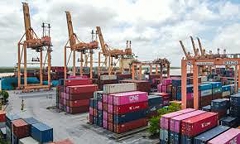
According to the World Bank (WB), exports of Vietnamese enterprises to the US in the period 2018 - 2021 grew nearly 25% faster than other markets.
The World Bank has just released its Semiannual Economic Outlook Report for East Asia and the Pacific. Binh Duong (EAP).
In this Report, the WB believes that EAP's developing economies will continue to grow faster than the rest of the region. world in 2024, but still slower than pre-pandemic times.
The World Bank forecasts EAP growth to reach 4,8% in 2024, before slowing to 4,4% in 2025. Among the countries, growth in Vietnam, Malaysia, the Philippines, and Thailand is expected to be lower than pre-pandemic levels in 2024 and 2025, while Indonesia is expected to maintain growth at or above this level.
Growth in the region's largest economy, China, is forecast to slow from 4,8% this year to 4,3% in 2025 due to a persistently weak property market, low investor and consumer confidence, and structural challenges such as an aging population and global tensions.
In contrast, overall growth in the region excluding China is forecast to reach 4,7% in 2024 and 4,9% in 2025, driven by rising domestic consumption, a recovery in merchandise exports, and Travel increase again.
Ms. Manuela V. Ferro, World Bank Vice President for East Asia and Thai Binh “Countries in the East Asia and Pacific region continue to be the growth engine for the world economy. However, the growth rate is slowing,” said Duong.
To maintain strong growth in the medium term, according to her Manuela V. Ferro, Countries in the region must proactively modernize and reform their economies to adapt to shifting trade patterns and technological changes.”
The WB report also pointed out three factors affecting growth in the region, which are trade and investment shifts, slowing growth in China and increasing global policy uncertainty.
Specifically, recent trade tensions between the US and China have created opportunities for countries like Vietnam to strengthen their role in the global value chain by “connecting” major trading partners.
First, Vietnamese companies exporting to the US market saw their revenues grow nearly 25% faster than those to other markets between 2018 and 2021. However, new evidence suggests that economies may be increasingly constrained in their ability to act as “one-way connectors” as new, stringent rules of origin and import-export restrictions are imposed.
Second, China's neighbors have benefited from its strong growth over the past three decades, but the scale of that momentum is now fading.
China has boosted other countries by importing goods, but import demand is now growing more slowly than GDP. Imports rose just 2,8% in the first seven months of this year, compared with nearly 7% a year in the previous decade.
Third, global uncertainty could have a negative impact on regional economies. In addition to geopolitical uncertainty, increased economic policy uncertainty could reduce industrial production and stock prices in EAP by up to 0,5% and 1%, respectively.
In addition, the Report also points out the fact that countries in the region are taking advantage of new technology to continue creating jobs. Industrial robots, artificial intelligence (AI) and digital platforms are affecting the labor market.
“In the period 2018-2022, the use of robots has helped create 2 million jobs for skilled workers, thanks to higher productivity and expanded production scale, along with the demand for complementary skills. However, robots have also replaced about 1,4 million low-skilled workers in ASEAN-5 countries,” the report stated.
Because the region has a high proportion of manual jobs, the proportion of jobs threatened by AI is lower than in developed economies. However, the region is also less likely to take advantage of AI’s benefits, with only 10% of jobs being AI-enabled, compared to 30% in developed economies.
“East Asia’s development model based on open global markets and labor-intensive manufacturing is being challenged by trade tensions and new technologies,” said Aaditya Mattoo, chief economist for the East Asia and Pacific region at the World Bank.
Therefore, “the best response is to take advantage of free trade agreements and equip people with the skills and mobility to take advantage of new technologies,” Mr. Aaditya Mattoo noted.
Source: Vietnam.vn
Các tin khác
- Viet Nam extends anti-dumping duties on some Thai sugar products to 2031 (05/06/2026)
- Hong Kong: Ministry of Commerce Rules on Inheritance of Anti-dumping Duty Rates for Copolymer Polyoxymethylene Imports Originating from S Korea, Thailand and Malaysia (05/06/2026)
- Early-season Vietnamese lychees conquer US consumers (05/06/2026)
- Global rubber prices surge, raising hopes for Vietnamese exporters (05/06/2026)
- Modern logistics creates new growth opportunities for Lang Son’s border-gate economy (05/06/2026)