Home
Home
 About Us



Vietnam fruit exported to new markets
02/12/2022 05:06
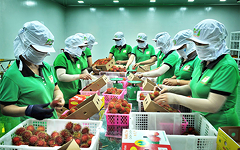
2022 has been a successful export year as Vietnam’s farm produce has accessed many international markets.
The Plant Protection Department under the Ministry of Agriculture and Rural Development (MARD) on November 24 held a press conference about the Japanese market opening to Vietnam’s longan, the Chinese market to sweet potatoes and the New Zealand market to lemons and pomelo.
This year, many Vietnamese produce items have obtained rights to enter foreign markets. Passion fruit, for example, has entered the Chinese market under temporary regulations. Durian and bananas were also accepted by China after the signing of a protocol on phytosanitary requirements. The two sides recently signed a protocol on phytosanitary requirements on sweet potatoes imported from Vietnam. On November 22, the Chinese customs agency announced the requirement on its website.
Vietnam’s lemon and pomelo now can enter New Zealand after import requirements were signed by the two sides on November 15. Most recently, MAFF (Ministry of Agriculture, Forestry and Fisheries of Japan) on November 18 officially stated on the government’s website that Vietnam’s fresh longan can be imported to Japan
Nguyen Quang Hieu, head of the International Cooperation and Communication, said that long negotiations had been conducted before Vietnam obtained an agreement on exporting farm produce to the markets.
It took three years, for example, to negotiate for the right to export lemon and pomelo to New Zealand. As for longan, the technical dossier was submitted in 2016, but only in November 2022 could the procedures be completed for export of the fruit to Japan. Meanwhile, it took up to 10 years to export sweet potatoes to China.
Officials said that it is difficult to negotiate to obtain the right for full-tax export of fruits to international markets, but it is even more difficult to retain the markets. Vietnam has to satisfy all the requirements of importing countries in phytosanitary and food safety rules. Fruits must be traceable with transparent information from growing areas with input and output products, and packaging and distribution information.
Vietnamese and Chinese agencies will carry out examinations at random in growing areas and packaging establishments after Vietnam begins exporting products (weekly or yearly). If repeated violations are discovered, China may stop imports from Vietnam.
Hoang Trung, head of the Plant Protection Department, said the signing of protocols for farm produce to be exported through official channels will create clear legal conditions and help Vietnamese farmers to organize production in a more professional way and on a larger scale.
Farmers and businesses will control harm to the environment and improve product quality. They will then be able to sell products at higher prices.
“Durian, for example, has seen prices increase by three times since the day the protocol was signed,” Trung said.
Source: VietNamNet
Các tin khác
- Viet Nam extends anti-dumping duties on some Thai sugar products to 2031 (05/06/2026)
- Hong Kong: Ministry of Commerce Rules on Inheritance of Anti-dumping Duty Rates for Copolymer Polyoxymethylene Imports Originating from S Korea, Thailand and Malaysia (05/06/2026)
- Early-season Vietnamese lychees conquer US consumers (05/06/2026)
- Global rubber prices surge, raising hopes for Vietnamese exporters (05/06/2026)
- Modern logistics creates new growth opportunities for Lang Son’s border-gate economy (05/06/2026)