Home
Home
 About Us



US Commerce Secretary Bemoans Restrictive WTO Rules
03/05/2017 12:00
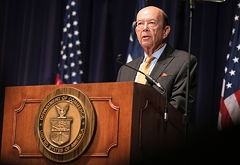
The United States Secretary of Commerce has spoken out against the World Trade Organization's most favored nation clause, which prevents the US from matching its tariffs with those imposed by its trading partners.
Wilbur Ross said most favored nation (MFN) status, which WTO members must accord to each other, means the United States cannot impose equally high tariffs on some territories with higher barriers to US firms.
The MFN clause requires that every WTO member state provide equal access to their market to every WTO member. A country generally cannot offer preferential access without extending the same to other members, except through a free trade agreement.
Ross said MFN treatment is preventing the US from adopting the "reciprocal concept" discussed by President Donald Trump, "namely [that] if we have a country that has big trade barriers against us, we should logically have similar trade barriers against them." He explained that without a reciprocal tariff, other countries would have little to gain from entering into a FTA with the US, which already has low tariffs.
"The fact we have been so free-trade orientated historically actually impedes our ability to make new free-trade agreements," said Ross. He went on to suggest that a forthcoming review of US trade relations could result in the US lobbying for changes to WTO rules and said withdrawal from WTO had not been taken "off the table."
May 3, 2017
Source: Tax news
Wilbur Ross said most favored nation (MFN) status, which WTO members must accord to each other, means the United States cannot impose equally high tariffs on some territories with higher barriers to US firms.
The MFN clause requires that every WTO member state provide equal access to their market to every WTO member. A country generally cannot offer preferential access without extending the same to other members, except through a free trade agreement.
Ross said MFN treatment is preventing the US from adopting the "reciprocal concept" discussed by President Donald Trump, "namely [that] if we have a country that has big trade barriers against us, we should logically have similar trade barriers against them." He explained that without a reciprocal tariff, other countries would have little to gain from entering into a FTA with the US, which already has low tariffs.
"The fact we have been so free-trade orientated historically actually impedes our ability to make new free-trade agreements," said Ross. He went on to suggest that a forthcoming review of US trade relations could result in the US lobbying for changes to WTO rules and said withdrawal from WTO had not been taken "off the table."
May 3, 2017
Source: Tax news
Các tin khác
- New-generation FTAs open wider export opportunities to Middle East and South Asia (15/06/2026)
- Updated regulations on foreign trade management and import quotas (15/06/2026)
- Mandatory traceability for high-risk goods from July 1st: What should businesses prepare for? (15/06/2026)
- Tariff pressure is forcing businesses to restructure in order to adapt. (15/06/2026)
- Coffee Citizens model aims to lift Vietnamese value chain (15/06/2026)