Home
Home
 About Us


G-20 leaders pledge to resist trade barriers
07/09/2016 12:00
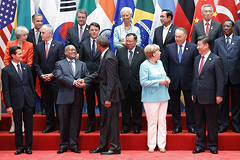
China agreed to cooperate more closely with its trading partners on its politically volatile steel exports as leaders of major economies ended a summit Monday with a forceful endorsement of free trade and a crowded agenda that included the Koreas, Syria and refugees.
In a joint statement, Chinese President Xi Jinping, President Obama and the leaders of Britain, Japan, Russia and other Group of 20 nations pledged to boost sluggish global growth by promoting innovation.
“The global recovery lacks momentum,” Xi told reporters after the meeting. “We need to do more to unlock the potential for medium and long-term growth.”
There was no mention of a global stimulus or other joint action, which officials said earlier was unworkable because economic conditions vary widely from country to country.
In an effort to shore up public support for trade, the leaders promised “inclusive growth” to spread the benefits to people who have been left behind by wrenching change. That reflects a recognition that economic strains are fueling political tensions and a growing clamor to raise barriers against foreign competition.
The statement expressed “opposition to protectionism on trade and investment in all its forms.”
The governments pledged to avoid devaluing their currencies to boost exports. They called for cooperation to reduce tax evasion. They appealed for stepped up aid for surging global numbers of refugees and their host countries.
Beijing made trade a theme of the gathering in this lakeside city southwest of Shanghai but faces complaints that a flood of low-cost Chinese steel into global markets threatens U.S. and European jobs, propelling the rise of political movements that promise to curb trade.
The joint statement calls for formation of a steel forum under the Organization for Economic Cooperation and Development to study excess production capacity.
In a concession to Beijing, the statement doesn’t mention China by name and says excess steel capacity is a global issue. However, U.S. and European officials say the vast Chinese state-owned industry, which accounts for half of worldwide output, is the root of the problem. Washington has hiked import duties by up to 500 percent on Chinese steel to offset what it says are improper subsidies.
The president of the European Union’s governing body, Jean-Claude Juncker, called Sunday for the G-20 to take action on steel. He said the trade bloc will look at Beijing’s response when deciding whether to grant China market economy status, which would make it harder to bring anti-dumping cases.
The World Trade Organization is forecasting global trade growth this year at just 2.8 percent — its fifth year below 3 percent. The International Monetary Fund has cut its outlook for global economic growth to 3.1 percent.
The summit got off to a rocky start Saturday when there was no staircase at the airport for Obama’s plane. Quarrels with Chinese officials broke out on the tarmac and at other venues over access by U.S. officials and reporters.
In a joint statement, Chinese President Xi Jinping, President Obama and the leaders of Britain, Japan, Russia and other Group of 20 nations pledged to boost sluggish global growth by promoting innovation.
“The global recovery lacks momentum,” Xi told reporters after the meeting. “We need to do more to unlock the potential for medium and long-term growth.”
There was no mention of a global stimulus or other joint action, which officials said earlier was unworkable because economic conditions vary widely from country to country.
In an effort to shore up public support for trade, the leaders promised “inclusive growth” to spread the benefits to people who have been left behind by wrenching change. That reflects a recognition that economic strains are fueling political tensions and a growing clamor to raise barriers against foreign competition.
The statement expressed “opposition to protectionism on trade and investment in all its forms.”
The governments pledged to avoid devaluing their currencies to boost exports. They called for cooperation to reduce tax evasion. They appealed for stepped up aid for surging global numbers of refugees and their host countries.
Beijing made trade a theme of the gathering in this lakeside city southwest of Shanghai but faces complaints that a flood of low-cost Chinese steel into global markets threatens U.S. and European jobs, propelling the rise of political movements that promise to curb trade.
The joint statement calls for formation of a steel forum under the Organization for Economic Cooperation and Development to study excess production capacity.
In a concession to Beijing, the statement doesn’t mention China by name and says excess steel capacity is a global issue. However, U.S. and European officials say the vast Chinese state-owned industry, which accounts for half of worldwide output, is the root of the problem. Washington has hiked import duties by up to 500 percent on Chinese steel to offset what it says are improper subsidies.
The president of the European Union’s governing body, Jean-Claude Juncker, called Sunday for the G-20 to take action on steel. He said the trade bloc will look at Beijing’s response when deciding whether to grant China market economy status, which would make it harder to bring anti-dumping cases.
The World Trade Organization is forecasting global trade growth this year at just 2.8 percent — its fifth year below 3 percent. The International Monetary Fund has cut its outlook for global economic growth to 3.1 percent.
The summit got off to a rocky start Saturday when there was no staircase at the airport for Obama’s plane. Quarrels with Chinese officials broke out on the tarmac and at other venues over access by U.S. officials and reporters.
Source: sfgate.com
Các tin khác
- New-generation FTAs open wider export opportunities to Middle East and South Asia (15/06/2026)
- Updated regulations on foreign trade management and import quotas (15/06/2026)
- Mandatory traceability for high-risk goods from July 1st: What should businesses prepare for? (15/06/2026)
- Tariff pressure is forcing businesses to restructure in order to adapt. (15/06/2026)
- Coffee Citizens model aims to lift Vietnamese value chain (15/06/2026)