Home
Home
 About Us



FOCUS - Tyremakers skid on Chinese imports; seek duty
18/06/2015 10:22
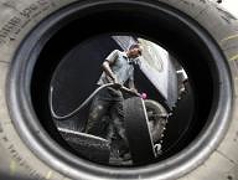
MUMBAI (Reuters) - India's tyre industry has been having a rough ride for some time now as cheap Chinese imports have made deep inroads into the country's replacement market, prompting calls for an anti-dumping duty by domestic players.
Tyres imported from China, often illegally, are cheaper by as much as 30 percent compared to Indian products, officials said.
"Today, Chinese imports in percentage terms into the replacement market is anywhere between 12-15 percent, which means every sixth tyre fitted on an Indian vehicle is a Chinese tyre," said Rajiv Budhraja, director-general of Automotive Tyre Manufacturers Association (ATMA).
Between 85-90 percent of India's tyre imports are Chinese, Budhraja said, and attract transporters and small-time traders.
"Inferior quality radial tyres are imported from China under the guise of bias tyres, which is done by small traders who resort to all sorts of means to evade duties," said Girish Solanki, an analyst at Angel Broking.
Bias tyres, largely identical to radial tyres, typically have a less fuel-efficient design than the standard radial.
Though the basic duty on tyre imports is 10 percent, Chinese imports attract only 8.6 percent as part of the Asia Pacific Trade Agreement, Budhraja said.
Traditionally, supplying to the replacement market provides better margins than selling to vehicle manufacturers, which is often done at discounted prices.
INDUSTRY FIGHTS BACK
Indian tyremakers, facing the double whammy of a slowdown in commercial vehicle (CV) sales and a shrinking replacement market, have now sought government intervention to check cheaper imports.
The Indian tyre replacement market has "contracted in totality" over the past few years as Chinese tyres are cheaper by 25 to 30 percent, said Koshy Varghese, executive vice president at MRF Ltd, India's top tyre firm by sales.
Share values of tyre firms have taken a beating, with the top four -- MRF, Apollo Tyres, JK Tyre, Ceat -- sliding over 50 percent over the past 12 months.
Tyre imports from China have risen dramatically over the last six years, data from ATMA showed. From about 80,000 CV tyres in 2002/03, imports have surged to 1.63 million units in the year ending March 2009, an almost 20-fold rise.
Tyre firms now want an anti-dumping duty on imported tyres.
"There is a licensing on Chinese commercial tyres currently, and we have made a representation for having an anti-dumping duty on Chinese radial commercial tyres and also on China passenger radial tyres," Varghese said.
India had placed the import of radial truck and bus tyres in the 'restricted category' last October and allowed import of tyres by actual users, including vehicle manufacturers.
While this move has bought some cheer to tyremakers like Ceat Ltd which saw a growth in after-market sales since October last year, much still needs to be done.
"Post-October our growth in the replacement market has been quite strong," Ceat's managing director Paras Chowdhary said, adding that the overall domestic replacement market had begun to see some recovery since late 2008.
Industry players are now awaiting the conclusion of general elections in mid-May, after which they hope the government will take more measures to provide relief.
"Now I would think any decision would be taken post-elections. Our case is strong because every country across the globe is today protecting its domestic industry raising tariff barriers," MRF's Varghese added.
Tyres imported from China, often illegally, are cheaper by as much as 30 percent compared to Indian products, officials said.
"Today, Chinese imports in percentage terms into the replacement market is anywhere between 12-15 percent, which means every sixth tyre fitted on an Indian vehicle is a Chinese tyre," said Rajiv Budhraja, director-general of Automotive Tyre Manufacturers Association (ATMA).
Between 85-90 percent of India's tyre imports are Chinese, Budhraja said, and attract transporters and small-time traders.
"Inferior quality radial tyres are imported from China under the guise of bias tyres, which is done by small traders who resort to all sorts of means to evade duties," said Girish Solanki, an analyst at Angel Broking.
Bias tyres, largely identical to radial tyres, typically have a less fuel-efficient design than the standard radial.
Though the basic duty on tyre imports is 10 percent, Chinese imports attract only 8.6 percent as part of the Asia Pacific Trade Agreement, Budhraja said.
Traditionally, supplying to the replacement market provides better margins than selling to vehicle manufacturers, which is often done at discounted prices.
INDUSTRY FIGHTS BACK
Indian tyremakers, facing the double whammy of a slowdown in commercial vehicle (CV) sales and a shrinking replacement market, have now sought government intervention to check cheaper imports.
The Indian tyre replacement market has "contracted in totality" over the past few years as Chinese tyres are cheaper by 25 to 30 percent, said Koshy Varghese, executive vice president at MRF Ltd, India's top tyre firm by sales.
Share values of tyre firms have taken a beating, with the top four -- MRF, Apollo Tyres, JK Tyre, Ceat -- sliding over 50 percent over the past 12 months.
Tyre imports from China have risen dramatically over the last six years, data from ATMA showed. From about 80,000 CV tyres in 2002/03, imports have surged to 1.63 million units in the year ending March 2009, an almost 20-fold rise.
Tyre firms now want an anti-dumping duty on imported tyres.
"There is a licensing on Chinese commercial tyres currently, and we have made a representation for having an anti-dumping duty on Chinese radial commercial tyres and also on China passenger radial tyres," Varghese said.
India had placed the import of radial truck and bus tyres in the 'restricted category' last October and allowed import of tyres by actual users, including vehicle manufacturers.
While this move has bought some cheer to tyremakers like Ceat Ltd which saw a growth in after-market sales since October last year, much still needs to be done.
"Post-October our growth in the replacement market has been quite strong," Ceat's managing director Paras Chowdhary said, adding that the overall domestic replacement market had begun to see some recovery since late 2008.
Industry players are now awaiting the conclusion of general elections in mid-May, after which they hope the government will take more measures to provide relief.
"Now I would think any decision would be taken post-elections. Our case is strong because every country across the globe is today protecting its domestic industry raising tariff barriers," MRF's Varghese added.
By Aniruddha Basu and Nandita Bose
Source: in.reuters.com
Source: in.reuters.com
Các tin khác
- New-generation FTAs open wider export opportunities to Middle East and South Asia (15/06/2026)
- Updated regulations on foreign trade management and import quotas (15/06/2026)
- Mandatory traceability for high-risk goods from July 1st: What should businesses prepare for? (15/06/2026)
- Tariff pressure is forcing businesses to restructure in order to adapt. (15/06/2026)
- Coffee Citizens model aims to lift Vietnamese value chain (15/06/2026)