Home
Home
 About Us



‘Murky protectionism’ worries Tokyo
11/08/2009 12:00
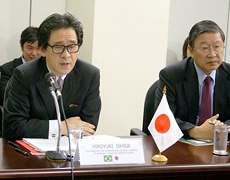
Japan is seriously concerned about the rising use of anti-dumping charges and other forms of "murky protectionism" being taken by trading partners amid the global economic slowdown, according to a senior Tokyo trade official.
In an interview with the FT, Hiroyuki Ishige, vice minister of the Ministry of Economy, Trade and Industry (Meti), said overt violations of free trade rules had been relatively limited since the onset of the slump last year, but warned that governments remained under huge pressure to shield their markets.
"More alarming is the murky protectionism, or invisible protectionism – that is spreading," Mr Ishige said. "Typically, anti-dumping measures are being increasingly used, technical barriers to trade intentionally misused, and 'buy-local' promoted."
Mr Ishige's comments highlight worries about the threat posed by protectionist sentiment to Japan's powerful exporters, which have already been badly battered by plunging demand. In February, Japanese exports were down nearly 50 per cent year-on-year.
The vice minister cited particular worries about the growing use of anti-dumping measures by developing countries.
With demand from the US and EU likely to take some time to recover, Japanese companies would have to focus on supplying the expanding middle-classes of markets such as India, China and Brazil – but these nations were "unfortunately" heavy users of anti-dumping action, he said.
The World Trade Organisation says the number of new anti-dumping investigations rose 17 per cent year-on-year in the second half of 2008. Such investigations are launched by governments at the request of domestic industries threatened by allegedly under-priced imports.
In the second quarter of 2009, new investigations were up 12 per cent, according to research by Chad Bown, an economics professor at Brandeis University and fellow at the Brookings Institution. The research suggests a wave of possible protectionism in 2010 as such investigations lead to the imposition of anti-dumping penalties. "We have serious concerns over anti-dumping duties," Mr Ishige said
While any fundamental change to the anti-dumping system is unlikely in the near term, Japan hopes to push for consensus on making it harder to "manipulate" the penalties imposed for alleged dumping and for action to increase the transparency of anti-dumping actions.
"Sometimes Japanese companies face procedural problems with anti-dumping duties taken by developing countries," Mr Ishige said. "The companies that are the focus of anti-dumping action…should be given information about what is going on."
While restrictions on anti-dumping would help Japanese companies, Meti also cites WTO data showing that in the past 13 years, 38 per cent of actions were initiated by developing countries against other developing countries.
"Strong discipline on anti-dumping would benefit everyone and is a must for steady economic growth," Mr Ishige said.
He echoed Pascal Lamy, WTO director-general, in arguing that progress on the long-stalled Doha round of global trade liberalisation talks would be the best way to forestall protectionist pressures.
The WTO says tariff and subsidy cuts for trade in goods under discussion as part of the Doha round would be equivalent to a stimulus package of $150bn for the world economy.
In an interview with the FT, Hiroyuki Ishige, vice minister of the Ministry of Economy, Trade and Industry (Meti), said overt violations of free trade rules had been relatively limited since the onset of the slump last year, but warned that governments remained under huge pressure to shield their markets.
"More alarming is the murky protectionism, or invisible protectionism – that is spreading," Mr Ishige said. "Typically, anti-dumping measures are being increasingly used, technical barriers to trade intentionally misused, and 'buy-local' promoted."
Mr Ishige's comments highlight worries about the threat posed by protectionist sentiment to Japan's powerful exporters, which have already been badly battered by plunging demand. In February, Japanese exports were down nearly 50 per cent year-on-year.
The vice minister cited particular worries about the growing use of anti-dumping measures by developing countries.
With demand from the US and EU likely to take some time to recover, Japanese companies would have to focus on supplying the expanding middle-classes of markets such as India, China and Brazil – but these nations were "unfortunately" heavy users of anti-dumping action, he said.
The World Trade Organisation says the number of new anti-dumping investigations rose 17 per cent year-on-year in the second half of 2008. Such investigations are launched by governments at the request of domestic industries threatened by allegedly under-priced imports.
In the second quarter of 2009, new investigations were up 12 per cent, according to research by Chad Bown, an economics professor at Brandeis University and fellow at the Brookings Institution. The research suggests a wave of possible protectionism in 2010 as such investigations lead to the imposition of anti-dumping penalties. "We have serious concerns over anti-dumping duties," Mr Ishige said
While any fundamental change to the anti-dumping system is unlikely in the near term, Japan hopes to push for consensus on making it harder to "manipulate" the penalties imposed for alleged dumping and for action to increase the transparency of anti-dumping actions.
"Sometimes Japanese companies face procedural problems with anti-dumping duties taken by developing countries," Mr Ishige said. "The companies that are the focus of anti-dumping action…should be given information about what is going on."
While restrictions on anti-dumping would help Japanese companies, Meti also cites WTO data showing that in the past 13 years, 38 per cent of actions were initiated by developing countries against other developing countries.
"Strong discipline on anti-dumping would benefit everyone and is a must for steady economic growth," Mr Ishige said.
He echoed Pascal Lamy, WTO director-general, in arguing that progress on the long-stalled Doha round of global trade liberalisation talks would be the best way to forestall protectionist pressures.
The WTO says tariff and subsidy cuts for trade in goods under discussion as part of the Doha round would be equivalent to a stimulus package of $150bn for the world economy.
By Mure Dickie in Tokyo
Source: www.ft.com
Source: www.ft.com
Các tin khác
- Rising global shipping costs put pressure on Viet Nam’s seafood exporters (22/06/2026)
- India likely to retain anti-dumping duties on Bangladeshi jute products (22/06/2026)
- Japan slaps anti-dumping duties on Chinese, Taiwanese steel (22/06/2026)
- India initiates anti-dumping probe against a Chinese, Japanese chemical used in tyre, rubber items (22/06/2026)
- Reasons why the US continues to suspend customs clearance for Vietnamese trailers (22/06/2026)