Home
Home
 About Us



Vietnamese garment industry should look inward: analysts
03/11/2008 12:00
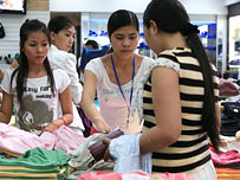
Vietnamese apparel businesses should focus more on their home market since exports, now their staple, may shrink because of the global crisis, experts have said.
Speaking at a conference in Ho Chi Minh City Thursday they warned, however, that even the home market could be challenging since imported clothes have captured a certain share of it, especially the high-end segment.
Vietnam is now the world’s ninth largest exporter of textiles. Shipments have grossed more than US$7.6 billion this year, a 20 percent year-on-year rise, according to official estimates.
But the experts said demand is set to fall in major markets like the US and EU because the credit crunch would hit importers hard.
The home market has its attractions, they pointed out as Le Quoc An, chairman of Vietnam Textile and Apparel Association (VITAS), said the country has a population of 86 million people, many of them young.
Apparels accounted for 5 percent of the country’s $45-billion retail market last year, An said. He expects the market to grow to $6 billion by 2010.
“Selling a shirt for VND150,000 ($9), producers can earn a profit of VND30,000. In case of export, they can make only about $1.”
A survey done last month by the think tank Business Studies and Assistance Center (BSAC) – one of the conference organizers – found that consumers in the 20 to 45 age group in Ho Chi Minh City spend 18.5 percent of their income on clothes, compared with 11 percent last year.
More than a third of the people surveyed said they shop for clothes at least once in three months.
An said apparel producers should therefore pay more attention to local consumers.
Upmarket
Experts at the conference urged garment makers to strengthen their brands, especially in the upmarket segment.
Sai Gon Giai Phong newspaper quoted Tran Anh Tuan, managing partner of Pathfinder Business Consulting, as saying the Vietnamese apparel industry has until now been able to compete only in the “low-cost, general, and conventional” clothing segments.
Some local companies like TCM, Tay Do, Legamex, F-House, An Phuoc, Viettien, Foci, and Ninomaxx are popular among consumers since they focus on casualwear.
But only a few of their brands have secured a strong base, leaving plenty of room for international brands and their knock-offs.
“They have missed a large piece of the market which has been targeted by Gucci, Armani, D&G, and Versace,” Tuan said.
“The international brands have invaded the high-end segment thanks to the weak competition from local designers.”
He said some collections by top designers like Sy Hoang or Vo Viet Chung may compete with famous international brands, but they have not commercialized their brands or retailed their products.
According to the BSAC, two-thirds of consumers surveyed said their choice is influenced by clothes worn by South Korean soap opera stars.
Experts told the conference that the lack of professional services offered by local retailers and distributors is also a factor keeping away consumers.
Speaking at a conference in Ho Chi Minh City Thursday they warned, however, that even the home market could be challenging since imported clothes have captured a certain share of it, especially the high-end segment.
Vietnam is now the world’s ninth largest exporter of textiles. Shipments have grossed more than US$7.6 billion this year, a 20 percent year-on-year rise, according to official estimates.
But the experts said demand is set to fall in major markets like the US and EU because the credit crunch would hit importers hard.
The home market has its attractions, they pointed out as Le Quoc An, chairman of Vietnam Textile and Apparel Association (VITAS), said the country has a population of 86 million people, many of them young.
Apparels accounted for 5 percent of the country’s $45-billion retail market last year, An said. He expects the market to grow to $6 billion by 2010.
“Selling a shirt for VND150,000 ($9), producers can earn a profit of VND30,000. In case of export, they can make only about $1.”
A survey done last month by the think tank Business Studies and Assistance Center (BSAC) – one of the conference organizers – found that consumers in the 20 to 45 age group in Ho Chi Minh City spend 18.5 percent of their income on clothes, compared with 11 percent last year.
More than a third of the people surveyed said they shop for clothes at least once in three months.
An said apparel producers should therefore pay more attention to local consumers.
Upmarket
Experts at the conference urged garment makers to strengthen their brands, especially in the upmarket segment.
Sai Gon Giai Phong newspaper quoted Tran Anh Tuan, managing partner of Pathfinder Business Consulting, as saying the Vietnamese apparel industry has until now been able to compete only in the “low-cost, general, and conventional” clothing segments.
Some local companies like TCM, Tay Do, Legamex, F-House, An Phuoc, Viettien, Foci, and Ninomaxx are popular among consumers since they focus on casualwear.
But only a few of their brands have secured a strong base, leaving plenty of room for international brands and their knock-offs.
“They have missed a large piece of the market which has been targeted by Gucci, Armani, D&G, and Versace,” Tuan said.
“The international brands have invaded the high-end segment thanks to the weak competition from local designers.”
He said some collections by top designers like Sy Hoang or Vo Viet Chung may compete with famous international brands, but they have not commercialized their brands or retailed their products.
According to the BSAC, two-thirds of consumers surveyed said their choice is influenced by clothes worn by South Korean soap opera stars.
Experts told the conference that the lack of professional services offered by local retailers and distributors is also a factor keeping away consumers.
Source: economictimes.indiatimes.com
Các tin khác
- Rising global shipping costs put pressure on Viet Nam’s seafood exporters (22/06/2026)
- India likely to retain anti-dumping duties on Bangladeshi jute products (22/06/2026)
- Japan slaps anti-dumping duties on Chinese, Taiwanese steel (22/06/2026)
- India initiates anti-dumping probe against a Chinese, Japanese chemical used in tyre, rubber items (22/06/2026)
- Reasons why the US continues to suspend customs clearance for Vietnamese trailers (22/06/2026)