Home
Home
 About Us



US: Congress ends ethanol tax subsidy, tariff
26/12/2011 12:00
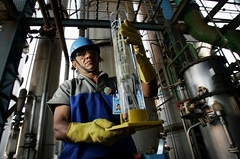
Washington —The United States has ended a 30-year tax subsidy for corn-based ethanol that cost taxpayers $6 billion annually, and ended a tariff on imported Brazilian ethanol.
Congress adjourned for the year on Friday, failing to extend the tax break that's drawn a wide variety of critics on Capitol Hill, including Sens. Tom Coburn, R-Okla., and Dianne Feinstein, D-Calif. Critics also have included environmentalists, frozen food producers, ranchers and others.
The policies have helped shift millions of tons of corn from feedlots, dinner tables and other products into gas tanks.
Environmental group Friends of the Earth praised the move.
"The end of this giant subsidy for dirty corn ethanol is a win for taxpayers, the environment and people struggling to put food on their tables," biofuels policy campaigner Michal Rosenoer said Friday. "Given corn ethanol's downsides, it's outrageous that taxpayers have been subsidizing the industry to the tune of $6 billion a year. The industry's inability to get this tax credit extended signals that it no longer has carte blanche in Washington: Corn ethanol is no longer a sacred cow."
The subsidy — the Volumetric Ethanol Excise Tax Credit — has provided the oil and agribusiness industries with 45 cents per gallon of ethanol blended into gasoline.
By some estimates, Congress has awarded $45 billion in subsidies to the ethanol industry since 1980.
Tom Buis, CEO of Growth Energy, an ethanol trade group, said earlier this month the industry would survive without the credit.
"The blenders' tax credit initially helped the ethanol industry develop. But today, we don't have a production problem, we have a market access problem," Buis said. "Without the tax credit, the ethanol industry will survive; it will continue to reduce our dependence on foreign oil, create jobs and strengthen our economy."
Congress also declined to extend the 54 cents per gallon tax on imported ethanol, which will expire Jan. 1, a move praised by the Brazilian Sugarcane Industry Association Leticia Phillips.
Ethanol supporters are worried Congress might roll back a 2007 mandate that dramatically boosts the use of ethanol annually through 2022. The mandate jumps from 15 billion gallons of renewable fuels — including cellulosic ethanol in 2015 — to 36 billion gallons by 2022.
The corn lobby has lost clout this year, losing votes in Congress.
The Senate voted 73-27 in June to end the ethanol tax subsidy and tariff.
But Michigan Democrats Carl Levin and Debbie Stabenow were among the 27 senators who voted against ending the ethanol subsidy.
Michigan is the nation's 11th-largest corn producer, harvesting 315 million bushels of corn in 2010. The state has more than 11,000 corn growers and they planted corn on 2.45 million acres last year, or about 4 percent of all land in the state.
Earlier in December, a bipartisan group of more than 70 House members urged a congressional block on higher levels of ethanol blended into gasoline.
Automakers and other engine makers have clashed with corn growers since 2010 over whether the United States should allow the use of a new blend of ethanol called E15 because it is 15 percent biofuel. The Environmental Protection Agency has approved the use in all vehicles from 2001 and newer.
In August, the EPA approved fuel labels designed to warn drivers of older vehicles not to use the fuel, but it still must be registered before the fuel can go on sale. In February, the House voted 285-136 to block the EPA from moving ahead with E15 regulations.
"E15 is not ready for prime time," said the letter signed by Reps. Gary Peters, D-Bloomfield Township; Mike Rogers, R-Brighton; John Conyers, D-Detroit; Tim Walberg, R-Tipton; Bill Huizenga, R-Zeeland; Darrell Issa, R-Calif.; and Loretta Sanchez, D-Calif., among others.
But Congress declined to add the provision.
Automakers and other groups have opposed approval of E15, warning it could damage engines in some models. Automakers "unanimously expressed concerns that E15 is likely to harm engines, void warranties and reduce fuel efficiency," said the congressional letter.
Automakers have twice filed suit challenging approval of use for the fuel.
Growth Energy said previously it expected E15 to be at pumps by the end of 2011. That seems unlikely now.
The group says it is essential to move to the higher blend in order to use the higher amounts of ethanol required by Congress under a 2007 energy act.
It says more than 136,000 new green-collar jobs will be created nationwide by moving to E15.
Opponents of ethanol argue that the use of more than 40 percent nation's corn has boosted food prices for consumers and feed costs for farmers. For the first time this year, more corn was used to produce ethanol than to feed animals in the United States.
Opponents of ethanol have cited a GAO study that suggested ethanol has boosted some food prices by 20 percent. Cellulosic ethanol has also suffered setbacks.
In June, the Environmental Protection Agency sharply reducing the amount of advanced ethanol it will require for use next year. Under a 2007 energy law, the United States was supposed to use 500 million gallons of cellulosic ethanol in gas tanks in 2012. This ethanol comes from renewable sources such as switchgrass, waste products and woody pulp, but it hasn't been made in any significant quantities. The EPA proposed requiring no more than 12.9 million gallons next year.
This is the third consecutive year the EPA slashed the cellulosic ethanol requirement. The targets set by Congress were 100 million gallons for 2010 and 250 million for 2011; EPA reduced them to 6.5 million gallons each year. In 2013, America is supposed to use 1 billion gallons of cellulosic ethanol and by 2022, the United States is supposed to be using 16 billion gallons annually.
Source: Detroit News
Các tin khác
- Following the imposition of the highest tariff of 37.13%, the Ministry of Industry and Trade is reviewing galvanized steel from China (19/06/2026)
- Official tariffs have been imposed on colorless float glass imported from Indonesia and Malaysia (19/06/2026)
- India seeks to continue anti-dumping duties on Bangladesh’s jute products (19/06/2026)
- Turkey Initiates Anti-Dumping Investigation into Polyester Cord Fabric from Viet Nam (19/06/2026)
- Chinese dumping in Brazil affected the entire garlic supply chain (19/06/2026)