Home
Home
 About Us



Trade wall goes up to stop Chinese invasion
10/05/2009 12:00
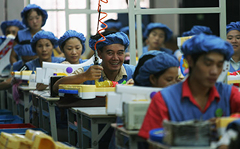
IN A tough stand against cheap imports from China, India has decided to employ every internationally sanctioned weapon in the trade armoury to shut out goods from the dragon land that hurt Indian companies in these hard times.
This follows India’s heightened economic threat perceptions about its northern neighbour. The government has gone on high alert to guard its home turf from being used as a dumping ground.
“China’s export markets in the US and the EU have shrunk but their production is already done. Thus, they are diverting their products to India and Africa. Hence, we have no option but to be active against China,” a senior commerce ministry official said, requesting anonymity.
In the past one year, imports from China into India have increased by almost 20 per cent. Between April and December 2007, imports from China were valued at $19.8 billion, which rose to $24.2 billion in the same period in 2008.
“Industry is concerned. In this time of global recession, dumping can become a serious issue. No other country poses threat to India as much as China does at this juncture,” a Ficci official who looks after World Trade Organisation (WTO) affairs in the apex chamber said.
Iron and steel imports, on face of it, hardly show any increase. They have risen to $1.7 billion from $1.6 billion. But a deeper look reveals that the Chinese have been dumping steel into India. During April-December 2008, steel prices crashed 40 per cent globally. The total value of imports shows that China dumped large quantities in the Indian market at cheap prices.
Imports of electronic goods rose to $6.6 billion from last year’s $ 5.9 billion. Korean companies get their goods made in China and import them to India to take the cost advantage.
China is a soft target for trade action. It is a late entrant to WTO, in 2000, and is yet to get universal recognition as a “free market economy” from membership of the global trade watchdog. New Delhi is, however, taking care that all its trade actions against China are well within the WTO framework.
“Whatever we are doing is WTO-compliant. We are being open about it. We are not resorting to such trade restricting measures at least through hidden stimulus packages as the US and the EU are doing,” the ministry official said.
Since October 2008, India has initiated as many as 17 anti-dumping cases against China on a host of commodities. The list includes: stainless steel, yarn and fabrics and aluminium products.
Typically, Chinese goods are 35 to 40 per cent cheaper than similar Indian products. Explains the Ficci official: “Unlike other countries, China’s pricing structure is not transparent. They have a massive production capacity of plastics and chemicals, which are artificially made cheaper because of non-transparent pricing structures.”
Besides anti-dumping action, India is keeping its powder dry for a quick strike against Chinese products through the imposition of safeguard duties.
Under the WTO rules, a safeguard duty can be imposed as an immediate measure to stop any sudden surge in imports. Unlike anti-dumping action, imposition of safeguard duty does not require an elaborate and quasi-judicial process of investigation and giving an opportunity to the foreign suppliers to be heard.
“In a safeguard duty, India will have to prove that compared to historical average in a given period of time there has been a surge in imports from China,” the Ficci official said.
For imposing a safeguard duty, only the imported commodity and its area of origin needs to be specified. On the other hand, an anti-dumping duty can be imposed only when the exporting country is selling the same commodity at a cheaper price abroad than in its own country. On an average a safeguard duty can be imposed within 21 days but in case of anti-dumping the procedure could take as long as 15 months.
India would be looking closely at records in the customs department and other independent sources including data compiled by Indian companies. The problems, however, are myriad. “Substantiating an anti-dumping case is a problem because so far there is no available data to suggest by how much imports have increased in the last few months. The latest available figures are only up to December 2008,” the Ficci official added.
The manner in which Chinese suppliers operate in foreign markets also poses a problem in making an anti-dumping or safeguard duty immediately effective. “Chinese exporters invariably ship products in their container-loads to foreign markets for stock and sale by their agents. The pricing is non-transparent and is always open to being beaten down to its lowest”, said Ficci secretary general Amit Mitra.
In the past eight years, trade between India and China has increased ten-fold. In 2000-01, trade between the two countries was valued at $ 5 billion, it shot up to $ 50 billion in 2008-09.
This follows India’s heightened economic threat perceptions about its northern neighbour. The government has gone on high alert to guard its home turf from being used as a dumping ground.
“China’s export markets in the US and the EU have shrunk but their production is already done. Thus, they are diverting their products to India and Africa. Hence, we have no option but to be active against China,” a senior commerce ministry official said, requesting anonymity.
In the past one year, imports from China into India have increased by almost 20 per cent. Between April and December 2007, imports from China were valued at $19.8 billion, which rose to $24.2 billion in the same period in 2008.
“Industry is concerned. In this time of global recession, dumping can become a serious issue. No other country poses threat to India as much as China does at this juncture,” a Ficci official who looks after World Trade Organisation (WTO) affairs in the apex chamber said.
Iron and steel imports, on face of it, hardly show any increase. They have risen to $1.7 billion from $1.6 billion. But a deeper look reveals that the Chinese have been dumping steel into India. During April-December 2008, steel prices crashed 40 per cent globally. The total value of imports shows that China dumped large quantities in the Indian market at cheap prices.
Imports of electronic goods rose to $6.6 billion from last year’s $ 5.9 billion. Korean companies get their goods made in China and import them to India to take the cost advantage.
China is a soft target for trade action. It is a late entrant to WTO, in 2000, and is yet to get universal recognition as a “free market economy” from membership of the global trade watchdog. New Delhi is, however, taking care that all its trade actions against China are well within the WTO framework.
“Whatever we are doing is WTO-compliant. We are being open about it. We are not resorting to such trade restricting measures at least through hidden stimulus packages as the US and the EU are doing,” the ministry official said.
Since October 2008, India has initiated as many as 17 anti-dumping cases against China on a host of commodities. The list includes: stainless steel, yarn and fabrics and aluminium products.
Typically, Chinese goods are 35 to 40 per cent cheaper than similar Indian products. Explains the Ficci official: “Unlike other countries, China’s pricing structure is not transparent. They have a massive production capacity of plastics and chemicals, which are artificially made cheaper because of non-transparent pricing structures.”
Besides anti-dumping action, India is keeping its powder dry for a quick strike against Chinese products through the imposition of safeguard duties.
Under the WTO rules, a safeguard duty can be imposed as an immediate measure to stop any sudden surge in imports. Unlike anti-dumping action, imposition of safeguard duty does not require an elaborate and quasi-judicial process of investigation and giving an opportunity to the foreign suppliers to be heard.
“In a safeguard duty, India will have to prove that compared to historical average in a given period of time there has been a surge in imports from China,” the Ficci official said.
For imposing a safeguard duty, only the imported commodity and its area of origin needs to be specified. On the other hand, an anti-dumping duty can be imposed only when the exporting country is selling the same commodity at a cheaper price abroad than in its own country. On an average a safeguard duty can be imposed within 21 days but in case of anti-dumping the procedure could take as long as 15 months.
India would be looking closely at records in the customs department and other independent sources including data compiled by Indian companies. The problems, however, are myriad. “Substantiating an anti-dumping case is a problem because so far there is no available data to suggest by how much imports have increased in the last few months. The latest available figures are only up to December 2008,” the Ficci official added.
The manner in which Chinese suppliers operate in foreign markets also poses a problem in making an anti-dumping or safeguard duty immediately effective. “Chinese exporters invariably ship products in their container-loads to foreign markets for stock and sale by their agents. The pricing is non-transparent and is always open to being beaten down to its lowest”, said Ficci secretary general Amit Mitra.
In the past eight years, trade between India and China has increased ten-fold. In 2000-01, trade between the two countries was valued at $ 5 billion, it shot up to $ 50 billion in 2008-09.
By Ronojoy Banerjee
New Delhi
Source: www.straitstimes.com
New Delhi
Source: www.straitstimes.com
Các tin khác
- Rising global shipping costs put pressure on Viet Nam’s seafood exporters (22/06/2026)
- India likely to retain anti-dumping duties on Bangladeshi jute products (22/06/2026)
- Japan slaps anti-dumping duties on Chinese, Taiwanese steel (22/06/2026)
- India initiates anti-dumping probe against a Chinese, Japanese chemical used in tyre, rubber items (22/06/2026)
- Reasons why the US continues to suspend customs clearance for Vietnamese trailers (22/06/2026)