Home
Home
 About Us



Shipments to South America, Africa and Asia buoy the line despite roadblocks
14/07/2010 12:00
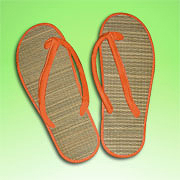
China’s slippers and flip-flops industry continues to experience growth despite the past year’s challenges.
Custom statistics show that 2009 exports of footwear with plastic uppers rose 4 percent YoY to $11.4 billion.
Those that have mostly textile components generated overseas sales of $4.6 billion, also 4 percent higher than the previous corresponding period. The featured line accounts for about 20 percent of shipments.
The upswing is still apparent in the first two months of 2010. In that span, the country sent abroad $5.31 billion worth of shoes, boots, sandals and slippers, denoting a YoY increase of 24 percent.
Emerging economies contribute significantly to growth, as many companies decided to focus on such nations at the time the US and Europe curbed spending. They continue to absorb a considerable share of exports, even though traditional markets are gradually recovering from the downturn.
In the first two months of 2010, Guangdong province, China’s largest footwear hub, acquired revenue of $57.2 million and $110 million from shipments to Africa and South America. The figures are 25 and 62 percent higher than those from one year ago.
Additionally, the China-ASEAN Free Trade Area agreement effective Jan. 1, 2010, is spurring makers to send more products to Brunei, Indonesia, Malaysia, Thailand, Singapore and the Philippines. Besides enjoying zero tariff, there is a high probability that transactions there may be settled in yuan.
Nevertheless, suppliers are aware that protective measures are likely to be enforced if domestic manufacturing in the destinations is affected by the surge in imports. To avoid this, many are shipping their releases to various locations instead of concentrating on just one area.
With the CAFTA in place, several businesses are also exploring the idea of setting up factories in ASEAN countries, where labor is less expensive and raw materials are abundant. Further, exporting from plants outside China will enable makers to circumvent the anti-dumping duties imposed against them.
Custom statistics show that 2009 exports of footwear with plastic uppers rose 4 percent YoY to $11.4 billion.
Those that have mostly textile components generated overseas sales of $4.6 billion, also 4 percent higher than the previous corresponding period. The featured line accounts for about 20 percent of shipments.
The upswing is still apparent in the first two months of 2010. In that span, the country sent abroad $5.31 billion worth of shoes, boots, sandals and slippers, denoting a YoY increase of 24 percent.
Emerging economies contribute significantly to growth, as many companies decided to focus on such nations at the time the US and Europe curbed spending. They continue to absorb a considerable share of exports, even though traditional markets are gradually recovering from the downturn.
In the first two months of 2010, Guangdong province, China’s largest footwear hub, acquired revenue of $57.2 million and $110 million from shipments to Africa and South America. The figures are 25 and 62 percent higher than those from one year ago.
Additionally, the China-ASEAN Free Trade Area agreement effective Jan. 1, 2010, is spurring makers to send more products to Brunei, Indonesia, Malaysia, Thailand, Singapore and the Philippines. Besides enjoying zero tariff, there is a high probability that transactions there may be settled in yuan.
Nevertheless, suppliers are aware that protective measures are likely to be enforced if domestic manufacturing in the destinations is affected by the surge in imports. To avoid this, many are shipping their releases to various locations instead of concentrating on just one area.
With the CAFTA in place, several businesses are also exploring the idea of setting up factories in ASEAN countries, where labor is less expensive and raw materials are abundant. Further, exporting from plants outside China will enable makers to circumvent the anti-dumping duties imposed against them.
July 12, 2010
Source: www.fashion.globalsources.com
Source: www.fashion.globalsources.com
Các tin khác
- Following the imposition of the highest tariff of 37.13%, the Ministry of Industry and Trade is reviewing galvanized steel from China (19/06/2026)
- Official tariffs have been imposed on colorless float glass imported from Indonesia and Malaysia (19/06/2026)
- India seeks to continue anti-dumping duties on Bangladesh’s jute products (19/06/2026)
- Turkey Initiates Anti-Dumping Investigation into Polyester Cord Fabric from Viet Nam (19/06/2026)
- Chinese dumping in Brazil affected the entire garlic supply chain (19/06/2026)