Home
Home
 About Us



Refusal to diversify may cost shrimp farmers dear
10/06/2010 12:00
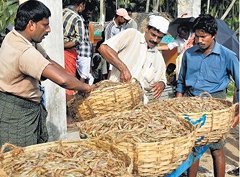
Indian shrimp specialities are costly, sea-based or aqua-cultured varieties such as the Black Tiger. This is about 60 per cent costlier to produce than the Vannamie variety being increasingly supplied by Taiwan, Vietnam and China, which supply the same markets in the US and Europe.
Vannamie is entirely produced through aqua-culture; it retails for about half the price in the West as our costlier species. In the US, about 70 per cent of the market has been taken by the Vannamie over the past decade, from almost scratch; the figure is comparable in Europe. The East Asians have been cultivating Vannamie in a big way for several years.
By contrast, it was only in May last year that the Indian government finally gave permission for importing the seed to begin cultivation of Vannamie. Barely 1,170 hectares are being presently used for this.
Meanwhile, we are being displaced from the Western market. The rise in shrimp exports has been less than five per cent annually by value in the past five years to the US; in 2009-10, it rose by just three per cent. By volume, it dropped by nearly 10 per cent. To Japan, it rose by barely 0,7 per cent.
Some quarters in the Marine Products Export Development Agency say the problem is high anti-dumping duty in markets like the US. However, other shrimp exporters seem to perform very well there, despite similar duties. They switched, clearly, in time to Vannamie.
Vannamie is entirely produced through aqua-culture; it retails for about half the price in the West as our costlier species. In the US, about 70 per cent of the market has been taken by the Vannamie over the past decade, from almost scratch; the figure is comparable in Europe. The East Asians have been cultivating Vannamie in a big way for several years.
By contrast, it was only in May last year that the Indian government finally gave permission for importing the seed to begin cultivation of Vannamie. Barely 1,170 hectares are being presently used for this.
Meanwhile, we are being displaced from the Western market. The rise in shrimp exports has been less than five per cent annually by value in the past five years to the US; in 2009-10, it rose by just three per cent. By volume, it dropped by nearly 10 per cent. To Japan, it rose by barely 0,7 per cent.
Some quarters in the Marine Products Export Development Agency say the problem is high anti-dumping duty in markets like the US. However, other shrimp exporters seem to perform very well there, despite similar duties. They switched, clearly, in time to Vannamie.
George Joseph / Kochi Jun 08, 2010, 00:31
Source: www.business-standard.com
Source: www.business-standard.com
Các tin khác
- Following the imposition of the highest tariff of 37.13%, the Ministry of Industry and Trade is reviewing galvanized steel from China (19/06/2026)
- Official tariffs have been imposed on colorless float glass imported from Indonesia and Malaysia (19/06/2026)
- India seeks to continue anti-dumping duties on Bangladesh’s jute products (19/06/2026)
- Turkey Initiates Anti-Dumping Investigation into Polyester Cord Fabric from Viet Nam (19/06/2026)
- Chinese dumping in Brazil affected the entire garlic supply chain (19/06/2026)