Home
Home
 About Us



PM must decide whether he is for or against free trade
04/03/2009 12:00
'THE Australian Government's position has never changed. It is a position informed by history and the appalling history of the Smoot-Hawley tariffs of the 1930s": Kevin Rudd, January 31, 2009.
That was the Prime Minister back when he believed in at least some of the market aspects of neo-liberalism, in particular the benefits of free and open trade. Well, not that far back.
It was shortly after the Christmas break, during the summer months at Kirribilli House, in between the cricket, that Rudd decided to give re-regulation and market intervention a good name via his now notable essay in The Monthly magazine.
In fact the press conference referred to above was held just the day before The Monthly hit the news stands. Segmenting his mind, the Prime Minister departed from his impending witch hunt against free markets. He was responding to questions about Barack Obama including some protectionist elements in his then proposed stimulus package, notably the requirement for US steel to be used in domestic infrastructure projects funded by the Government.
Which just goes to show you can apparently pick and choose the elements of neo-liberal market philosophy when it suits you, that is, when you're Prime Minister of a middle-sized export-dependent economy.
Rudd was right to do so. The fact he reached back through the ages to Hoot-Smawley to make the point shows not only that Prime Minister acknowledges some economic benefits flowing from the free market but that he understands the lessons of history as well.
The Smoot-Hawley Tariff Act of June 17, 1930, was brought to the US Congress in response to the onset of the Great Depression. It raised the tariffs on 20,000 US imports to record levels.
Fully 1028 US economists signed a petition against it. Of course, other countries duly retaliated and US imports and exports plunged by more than half. The Depression rolled on with increased force, sweeping all before it. That's what happens when a witch hunt against decent economic orthodoxy, led by opinion makers such as legislators, gets up a good head of steam.
We're nowhere near that in Australia at the moment of course, Monthly magazine or no Monthly magazine.
Domestic political positioning aside, Rudd knows the fundamentals. Confronted by the easy target of Malcolm Turnbull, a former merchant banker, he just can't help himself.
The demise of Pacific Brands, however, demonstrates that dormant anti-free trade and pro-protectionist forces are stirring once again. These forces, of course, have been blunted by the bounty of a protracted period of prosperity. But once again, we are upon cyclical hard times. And it is these times that suit such forces, always in search of evidence of a systemic failure in capitalism.
In this environment, vigilance is everything. John Denton, the chairman of the Business Council of Australia Task Force on Global Engagement, puts it well. "Australians have benefited substantially from freer trade and investment policies," he says. "We have built valuable export markets throughout the world, and especially in Asia where China, Japan and South Korea are all among our top five trading partners.
"Added to these, India has become one of our fastest growing export markets. At the same time, Australian industry has drawn on global investment to drive development, growth and international sales. Access to foreign investment has underpinned greater levels of employment and a higher standard of living than would otherwise have been possible."
The director general of the World Trade Organisation, Pascal Lamy, is visiting Australia this week and will sound the same alarm. Lamy was in Seoul last week, a market that has ballooned for Australia under the aegis of free trade. There, he warned the "temptation" to raise trade barriers had "many faces". He nominated non-tariff barriers, anti-dumping measures and subsidies by another name such as "buy local".
I would nominate another manifestation: nationalism.
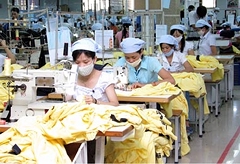
The case of Pacific Brands has made this phenomenon extant, not least because its move offshore means the end of the local manufacture of signature Australian brands such as Chesty Bonds. The decision by management to move offshore - an inevitability largely unrelated to the global financial meltdown - provoked headlines such as "Chesty Bond Blockade", a reference to transport unions attempting to stop the movement of Pacific Brands machinery to new factories in China.
The justification: taxpayers have subsidised the re-tooling of Pacific Brands by about $100 million during the past decade.
The blockade has superficial appeal. But not when you consider the logical end of the transport blockade: more failed protection funded by the Australian taxpayer. The human cost of any factory closure is immense. But in the end it cannot justify throwing good public money after bad. Ultimately such policies are only a temporary protection for jobs.
And isn't it an act of betrayal to encourage poor non-English-speaking migrants into dead-end work? That makes headlines such as "Fighting for Aussie jobs" a long-term non-sequitur.
But perhaps, just perhaps, the readers of newspapers pushing such campaigns have been educated about the benefits of globalisation just as much as policy makers on a good day, in the case of Kevin Rudd.
There's a demonstration of this in the present debate over Chinalco's attempts to buy into Rio Tinto.
This is a multi-faceted debate, of course, which must include the potential market distorting effects of a state-sponsored entity deliberately buying our resources at below their real value.
But insofar as economic nationalism is protectionism in another guise, whose near neighbour is xenophobia, there's new evidence that Australians are now much more worldly than at the time of the last recession in 1990-92.
A survey by UMR Research, demonstrates this, but you should know that UMR Research works with Hawker Britton, which advises both the ALP and Chinalco.
Based on a 1000-person survey, UMR found that the Beijing Olympics had contributed to a significant opinion shift in attitudes to China. Australians are now more positive towards China than people in the US or Russia.
Attitudes to foreign investment remain positive and stable, says UMR, and opposition to Chinese investment has dropped significantly compared with a similar survey in April 2008.
Which means that maybe Australians are past the point where they really care whether their singlets carry the tag Chesty Bonds. For all our sakes - including, ultimately, the workers at Pacific Brands - let's hope so.
That was the Prime Minister back when he believed in at least some of the market aspects of neo-liberalism, in particular the benefits of free and open trade. Well, not that far back.
It was shortly after the Christmas break, during the summer months at Kirribilli House, in between the cricket, that Rudd decided to give re-regulation and market intervention a good name via his now notable essay in The Monthly magazine.
In fact the press conference referred to above was held just the day before The Monthly hit the news stands. Segmenting his mind, the Prime Minister departed from his impending witch hunt against free markets. He was responding to questions about Barack Obama including some protectionist elements in his then proposed stimulus package, notably the requirement for US steel to be used in domestic infrastructure projects funded by the Government.
Which just goes to show you can apparently pick and choose the elements of neo-liberal market philosophy when it suits you, that is, when you're Prime Minister of a middle-sized export-dependent economy.
Rudd was right to do so. The fact he reached back through the ages to Hoot-Smawley to make the point shows not only that Prime Minister acknowledges some economic benefits flowing from the free market but that he understands the lessons of history as well.
The Smoot-Hawley Tariff Act of June 17, 1930, was brought to the US Congress in response to the onset of the Great Depression. It raised the tariffs on 20,000 US imports to record levels.
Fully 1028 US economists signed a petition against it. Of course, other countries duly retaliated and US imports and exports plunged by more than half. The Depression rolled on with increased force, sweeping all before it. That's what happens when a witch hunt against decent economic orthodoxy, led by opinion makers such as legislators, gets up a good head of steam.
We're nowhere near that in Australia at the moment of course, Monthly magazine or no Monthly magazine.
Domestic political positioning aside, Rudd knows the fundamentals. Confronted by the easy target of Malcolm Turnbull, a former merchant banker, he just can't help himself.
The demise of Pacific Brands, however, demonstrates that dormant anti-free trade and pro-protectionist forces are stirring once again. These forces, of course, have been blunted by the bounty of a protracted period of prosperity. But once again, we are upon cyclical hard times. And it is these times that suit such forces, always in search of evidence of a systemic failure in capitalism.
In this environment, vigilance is everything. John Denton, the chairman of the Business Council of Australia Task Force on Global Engagement, puts it well. "Australians have benefited substantially from freer trade and investment policies," he says. "We have built valuable export markets throughout the world, and especially in Asia where China, Japan and South Korea are all among our top five trading partners.
"Added to these, India has become one of our fastest growing export markets. At the same time, Australian industry has drawn on global investment to drive development, growth and international sales. Access to foreign investment has underpinned greater levels of employment and a higher standard of living than would otherwise have been possible."
The director general of the World Trade Organisation, Pascal Lamy, is visiting Australia this week and will sound the same alarm. Lamy was in Seoul last week, a market that has ballooned for Australia under the aegis of free trade. There, he warned the "temptation" to raise trade barriers had "many faces". He nominated non-tariff barriers, anti-dumping measures and subsidies by another name such as "buy local".
I would nominate another manifestation: nationalism.
The case of Pacific Brands has made this phenomenon extant, not least because its move offshore means the end of the local manufacture of signature Australian brands such as Chesty Bonds. The decision by management to move offshore - an inevitability largely unrelated to the global financial meltdown - provoked headlines such as "Chesty Bond Blockade", a reference to transport unions attempting to stop the movement of Pacific Brands machinery to new factories in China.
The justification: taxpayers have subsidised the re-tooling of Pacific Brands by about $100 million during the past decade.
The blockade has superficial appeal. But not when you consider the logical end of the transport blockade: more failed protection funded by the Australian taxpayer. The human cost of any factory closure is immense. But in the end it cannot justify throwing good public money after bad. Ultimately such policies are only a temporary protection for jobs.
And isn't it an act of betrayal to encourage poor non-English-speaking migrants into dead-end work? That makes headlines such as "Fighting for Aussie jobs" a long-term non-sequitur.
But perhaps, just perhaps, the readers of newspapers pushing such campaigns have been educated about the benefits of globalisation just as much as policy makers on a good day, in the case of Kevin Rudd.
There's a demonstration of this in the present debate over Chinalco's attempts to buy into Rio Tinto.
This is a multi-faceted debate, of course, which must include the potential market distorting effects of a state-sponsored entity deliberately buying our resources at below their real value.
But insofar as economic nationalism is protectionism in another guise, whose near neighbour is xenophobia, there's new evidence that Australians are now much more worldly than at the time of the last recession in 1990-92.
A survey by UMR Research, demonstrates this, but you should know that UMR Research works with Hawker Britton, which advises both the ALP and Chinalco.
Based on a 1000-person survey, UMR found that the Beijing Olympics had contributed to a significant opinion shift in attitudes to China. Australians are now more positive towards China than people in the US or Russia.
Attitudes to foreign investment remain positive and stable, says UMR, and opposition to Chinese investment has dropped significantly compared with a similar survey in April 2008.
Which means that maybe Australians are past the point where they really care whether their singlets carry the tag Chesty Bonds. For all our sakes - including, ultimately, the workers at Pacific Brands - let's hope so.
Glenn Milne | March 02, 2009
Article from: The Australian
Source: www.theaustralian.news.com.au
Article from: The Australian
Source: www.theaustralian.news.com.au
Các tin khác
- Rising global shipping costs put pressure on Viet Nam’s seafood exporters (22/06/2026)
- India likely to retain anti-dumping duties on Bangladeshi jute products (22/06/2026)
- Japan slaps anti-dumping duties on Chinese, Taiwanese steel (22/06/2026)
- India initiates anti-dumping probe against a Chinese, Japanese chemical used in tyre, rubber items (22/06/2026)
- Reasons why the US continues to suspend customs clearance for Vietnamese trailers (22/06/2026)