Home
Home
 About Us



Pakisan: ‘Local industry deprived of liberalised trade benefits’
09/08/2012 12:00
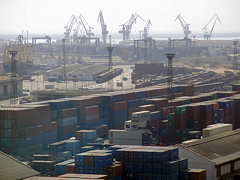
LAHORE: The local industry has been deprived of the benefits of liberalised trade under the World Trade Organization (WTO) regime due to clearance of numerous under-invoiced products that has exposed the administrative flaws and institutional weaknesses of regulators, experts said on Tuesday.
“Opening of economy has forced the local industries to match global efficiencies,” said Mian Anjum Nisar, a leading producer of artificial leather in the country.
The manufacturers, he said, have failed to take full advantage of higher efficiencies they achieved at high cost as industries are under severe threat from under-invoiced imports and smuggling.
Officially, the local industries are protected by 10-15 percent tariff from similar imported products, he said, and deplored that the imported goods are cleared at low rates that not only nullify the duty protection advantage but the local producers end up paying higher government levies than imported goods.
A misconception has been propagated by vested interests that the Customs officials under the WTO rules do not have the authority to question the declared value of finished imported goods unless a complaint is launched for each specific case or if anti-dumping duty is imposed on the complaint of the local manufacturers, said Nisar.
In reality the Customs officials under the WTO are authorised to assess the actual value of the imported goods. According to the WTO rules, “The decision on Customs valuation would give the Customs administration the right to request further information of importers where they have reason to doubt the accuracy of the declared value of imported goods. If the administration maintains a reasonable doubt, despite any additional information, it may be deemed that the Customs value of the imported goods cannot be determined on the basis of the declared value, and the Customs would need to establish the value taking into account the provisions of the agreement.”
Saad Mukhtar, a Customs clearing agent, said that the clearance of finished goods below the rates of the basic raw material from which they are produced shows that either the Customs officials are incompetent or they condone this act for other motives.
There is discrepancy in evaluation of price of raw material and finished products, he said “The Customs officials are extremely rigid in evaluating the price of raw materials imported by the local industry,” he said, adding that in the case of import of products produced from these raw materials they tend to ignore lower rates.
He said they are authorised under the WTO rules to challenge a seemingly low rate, as normally they do not take any action unless someone lodges written complaint against under-invoicing.
Farooq Iftikhar, former senior vice president of the Lahore Chamber of Commerce and Industry (LCCI), said another issue that is hurting the local industry is the unawareness of the manufacturers about the exact procedure for lodging anti-dumping complaints against cheap imports.
The anti-dumping law provides protection to the local industry against imports that are less than the cost of the same local product, he said, adding that a few manufacturers are aware of the fact that the complaint under the WTO rules could only be entertained if at least 20 percent of the local manufacturers claim that they were being hurt by cheap imports.
Pakistan’s shoe industry has been ruined by cheap imports dumped from several Far Eastern countries, he said, adding that the anti-dumping complaint lodged by two main local shoe manufacturers was not entertained, as their combined shoes production was less than 20 percent of the total production in the country.
The regulators must ensure that all manufacturing associations recognised by them have at least combined manufacturing capacity of 51 percent so that in the case of dumping of goods by foreign countries they are able to file anti-dumping complaint, he said.
“Domestic manufacturers in Pakistan would continue to suffer if the regulatory trade bodies failed to reform under the WTO rules,” he added.
“Opening of economy has forced the local industries to match global efficiencies,” said Mian Anjum Nisar, a leading producer of artificial leather in the country.
The manufacturers, he said, have failed to take full advantage of higher efficiencies they achieved at high cost as industries are under severe threat from under-invoiced imports and smuggling.
Officially, the local industries are protected by 10-15 percent tariff from similar imported products, he said, and deplored that the imported goods are cleared at low rates that not only nullify the duty protection advantage but the local producers end up paying higher government levies than imported goods.
A misconception has been propagated by vested interests that the Customs officials under the WTO rules do not have the authority to question the declared value of finished imported goods unless a complaint is launched for each specific case or if anti-dumping duty is imposed on the complaint of the local manufacturers, said Nisar.
In reality the Customs officials under the WTO are authorised to assess the actual value of the imported goods. According to the WTO rules, “The decision on Customs valuation would give the Customs administration the right to request further information of importers where they have reason to doubt the accuracy of the declared value of imported goods. If the administration maintains a reasonable doubt, despite any additional information, it may be deemed that the Customs value of the imported goods cannot be determined on the basis of the declared value, and the Customs would need to establish the value taking into account the provisions of the agreement.”
Saad Mukhtar, a Customs clearing agent, said that the clearance of finished goods below the rates of the basic raw material from which they are produced shows that either the Customs officials are incompetent or they condone this act for other motives.
There is discrepancy in evaluation of price of raw material and finished products, he said “The Customs officials are extremely rigid in evaluating the price of raw materials imported by the local industry,” he said, adding that in the case of import of products produced from these raw materials they tend to ignore lower rates.
He said they are authorised under the WTO rules to challenge a seemingly low rate, as normally they do not take any action unless someone lodges written complaint against under-invoicing.
Farooq Iftikhar, former senior vice president of the Lahore Chamber of Commerce and Industry (LCCI), said another issue that is hurting the local industry is the unawareness of the manufacturers about the exact procedure for lodging anti-dumping complaints against cheap imports.
The anti-dumping law provides protection to the local industry against imports that are less than the cost of the same local product, he said, adding that a few manufacturers are aware of the fact that the complaint under the WTO rules could only be entertained if at least 20 percent of the local manufacturers claim that they were being hurt by cheap imports.
Pakistan’s shoe industry has been ruined by cheap imports dumped from several Far Eastern countries, he said, adding that the anti-dumping complaint lodged by two main local shoe manufacturers was not entertained, as their combined shoes production was less than 20 percent of the total production in the country.
The regulators must ensure that all manufacturing associations recognised by them have at least combined manufacturing capacity of 51 percent so that in the case of dumping of goods by foreign countries they are able to file anti-dumping complaint, he said.
“Domestic manufacturers in Pakistan would continue to suffer if the regulatory trade bodies failed to reform under the WTO rules,” he added.
Wednesday, August 08, 2012
By Mansoor Ahmad
Source: thenews.com.pk
By Mansoor Ahmad
Source: thenews.com.pk
Các tin khác
- Following the imposition of the highest tariff of 37.13%, the Ministry of Industry and Trade is reviewing galvanized steel from China (19/06/2026)
- Official tariffs have been imposed on colorless float glass imported from Indonesia and Malaysia (19/06/2026)
- India seeks to continue anti-dumping duties on Bangladesh’s jute products (19/06/2026)
- Turkey Initiates Anti-Dumping Investigation into Polyester Cord Fabric from Viet Nam (19/06/2026)
- Chinese dumping in Brazil affected the entire garlic supply chain (19/06/2026)