Home
Home
 About Us



Obama to ease fears over protectionism
20/02/2009 12:00
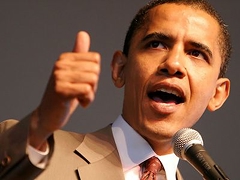
Obama to ease fears over protectionism: aide 18 February 2009 AFP--US President Barack Obama will try to ease concerns over US protectionism when he visits Canada later this week, a senior White House official said Tuesday. Speaking two days before Obama embarks on his first overseas trip since taking office last month, Denis McDonough, a senior foreign policy advisor, said the visit will focus on economics and would underline the need to avoid protectionist measures. "One of the lessons from history is to avoid any signals that suggest that anybody is engaging in practices that may result in further decline of international trade," McDonough said. Oabama has drawn fire from some quarters over a campaign promise to renegotiate the North America Free Trade Agreement (NAFTA) between the US, Canada and Mexico. "In terms of what the president has to offer on trade, I think he wants to underscore the importance of what is already a very robust trade relationship," McDonough said. Concerns have also been raised about a "Buy American" provision in the 787-million-dollar stimulus package Obama signed Tuesday that trade partners believe could hit their firms. "The president has been very clear on the record ... that the provision is obviously going to be implemented consistent with our international trade obligations, with our WTO obligations and our NAFTA obligations," McDonough said. However, the advisor hinted that Obama may want to reexamine labor and environmental standards which McDonough described as "side agreements in the NAFTA agreement and many other agreements." "I think (Obama's) view has been that he would like to work with our Canadian and Mexican friends to help them understand 'why this position makes good sense.'" During a meeting with Canadian Prime Minister Stephen Harper the two men are expected to explore what "synergies" exist between stimulus packages recently proposed in both countries.
Obama signs huge stimulus, readies foreclosure aid By LIZ SIDOTI and TOM RAUM DENVER (AP) — Racing to reverse the country's economic spiral, President Barack Obama signed the mammoth stimulus package into law Tuesday and readied a new $50 billion foreclosure rescue for legions of Americans who are in danger of losing their homes. There was no recovery yet for beleaguered automakers, who were back in Washington for more bailout billions. General Motors Corp. said it was closing plants, Chrysler LLC said it was cutting vehicle models and both said they were getting rid of thousands more jobs as they made their restructuring cases for $5 billion more for Chrysler and as much as $16.6 billion more for GM. The United Auto Workers union said it had agreed to tentative concessions that could help Detroit's struggling Big Three. Anything but reassured, Wall Street dove ever lower. The Dow Jones industrials fell 297.81 points, closing less than a point above their lowest level in five and a half years. Obama focused on the $787 billion stimulus plan, an ambitious package of federal spending and tax cuts designed to revive the economy and save millions of jobs. Most wage-earners will soon see the first paycheck evidence of tax breaks that will total $400 for individuals and $800 for couples. The stimulus package was a huge victory for Obama less than one month into his presidency. But he struck a sober tone and lowered expectations for an immediate turnaround in the severe recession that is well into its second year.
Former Bush aide: 'Buy American' hurts growth 17 February 2009 AFP--A "Buy American" clause in a giant US stimulus package risks undermining efforts to revive the ailing global economy, George W. Bush's top White House adviser on trade issues warned Tuesday. "We can't get the global economy back on a path to growth if each country pursues its domestic recovery in a manner that disadvantages others or seeks to disrupt global supply chains," Dan Price told AFP by telephone from Brussels. US lawmakers last week approved a plan to pump 787 billion dollars into the economy, including a provision saying projects must use only US-made iron and steel and manufactured goods, albeit in a manner consistent with Washington's international treaty obligations. "The issue is not whether a measure is consistent with WTO obligations, but rather whether it constrains global trade," said Price, now senior partner for global issues at the powerful Sidley Austin law firm in Washington.
US trade bulldogs' aide in line for key USTR post By Doug Palmer WASHINGTON, Feb 17 (Reuters) - A top aide to Democratic lawmakers who have long called for tougher enforcement of U.S. trade agreements is expected to join President Barack Obama's trade office as the chief enforcement attorney, a congressional aide said on Tuesday. Tim Reif's last day as trade staff director on the House of Representatives Ways and Means Committee was on Friday, the aide said, speaking on condition he not be identified. Reif left to join USTR shortly as general counsel, the congressional aide said. An assistant in USTR's press office said she could not confirm that Reif had been tapped to become USTR general counsel, a job that does not require Senate confirmation. USTR still does not have an official spokesperson one month after Obama took office and the White House press office did not immediately return a call asking for comment. Obama's choice for U.S. Trade Representative, former Dallas Mayor Ron Kirk, is still waiting to be confirmed by the Senate. There is still no date for a hearing on his nomination. Reif is closely associated with two lawmakers -- House Ways and Means Committee Chairman Charles Rangel, a New York Democrat, and House Trade Subcommittee Chairman Sander Levin, a Michigan Democrat -- who regularly criticized former President George W. Bush's administration for not filing more trade cases against China and other U.S. trading partners.
Brazil Trade Min: Ready For WTO Protectionism Fight If Needed BRASILIA (Dow Jones)--Brazil's government is prepared to take a fight against trade partners' protectionist measures to the WTO if necessary, Brazilian Trade Minister Miguel Jorge said Tuesday. "We are ready to complain at the WTO - I think that all countries that defend free trade should be prepared to complain," Jorge said. Jorge said that so far the government didn't see a need to register a formal complaint against any trade partners, but was monitoring the environment closely. "For the moment, there haven't been many protectionist measures implemented, but a lot of intentions of protectionism have been raised," he said. Jorge's comments came after Brazilian President Luiz Inacio Lula da Silva earlier in the day complained of the threat of protectionist measures by developed countries. "We need to fight protectionist practices in developed countries," Lula said. "Protectionism only deepens the economic crisis." Jorge made the remarks as he and his colleagues in the Brazilian government prepared to meet with Argentine Foreign Minister Jorge Taiana and Argentine Finance Minister Carlos Fernandez to discuss recent Argentine measures to delay import licensing for Brazilian products by up to 60 days. Jorge, however, noted that the licensing period was within WTO rules and expressed optimism that differences with Argentina could easily be resolved.
INTERVIEW-Sweden laments France's protectionist "virus" By Francois Murphy PARIS, Feb 17 (Reuters) - France has contracted a dangerous protectionist "virus" that risks infecting other parts of the European Union, Swedish Trade Minister Ewa Bjorling said in an interview on Tuesday. French President Nicolas Sarkozy angered some EU partners this month by promising 6 billion euros ($7.6 billion) in loans to carmakers Renault and Peugeot PSA Citroen in exchange for a pledge not to close sites in France. On a visit to France, Bjorling, whose country is home to carmakers Volvo, owned by Ford, and Saab, which is part of General Motors, said the move was hazardous. "It seems that the protectionist virus has spread over the sea to France," Bjorling said, after laying out her concerns about stimulus measures in the United States. "This is for the automotive industry. Who's next knocking on the door?" she said, adding: "It's a risky business when we are competing with each other... one package will lead to another." France had also failed to consult properly with the European Commission, which polices the bloc's competition and state aid rules, before announcing its plan, she said.
Canada May Resume WTO Complaint Over U.S. Label Rules By Alexandre Deslongchamps Feb. 17 (Bloomberg) -- Canada would resume its WTO complaint against U.S. labeling rules for meat and fresh produce if U.S. President Barack Obama decides to change them, Canadian Agriculture Minister Gerry Ritz said today. The country-of-origin labeling law went into effect on an interim basis on Sept. 30. It requires food sold in the U.S. to carry markers showing where it was produced. Obama has ordered a review of the rules before they become permanent, which had been scheduled for mid-March. “Should the Obama administration continue on with protectionism, we will then re-ignite our WTO challenge,” Ritz said from Amman, Jordan in a telephone call with reporters. The U.S. imposed its first country-of-origin labeling rules amid public concern about unsafe imports. Canada launched its original complaint when the rules where announced, but put it on hold after they were changed to Canada’s satisfaction. Statistics Canada said today the U.S. labeling rules generated uncertainty about demand for Canadian meat that contributed to reducing the country’s cattle herd last year. The cattle and calf herd shrank 5.1 percent to 13.2 million head from 13.9 million, according to the agency. Canada is the largest foreign supplier of pork and beef to the U.S., government data show.
RI may slap anti-dumping duties on Thai-made plastics Mustaqim Adamrah 18 February 2009 The Jakarta Post The Indonesian Anti-Dumping Committee (KADI) plans to impose temporary anti-dumping measures on bi-axially oriented polypropylene film (BOPP film) imported from Thailand, waiting only for the Finance Ministry's approval. "After an investigation, Thai companies are proven to have dumped (their products)," KADI secretary Penta Riris Nasution told reporters on Tuesday. "We have submitted a letter to the Finance Ministry and are still awaiting for its approval for (imposition of) temporary anti-dumping import duties," she said. She said KADI had gone through all the required preparatory procedures since May 9 last year. She also said temporary additional import duties would be effective for four months once they were applied, but refused to disclose the percentage of additional import duties that KADI had proposed.
Textile Restructure A Must To Stave Off Crisis By Qin Xiaoying 18 February 2009 China Daily The State Council, China's Cabinet, passed in principle a program to rejuvenate the country's textile and machinery manufacturing industries after reviewing it at a meeting chaired by Premier Wen Jiabao early this month. It came less than a month after the central government launched an enormous stimulus package aimed at reviving the slackened auto and steel sectors. The latest move, according to economists, will help the suffering textile and machinery industries survive the prolonged economic winter through a long-expected industrial upgrade. As the oldest labor-intensive industry that closely relates to ordinary people's livelihoods, the textile sector has long served as a traditional pillar of the national economy. It has played a crucial role in national economic development in recent decades. In particular, since its accession to the WTO, China has been the largest textile manufacturer and exporter in the world and enjoyed an overwhelming advantage over other countries amid fierce international competition.
Europe Posts Biggest Trade Gap in Euro’s History By Jurjen van de Pol Feb. 17 (Bloomberg) -- Europe recorded the biggest trade deficit in 2008 since the euro’s introduction 10 years ago as higher oil prices boosted energy costs and the global financial crisis curtailed exports. The region’s trade deficit of 32.1 billion euros ($40.5 billion) compared with a surplus of 15.8 billion euros in 2007, the European Union’s statistics office in Luxembourg said today. The spreading of the global recession is curbing demand for European products, adding to pressure on the economy, which shrank the most in 15 years in the fourth quarter. Volkswagen AG, Europe’s largest carmaker, said deliveries fell about 20 percent last month and that sales in the export markets of Brazil, Russia, India and China have been “particularly hit” by the credit freeze. “Extremely weak global economic activity seems certain to hit euro zone exporters hard,” said Howard Archer, chief European economist at IHS Global Insight in London. “Sharply contracting domestic demand in the U.K. and the U.S., as well as substantially slowing activity in emerging Europe, is particularly bad news.” In December, exports fell a seasonally adjusted 0.9 percent from November, the report showed. Imports declined 3.9 percent from the previous month. The deficit narrowed to 300 million euros in December from 4 billion euros in November.
India changes raw sugar import rules, may fuel prices By Mayank Bhardwaj NEW DELHI, Feb 17 (Reuters) - India formally allowed duty-free imports of raw sugar for domestic sale on Tuesday, a move traders say will increase purchases by coastal units but total imports may be lower than previously estimated. Trade Minister Kamal Nath said on Feb. 3 raw import norms would be eased but the two-week delay would limit imports as most mills will stop crushing next month, trade officials say.
SC asks customs dept not to initiate action against ITC New Delhi, Feb 17 (PTI) -- The Supreme Court has restrained the customs department from taking any action against ITC Ltd, which has been held responsible for importing around 1,000 tonnes of "hazardous municipal waste". Holding ITC responsible for dumping the waste, the Madras High Court had asked the company to send the material back to the US, the country of origin.
Overfishing threatens shrimp industry: FAO 17 February 2009 AFP--Shrimp, an important source of income for developing countries, is increasingly threatened by overfishing, the Food and Agriculture Organisation (FAO) warned Tuesday. Overfishing of shrimp in turn degrades ecologically important seagrass beds and coastal habitats, the Rome-based UN agency said in a report titled "The Global Study of Shrimp Fisheries."
Obama signs huge stimulus, readies foreclosure aid By LIZ SIDOTI and TOM RAUM DENVER (AP) — Racing to reverse the country's economic spiral, President Barack Obama signed the mammoth stimulus package into law Tuesday and readied a new $50 billion foreclosure rescue for legions of Americans who are in danger of losing their homes. There was no recovery yet for beleaguered automakers, who were back in Washington for more bailout billions. General Motors Corp. said it was closing plants, Chrysler LLC said it was cutting vehicle models and both said they were getting rid of thousands more jobs as they made their restructuring cases for $5 billion more for Chrysler and as much as $16.6 billion more for GM. The United Auto Workers union said it had agreed to tentative concessions that could help Detroit's struggling Big Three. Anything but reassured, Wall Street dove ever lower. The Dow Jones industrials fell 297.81 points, closing less than a point above their lowest level in five and a half years. Obama focused on the $787 billion stimulus plan, an ambitious package of federal spending and tax cuts designed to revive the economy and save millions of jobs. Most wage-earners will soon see the first paycheck evidence of tax breaks that will total $400 for individuals and $800 for couples. The stimulus package was a huge victory for Obama less than one month into his presidency. But he struck a sober tone and lowered expectations for an immediate turnaround in the severe recession that is well into its second year.
Former Bush aide: 'Buy American' hurts growth 17 February 2009 AFP--A "Buy American" clause in a giant US stimulus package risks undermining efforts to revive the ailing global economy, George W. Bush's top White House adviser on trade issues warned Tuesday. "We can't get the global economy back on a path to growth if each country pursues its domestic recovery in a manner that disadvantages others or seeks to disrupt global supply chains," Dan Price told AFP by telephone from Brussels. US lawmakers last week approved a plan to pump 787 billion dollars into the economy, including a provision saying projects must use only US-made iron and steel and manufactured goods, albeit in a manner consistent with Washington's international treaty obligations. "The issue is not whether a measure is consistent with WTO obligations, but rather whether it constrains global trade," said Price, now senior partner for global issues at the powerful Sidley Austin law firm in Washington.
US trade bulldogs' aide in line for key USTR post By Doug Palmer WASHINGTON, Feb 17 (Reuters) - A top aide to Democratic lawmakers who have long called for tougher enforcement of U.S. trade agreements is expected to join President Barack Obama's trade office as the chief enforcement attorney, a congressional aide said on Tuesday. Tim Reif's last day as trade staff director on the House of Representatives Ways and Means Committee was on Friday, the aide said, speaking on condition he not be identified. Reif left to join USTR shortly as general counsel, the congressional aide said. An assistant in USTR's press office said she could not confirm that Reif had been tapped to become USTR general counsel, a job that does not require Senate confirmation. USTR still does not have an official spokesperson one month after Obama took office and the White House press office did not immediately return a call asking for comment. Obama's choice for U.S. Trade Representative, former Dallas Mayor Ron Kirk, is still waiting to be confirmed by the Senate. There is still no date for a hearing on his nomination. Reif is closely associated with two lawmakers -- House Ways and Means Committee Chairman Charles Rangel, a New York Democrat, and House Trade Subcommittee Chairman Sander Levin, a Michigan Democrat -- who regularly criticized former President George W. Bush's administration for not filing more trade cases against China and other U.S. trading partners.
Brazil Trade Min: Ready For WTO Protectionism Fight If Needed BRASILIA (Dow Jones)--Brazil's government is prepared to take a fight against trade partners' protectionist measures to the WTO if necessary, Brazilian Trade Minister Miguel Jorge said Tuesday. "We are ready to complain at the WTO - I think that all countries that defend free trade should be prepared to complain," Jorge said. Jorge said that so far the government didn't see a need to register a formal complaint against any trade partners, but was monitoring the environment closely. "For the moment, there haven't been many protectionist measures implemented, but a lot of intentions of protectionism have been raised," he said. Jorge's comments came after Brazilian President Luiz Inacio Lula da Silva earlier in the day complained of the threat of protectionist measures by developed countries. "We need to fight protectionist practices in developed countries," Lula said. "Protectionism only deepens the economic crisis." Jorge made the remarks as he and his colleagues in the Brazilian government prepared to meet with Argentine Foreign Minister Jorge Taiana and Argentine Finance Minister Carlos Fernandez to discuss recent Argentine measures to delay import licensing for Brazilian products by up to 60 days. Jorge, however, noted that the licensing period was within WTO rules and expressed optimism that differences with Argentina could easily be resolved.
INTERVIEW-Sweden laments France's protectionist "virus" By Francois Murphy PARIS, Feb 17 (Reuters) - France has contracted a dangerous protectionist "virus" that risks infecting other parts of the European Union, Swedish Trade Minister Ewa Bjorling said in an interview on Tuesday. French President Nicolas Sarkozy angered some EU partners this month by promising 6 billion euros ($7.6 billion) in loans to carmakers Renault and Peugeot PSA Citroen in exchange for a pledge not to close sites in France. On a visit to France, Bjorling, whose country is home to carmakers Volvo, owned by Ford, and Saab, which is part of General Motors, said the move was hazardous. "It seems that the protectionist virus has spread over the sea to France," Bjorling said, after laying out her concerns about stimulus measures in the United States. "This is for the automotive industry. Who's next knocking on the door?" she said, adding: "It's a risky business when we are competing with each other... one package will lead to another." France had also failed to consult properly with the European Commission, which polices the bloc's competition and state aid rules, before announcing its plan, she said.
Canada May Resume WTO Complaint Over U.S. Label Rules By Alexandre Deslongchamps Feb. 17 (Bloomberg) -- Canada would resume its WTO complaint against U.S. labeling rules for meat and fresh produce if U.S. President Barack Obama decides to change them, Canadian Agriculture Minister Gerry Ritz said today. The country-of-origin labeling law went into effect on an interim basis on Sept. 30. It requires food sold in the U.S. to carry markers showing where it was produced. Obama has ordered a review of the rules before they become permanent, which had been scheduled for mid-March. “Should the Obama administration continue on with protectionism, we will then re-ignite our WTO challenge,” Ritz said from Amman, Jordan in a telephone call with reporters. The U.S. imposed its first country-of-origin labeling rules amid public concern about unsafe imports. Canada launched its original complaint when the rules where announced, but put it on hold after they were changed to Canada’s satisfaction. Statistics Canada said today the U.S. labeling rules generated uncertainty about demand for Canadian meat that contributed to reducing the country’s cattle herd last year. The cattle and calf herd shrank 5.1 percent to 13.2 million head from 13.9 million, according to the agency. Canada is the largest foreign supplier of pork and beef to the U.S., government data show.
RI may slap anti-dumping duties on Thai-made plastics Mustaqim Adamrah 18 February 2009 The Jakarta Post The Indonesian Anti-Dumping Committee (KADI) plans to impose temporary anti-dumping measures on bi-axially oriented polypropylene film (BOPP film) imported from Thailand, waiting only for the Finance Ministry's approval. "After an investigation, Thai companies are proven to have dumped (their products)," KADI secretary Penta Riris Nasution told reporters on Tuesday. "We have submitted a letter to the Finance Ministry and are still awaiting for its approval for (imposition of) temporary anti-dumping import duties," she said. She said KADI had gone through all the required preparatory procedures since May 9 last year. She also said temporary additional import duties would be effective for four months once they were applied, but refused to disclose the percentage of additional import duties that KADI had proposed.
Textile Restructure A Must To Stave Off Crisis By Qin Xiaoying 18 February 2009 China Daily The State Council, China's Cabinet, passed in principle a program to rejuvenate the country's textile and machinery manufacturing industries after reviewing it at a meeting chaired by Premier Wen Jiabao early this month. It came less than a month after the central government launched an enormous stimulus package aimed at reviving the slackened auto and steel sectors. The latest move, according to economists, will help the suffering textile and machinery industries survive the prolonged economic winter through a long-expected industrial upgrade. As the oldest labor-intensive industry that closely relates to ordinary people's livelihoods, the textile sector has long served as a traditional pillar of the national economy. It has played a crucial role in national economic development in recent decades. In particular, since its accession to the WTO, China has been the largest textile manufacturer and exporter in the world and enjoyed an overwhelming advantage over other countries amid fierce international competition.
Europe Posts Biggest Trade Gap in Euro’s History By Jurjen van de Pol Feb. 17 (Bloomberg) -- Europe recorded the biggest trade deficit in 2008 since the euro’s introduction 10 years ago as higher oil prices boosted energy costs and the global financial crisis curtailed exports. The region’s trade deficit of 32.1 billion euros ($40.5 billion) compared with a surplus of 15.8 billion euros in 2007, the European Union’s statistics office in Luxembourg said today. The spreading of the global recession is curbing demand for European products, adding to pressure on the economy, which shrank the most in 15 years in the fourth quarter. Volkswagen AG, Europe’s largest carmaker, said deliveries fell about 20 percent last month and that sales in the export markets of Brazil, Russia, India and China have been “particularly hit” by the credit freeze. “Extremely weak global economic activity seems certain to hit euro zone exporters hard,” said Howard Archer, chief European economist at IHS Global Insight in London. “Sharply contracting domestic demand in the U.K. and the U.S., as well as substantially slowing activity in emerging Europe, is particularly bad news.” In December, exports fell a seasonally adjusted 0.9 percent from November, the report showed. Imports declined 3.9 percent from the previous month. The deficit narrowed to 300 million euros in December from 4 billion euros in November.
India changes raw sugar import rules, may fuel prices By Mayank Bhardwaj NEW DELHI, Feb 17 (Reuters) - India formally allowed duty-free imports of raw sugar for domestic sale on Tuesday, a move traders say will increase purchases by coastal units but total imports may be lower than previously estimated. Trade Minister Kamal Nath said on Feb. 3 raw import norms would be eased but the two-week delay would limit imports as most mills will stop crushing next month, trade officials say.
SC asks customs dept not to initiate action against ITC New Delhi, Feb 17 (PTI) -- The Supreme Court has restrained the customs department from taking any action against ITC Ltd, which has been held responsible for importing around 1,000 tonnes of "hazardous municipal waste". Holding ITC responsible for dumping the waste, the Madras High Court had asked the company to send the material back to the US, the country of origin.
Overfishing threatens shrimp industry: FAO 17 February 2009 AFP--Shrimp, an important source of income for developing countries, is increasingly threatened by overfishing, the Food and Agriculture Organisation (FAO) warned Tuesday. Overfishing of shrimp in turn degrades ecologically important seagrass beds and coastal habitats, the Rome-based UN agency said in a report titled "The Global Study of Shrimp Fisheries."
(END)
WORLD TRADE NEWS
NEWS SUMMARY FOR WTO REFERENCE CENTRES AND NON-RESIDENT MISSIONS
18 February 2009
No. 1889
Source: www.wtocenter.org.tw
WORLD TRADE NEWS
NEWS SUMMARY FOR WTO REFERENCE CENTRES AND NON-RESIDENT MISSIONS
18 February 2009
No. 1889
Source: www.wtocenter.org.tw
Các tin khác
- Rising global shipping costs put pressure on Viet Nam’s seafood exporters (22/06/2026)
- India likely to retain anti-dumping duties on Bangladeshi jute products (22/06/2026)
- Japan slaps anti-dumping duties on Chinese, Taiwanese steel (22/06/2026)
- India initiates anti-dumping probe against a Chinese, Japanese chemical used in tyre, rubber items (22/06/2026)
- Reasons why the US continues to suspend customs clearance for Vietnamese trailers (22/06/2026)