Home
Home
 About Us



Iran's carpet industry floored by U.S. sanctions
22/10/2010 12:00
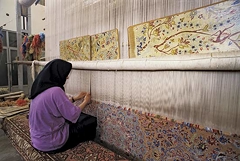
TEHRAN, Oct 21, 2010 -- Iran's famed rug industry faces a serious threat from the latest sanctions imposed by the United States, the biggest market for Persian carpets.
The U.S.-imposed ban on importing Iran-made rugs came into effect just as a weeklong international carpet exhibition was concluding in Tehran. Government officials painted a glowing picture of the carpet industry, estimating that rug exports could reach $500 million a year. They noted that sales for the first five months of the year stood at $207 million, nearly a 50 percent increase compared with the like period last year.
But with the ban now in effect, and the United States accounting for about 20 percent of Persian carpet exports, overall sales for the remainder of the year are expected to plummet.
Around 2 million jobs in Iran are connected to the production and trading of handmade rugs. That means that roughly 10 percent of Iran's population relies on rug making.
It is still too early to estimate what impact the loss of the U.S. market will have on overall sales, but many Iranians are already complaining that they're being punished for the actions of their government.
"We're wondering why the American government would do this," said Mohammad Mehdizadeh, who comes from the renowned carpet-weaving city of Kerman and was exhibiting his wares at the international fair in Tehran. "These sanctions will only affect people in the trade. What connection does the rug business have with politics?"
It's not the first time that Iranian carpet-weavers have been cut off from their primary market. The United States banned Persian carpets for most of the 1980s and all of the 1990s _ with limited success.
"The last U.S. embargo spawned a great frenzy of attempting to circumvent the blockade, by exporting rugs to the U.S. via Canada," said one dealer who asked not to be named because he had engaged in illegal carpet sales. "Some dealers were successful and made money; others were apprehended, arrested, tried and served prison time." When the Clinton administration lifted the ban in the late 1990s, it resulted in a flood of Persian rugs being exported to the United States.
But as the West has grown increasingly frustrated with Iran's government in general and its uranium enrichment program in particular, Washington has reacted by imposing increasingly stiff economic sanctions on Iran, including the ban on carpet imports.
Some, however, may actually profit from the embargo."This time dealers were aware (the sanctions) this action was coming," said one American importer who was in Tehran for the exhibition and asked that his name not be used. "Many had been expecting it for years. Some of them had been attempting to bring Persian rugs into the country legally before the embargo went into effect."
Now, they're hoping that the import ban and resulting scarcity will boost the price of the Persian carpets they already have on hand.
By Jason Rezaian
Source: iwpr.net
Các tin khác
- Following the imposition of the highest tariff of 37.13%, the Ministry of Industry and Trade is reviewing galvanized steel from China (19/06/2026)
- Official tariffs have been imposed on colorless float glass imported from Indonesia and Malaysia (19/06/2026)
- India seeks to continue anti-dumping duties on Bangladesh’s jute products (19/06/2026)
- Turkey Initiates Anti-Dumping Investigation into Polyester Cord Fabric from Viet Nam (19/06/2026)
- Chinese dumping in Brazil affected the entire garlic supply chain (19/06/2026)