Home
Home
 About Us



Imports for investment and production seen supporting long-term growth: NSO
19/06/2026 03:17
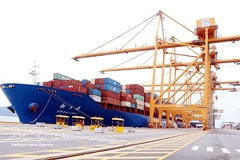
Viet Nam recorded trade deficits of 1.78 billion USD in January, 1.01 billion USD in February, 680 million USD in March, 3.99 billion USD in April and 5.21 billion USD in May, bringing the cumulative deficit in the first five months of 2026 to 13.8 billion USD.
Viet Nam’s shift from a long-standing trade surplus to a deficit reflects rising imports of fuel, machinery and production inputs linked to investment expansion and industrial growth, a trend that could strengthen the economy’s production capacity over the longer term, according to the National Statistics Office (NSO).
NSO Deputy Director Le Trung Hieu said Viet Nam recorded trade deficits of 1.78 billion USD in January, 1.01 billion USD in February, 680 million USD in March, 3.99 billion USD in April and 5.21 billion USD in May, bringing the cumulative deficit in the first five months of 2026 to 13.8 billion USD.
A key factor behind the widening deficit is the changing structure of crude oil trade. Viet Nam, once a crude oil exporter, now relies largely on imported crude to meet domestic refining and production demand, while exports of the commodity have declined.
Meanwhile, imports of electronic components, semiconductors and other high-tech materials have risen sharply as foreign-invested enterprises (FDI) expand manufacturing operations across the country.
Major investors are rolling out new electronics and semiconductor projects in localities such as Phu Tho and Thai Nguyen. Before production begins, businesses typically import significant volumes of machinery, equipment, components and raw materials to prepare factories for operation.
The NSO noted that imports are expected to continue increasing as Viet Nam accelerates investment in digital infrastructure, technology and large-scale development projects. However, such imports should be assessed in line with project implementation schedules.
The agency is working with ministries and sectors to analyse the import structure in greater detail, separating machinery and equipment, production materials and consumer goods to better evaluate their impact on economic growth.
According to the NSO, imports of machinery and equipment for production and long-term investment contribute to capital accumulation and enhance production capacity. Imported electronic components and semiconductors are also used in domestic manufacturing, creating products that may later be exported.
During the first five months of the year, the FDI sector accounted for around 80% of total exports, up from roughly 70-72% in previous years. The figure highlights the need for domestic enterprises to further improve competitiveness, particularly as borrowing costs and interest rates continue to put pressure on business activities.
The NSO also warned that rising energy imports could increase production costs and inflationary pressures, with higher fuel prices potentially affecting related products such as chemicals and fertilisers.
Official data show that Viet Nam posted a trade deficit of about 13.8 billion USD in the January-May period. The domestic sector recorded a deficit of 20.76 billion USD, while the foreign-invested sector generated a trade surplus of 6.96 billion USD. By comparison, the country recorded a trade surplus of approximately 5.1 billion USD in the same period last year.
Hieu said the current deficit should not be viewed as a negative signal if imports continue to be concentrated in production inputs and investment goods that expand the economy’s manufacturing capacity.
The office estimated that petroleum imports accounted for around 8 billion USD of the deficit in the first five months, largely due to higher crude oil prices and Viet Nam’s growing dependence on imported crude for domestic refineries.
Commenting on the impact of the deficit on growth, NSO Director General Nguyen Thi Huong said a trade deficit generally weighs on economic performance. She noted that imported inputs were previously used mainly for export-oriented manufacturing, such as Samsung’s imports of electronic components for products destined for overseas markets.
However, she said some imported components are now being used to assemble products, including electric vehicles, that are primarily sold domestically. As these imports are not offset by exports, they contribute to a wider trade deficit.
Regarding whether the current deficit is a cause for concern, Huong said a more comprehensive assessment would require detailed import-export data to determine whether capital flows are supporting investment and asset accumulation or are being directed towards consumption./.
Source: Vietnam+
Các tin khác
- Following the imposition of the highest tariff of 37.13%, the Ministry of Industry and Trade is reviewing galvanized steel from China (19/06/2026)
- Official tariffs have been imposed on colorless float glass imported from Indonesia and Malaysia (19/06/2026)
- India seeks to continue anti-dumping duties on Bangladesh’s jute products (19/06/2026)
- Turkey Initiates Anti-Dumping Investigation into Polyester Cord Fabric from Viet Nam (19/06/2026)
- Chinese dumping in Brazil affected the entire garlic supply chain (19/06/2026)