Home
Home
 About Us


European Union asks Argentina not to restrict imports
17/05/2010 12:00
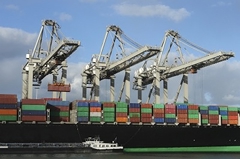
The European Union asked Argentina not to restrict food imports, which was reported by manufacturers and producers.
Manufacturing sources said that restrictions began being applied in the last few days on products that are also elaborated locally, in a non-written measure that primarily affects the EU and Brazil.
"Said restrictions, if carried out, would be incompatible with regulations of the World Trade Organization and with the commitment acquired by Argentina in the G-20 framework," said the local EU delegation in a communiqué.
"The European Union is therefore calling on Argentine authorities not to implement the announced measures," it added.
The Argentine food and beverage sectors export US$12 billion per year in processed products, and imports US$900 million, according to the coordinator of the food products industry.
"Everything the market demands in matters of imported foods will be available in supermarket aisles of our country," said the Argentine Industry and Tourism Minister, Débora Giorgi, in a rally which took place in Córdoba province.
"Argentina works under the norms of the World Trade Organization and we will continue to do so in this fashion, not only regarding the non-automatic licensing application, but also in relation to anti-dumping measures, and we will not allow disloyal competition linked to products to enter our country with social, financial, and/or environmental dumping," she affirmed.
A spokesman for the National Drugs, Foods, and Medical Technology Administration (ANMAT) said that the organism should daily remit a list of products that require authorization in order to be imported, and the Secretary of Commerce should approve them.
Manufacturing sources said that restrictions began being applied in the last few days on products that are also elaborated locally, in a non-written measure that primarily affects the EU and Brazil.
"Said restrictions, if carried out, would be incompatible with regulations of the World Trade Organization and with the commitment acquired by Argentina in the G-20 framework," said the local EU delegation in a communiqué.
"The European Union is therefore calling on Argentine authorities not to implement the announced measures," it added.
The Argentine food and beverage sectors export US$12 billion per year in processed products, and imports US$900 million, according to the coordinator of the food products industry.
"Everything the market demands in matters of imported foods will be available in supermarket aisles of our country," said the Argentine Industry and Tourism Minister, Débora Giorgi, in a rally which took place in Córdoba province.
"Argentina works under the norms of the World Trade Organization and we will continue to do so in this fashion, not only regarding the non-automatic licensing application, but also in relation to anti-dumping measures, and we will not allow disloyal competition linked to products to enter our country with social, financial, and/or environmental dumping," she affirmed.
A spokesman for the National Drugs, Foods, and Medical Technology Administration (ANMAT) said that the organism should daily remit a list of products that require authorization in order to be imported, and the Secretary of Commerce should approve them.
May 12, 2010
Source: www.buenosairesherald.com
Source: www.buenosairesherald.com
Các tin khác
- Following the imposition of the highest tariff of 37.13%, the Ministry of Industry and Trade is reviewing galvanized steel from China (19/06/2026)
- Official tariffs have been imposed on colorless float glass imported from Indonesia and Malaysia (19/06/2026)
- India seeks to continue anti-dumping duties on Bangladesh’s jute products (19/06/2026)
- Turkey Initiates Anti-Dumping Investigation into Polyester Cord Fabric from Viet Nam (19/06/2026)
- Chinese dumping in Brazil affected the entire garlic supply chain (19/06/2026)