Home
Home
 About Us



EU Urges China to Let Currency Appreciate
06/10/2010 12:00
BRUSSELS—European policy makers increased pressure on China to allow its currency to strengthen, claiming the yuan's weakness threatens Europe's economic recovery.
Their direct language followed their meeting with Chinese Prime Minister Wen Jiabao as part of the Asia-Europe summit in Brussels, and their comments marked growing support from Europe for U.S. efforts to offset China's export advantage from the weak yuan, also known as the renminbi.
Jean-Claude Trichet, president of the European Central Bank, departed from ECB practice of not singling out countries for criticism. "We noted that the evolution in terms of the effective exchange rate, also vis-a-vis the euro, was not exactly what we would have hoped ourselves," Mr. Trichet said Tuesday at a news conference. "This exchange-rate flexibility is very, very much in the interests of China."
Mr. Trichet said he thanked the premier for his announcement over the weekend that China would buy Greek government bonds when the country again attempts to obtain financing in commercial markets. At the same news conference, the European commissioner for economic affairs, Olli Rehn, kept up pressure for currency revaluation to be included among China's economic overhauls.
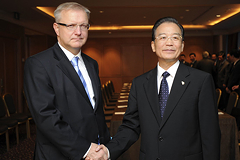
Chinese Premier Wen Jiabao, on the right, shakes hands with European Union Economic and Monetary Affairs Commissioner Olli Rehn in Brussels, Belgium.
"These reforms should be complemented by an increased flexibility and thus by a broad-based appreciation of the renminbi exchange rate in relation to its main trading partners, including the euro area," Mr. Rehn said. "If the euro continues to bear a disproportionate burden in the adjustment of global exchange rates, the recovery of the euro-area economy might be weakened."
Europe's rising criticism of China's currency stance means Beijing will face intense pressure to revalue the yuan at this weekend's meeting of the International Monetary Fund and at a November summit of Group of 20 leaders in South Korea.
In the U.S., Congressional leaders have stepped up criticism of China's currency policies ahead of next month's midterm elections, when the sluggish U.S. economy and weak job market are likely to spell trouble for incumbent politicians. The House of Representatives passed legislation targeting China and its currency policy on Wednesday. Treasury Secretary Timothy Geithner has warned that China's yuan advantage "is a serious issue for the American people."
The Asia-Europe meetings in Brussels also discussed U.S. proposals to overhaul the representation of the different governments on the IMF board, calling for a reduced European role and an increase for emerging economies such as China and India. European Union countries currently hold eight of the 24 seats. Italian Foreign Affairs Minister Franco Frattini said Monday that he doesn't see enough consensus at the coming G20 meeting to change IMF board representation.
EU finance ministers Friday discussed a proposal that would reduce the number of board seats held by European nations, excluding the U.K., to six from eight, as part of a broader reform package. The current IMF executive board representation and quota structure are a legacy of the period just after World War II. The board runs day-to-day operations, and the quota—based on economic weight and other factors—determines countries' financial contributions and voting power.
By Alessandro Torello And Matthew Dalton
Source: online.wsj.com
Các tin khác
- Following the imposition of the highest tariff of 37.13%, the Ministry of Industry and Trade is reviewing galvanized steel from China (19/06/2026)
- Official tariffs have been imposed on colorless float glass imported from Indonesia and Malaysia (19/06/2026)
- India seeks to continue anti-dumping duties on Bangladesh’s jute products (19/06/2026)
- Turkey Initiates Anti-Dumping Investigation into Polyester Cord Fabric from Viet Nam (19/06/2026)
- Chinese dumping in Brazil affected the entire garlic supply chain (19/06/2026)