Home
Home
 About Us



China seeks to calm anger over soy imports
16/12/2008 12:00
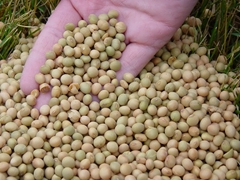
BEIJING, Dec 11 (Reuters) - China is facing calls to raise import tariffs on soybeans after a state buying plan backfired in its largest soy growing area, prompting officials from Beijing to rush to the countryside to try to calm tempers.
The dispute is pitting Chinese farmers and soy plants in the north against coastal rivals, including state-run agri-giant COFCO and foreign firms such as Wilmar International Ltd (WLIL.SI: Quote, Profile, Research, Stock Buzz), Bunge Ltd (BG.N: Quote, Profile, Research, Stock Buzz) and Cargill [CARG.UL], which supply the world's top soybean-importing country.
China's government is trying to help farmers by buying up soybeans and other crops, but the government's price is higher than the international market, encouraging imports in coastal areas and forcing soy crushers in inland provinces to stop work.
Major crushers in inland Heilongjiang province, the largest soy producing area, have called on the government to restrict imports by charging higher tariffs or an anti-dumping tax so they can compete with plants in coastal areas, which rely on cheap imports at this time of year, from the United States.
China's top planning body, the National Development and Reform Commission, called a meeting in Beijing earlier this week to consult major crushers, fearing a risk of rural unrest.
"The imported prices for soy are lower than production costs. Cheap imports are being dumped on domestic market," said Liu Denggao, vice-chairman of China's soybean association, who used the meeting to call for extra import taxes.
"It is in the interests of 40 million farmers. The government should not care only about the interests of (coastal) crushers."
Beijing initiated a state stockbuilding plan this autumn to buy 3 million tonnes of soy, or 18 percent of the harvest, directly from farmers, including many in Heilongjiang. The aim was to stop domestic prices falling below planting costs and leaving farmers unable to sell their harvest or to make money.
It set a higher-than market price for soy at 3,700 yuan ($539.8) per tonne, now nearly 1,000 yuan ($145.9) per tonne higher than U.S. soybeans for delivery in the next two months.
Crushers in Heilongjiang have stopped buying local beans, leaving Beijing's state warehouses as the major consumer. But the state's buying plan only covers one quarter of the local harvest, leaving most farmers unable to sell their crops.
"Farmers in the northeast cannot sell their harvest and have to pay back loans by year-end. Next month is the Chinese New Year, how can they have the New Year without money?" asked Lu Lin-gang, deputy secretary-general of the same association.
"Farmers could come to Beijing to petition."
Coastal crushers such as those run by Wilmar, Bunge and Cargill, which control more than 70 percent of China's capacity, use mainly imported soy to produce soymeal and soy oil for the Chinese market.
DOWN ON THE FARM
But Lu said import restrictions may not be the best solution.
"The anti-dumping procedure has to go to the Ministry of Commerce and takes long time," he said. "To subsidise local crushers is the only realistic and timely solution as these crushers could help buy local soybeans and process them into cooking oils, which we can put into storage."
An executive in the southern coastal province of Guangdong said any import restrictions would hurt the industry, which relies heavily on imports. China imports more than 30 million tonnes annually, nearly twice its own harvest.
"We are against the proposals. It is not good for the soy crushing industry," said the executive. "The government can susbidise farmers, so why should they subsidise crushers there?"
The policy-making NDRC has not made any decision about how to resolve the situation but farmers say they are the victims.
"We only managed to sell 14,000 tonnes out of 400,000 tonnes harvest to state reserves. Local crushers have closed because of thier losses and it's very difficult to sell our harvest," said Chen Yangui, a farmer in Heilongjiang province.
"But state warehouses are not buying from us either, they are buying from traders, which pay them for running quality checks." ($1=6.854 Yuan)
Các tin khác
- Rising global shipping costs put pressure on Viet Nam’s seafood exporters (22/06/2026)
- India likely to retain anti-dumping duties on Bangladeshi jute products (22/06/2026)
- Japan slaps anti-dumping duties on Chinese, Taiwanese steel (22/06/2026)
- India initiates anti-dumping probe against a Chinese, Japanese chemical used in tyre, rubber items (22/06/2026)
- Reasons why the US continues to suspend customs clearance for Vietnamese trailers (22/06/2026)