Home
Home
 About Us



China: Australia ‘negotiating’ wine tariffs that shouldn’t have been imposed
08/11/2023 04:38
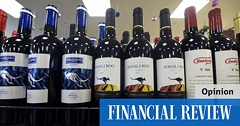
Anti-dumping tariffs should be scrapped. But they become cover for China’s political retaliation against Australian trade.
China’s offer to negotiate the removal of its “tariffs” on imports of Australian wine is seen by many as a generous act to facilitate the visit by Prime Minister Anthony Albanese.
There is little if any generosity involved.
Simon Birmingham, trade minister at the time of the imposition of the tariffs, recently restated his long-held view that: “the tariffs should never have been put in place in the first place. It was an attempt at economic coercion” and they “contravene the rules of both the World Trade Organisation [WTO] and Australia’s free trade agreement with China [CHAFTA].”
If indeed the tariffs should never have been put in place, why are we now obliged to “negotiate” their removal?
Australian wine producers have lost a market worth $1.2 billion a year and are apparently faced with the “equivalent of 859 Olympic-sized swimming pools of wine sloshing around Australia”.
Further, if coercion is the motive, why are tariffs on wine (or barley) the chosen instruments?
This requires an explanation.
As CHAFTA provides for tariff-free imports of Australian wine (and barley), increased tariffs violate this agreement. The chosen route for economic coercion has been the imposition of anti-dumping dutiesjustified by China as complying with WTO rules and procedures.
Increasingly, trade measures are no longer what they seem to be.
Dumping, or selling a product in a foreign market at less than domestic prices, is a normal commercial practice. It does not contravene trade rules. However, if it can be proved that the product, in this case Australian wine, has been dumped and causes serious injury to producers of comparable wine in China, anti-dumping duties may be legally imposed.
After a domestic inquiry in China, authorities claimed Australian wine was both dumped and caused serious injury to Chinese producers. China imposed anti-dumping duties equivalent to 116.2 per cent to 218.4 per cent of the import price to deal with the price advantage gained by Australian dumped wine.
Australia challenged these measures and in September 2021 requested the establishment of a WTO panel to rule on the legality of the duties.
Australia’s first written submission (394 pages) to the panel identified what it considered to be 47 inconsistencies in China’s anti-dumping duties under WTO rules or procedures.
The submission pulled no punches: “China’s decision to impose anti‐dumping duties … was an absurd decision reached based on findings that lacked any logical relationship to the facts on the record, following a deeply flawed investigation that did not comply with China’s obligations under WTO anti-dumping rules and procedures.”
COVID inquiry link
The WTO panel was created and has now completed its work. It made available its findings to Australia and China on August 24, 2023, but not to other WTO members or the public. The final panel report to all WTO members said simply that its “findings were confined to a brief description of the case informing [all WTO] members that a mutually agreed solution had been reached”.
Albanese announced that the two countries had agreed to suspend their WTO dispute while Beijing undertook an “expedited review” of duties over the next five months. If no mutual solution is found at the end of the review, Australia will resume the WTO dispute.
But what does it mean to “resume the dispute”?
There is little doubt in my mind that many, if not all, of the 47 inconsistencies identified by Australia breached WTO rules or procedures.
The negotiating coin held by China is that it could appeal any of the 47 inconsistencies thereby prolonging the duties and extending the pain of Australian wine producers.
So why the coercion?
The overwhelming sentiment (including in the reputable press of China) is that the duties are the result of the Australian government’s request for an inquiry into the origins of COVID-19. Anti-dumping measures provided a convenient, and in the view of China, “legitimate” tool to inflict high-profile pain on Australian wine producers.
There could be other considerations influencing the choice of the “coercive” measures. Perhaps there is an element of retaliation.Australia has applied anti-dumping duties on Chinese goods on 36 occasions since the inception of the WTO. It has also carried out investigations – almost as disruptive as duties themselves – on 64 occasions.
China has applied anti-dumping duties on Australian imports on two occasions.
A further consideration is that, of the 164 WTO members, Australia is the fourth-most frequent user of anti-dumping measures. In its recent Five-year Productivity Inquiry, the Productivity Commission proposed: “progressively removing Australia’s anti-dumping and countervailing measures and subjecting any new measures to an economy-wide cost-benefit test”.
While the eventual removal of the anti-dumping duties is to be lauded, paradoxically, the primary losers in this dispute remain the wine exporters even though the source of the “economic coercion” had nothing to do with wine.
An important lesson to be learned is that in this fractious and uncertain world, trading partners should avoid political considerations intruding into their trade policy decisions. Increasingly, trade measures are no longer what they seem to be.
Source: The Australian Financial Review
Các tin khác
- Following the imposition of the highest tariff of 37.13%, the Ministry of Industry and Trade is reviewing galvanized steel from China (19/06/2026)
- Official tariffs have been imposed on colorless float glass imported from Indonesia and Malaysia (19/06/2026)
- India seeks to continue anti-dumping duties on Bangladesh’s jute products (19/06/2026)
- Turkey Initiates Anti-Dumping Investigation into Polyester Cord Fabric from Viet Nam (19/06/2026)
- Chinese dumping in Brazil affected the entire garlic supply chain (19/06/2026)