Home
Home
 About Us



Cheaper Cement Imports Flood East Africa Market
01/07/2009 12:00
Nairobi — Cement makers in East Africa are threatened with closure following an upsurge in cheaper imports from Asia and the Middle East.
Producers say importers have taken advantage of the removal of the suspended duty to flood regional markets with cheaper products, leaving them with a shrinking market.
"The situation is particularly grim in Tanzania where imports have grown from two per cent to 20 per cent. In Tanzania, two of the three companies have suspended production and asked employees to go on leave. The situation expected to spread to other East African Community (EAC) countries unless suspended duties are restored," says the East Africa Cement Producers Association in a report presented to Kenya's Ministry of East African Community.
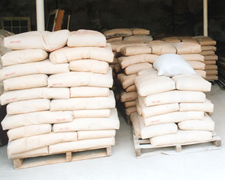
Bags of cement: There is an upsurge of cheaper imports of cement from Asia and the Middle East. NET PHOTO
Mbeya Cement Company, a member of Lafarge, the world's biggest cement maker has cut output in its plant in Tanzania following the flooding of that market with imported cement which has diluted demand from local producers.
Producers are feeling the pinch following a decision by EAC in 2008 to cut down the common external tariff (GET) from 40 to 25 per cent in 2008 to allow imports because of a growing demand. This was in contrast to a 2005 agreement for a gradual reduction of GET by five per cent every year.
The situation has resulted into excess cement in the East African market. The region has consumption of five million tonnes against a capacity of 5.8 million tonnes. EAC imported about 560,000 tonnes in 2007 and producers say import is growing steadily. They project a 9.3 million tonne consumption in 2015. The cement producers are calling on EAC governments to increase tax on cement imports to reflect the dif-ficult production environment in the region.
Producers say they have had to deal with high cost of electricity and reduced taxes for imported cement. The report says that with the current cost of energy and infrastructure, Tan-zanian cement cannot compete and that Egypt can target and take over Kenya market.
But Kenya's Assistant Minister for East Africa Community Mr Peter Munya says the cheaper imports are beneficial to consumers.
"There is need to look at both sides of the coin. Consumers need to access cement at affordable prices. Meaning some imports need to be allowed in. There is need for countervailing measures, anti-dumping and safeguard measures to be put in place."
The cement producers project that 75 per cent of EAC market can be taken over by imports and this spells potential collapse of EAC cement industry.
"We are not requesting for protection. We are asking to be given a chance to compete fairly, hi East Africa, our operations are stifled by high energy charges, among others and that has led to excess capacity that we are now experiencing. By 2011, things will be worse," says John Nyambok, managing director of East African Portland Cement
But Kenya's biggest producer Bamburi Cement says all is not lost. According to the company, cement consumption in the region will growby 12 per cent since the regional government's unveiled budgets which focused on spending on infrastructure projects such as roads.
"Cement consumption in East Africa is still growing. We see about 12 per cent growth," said Hussein Mansi, Bamburi managing director.
Cement consumption forms a key indicator that shows the economic strength of a country.
Kenya's minister for East African GommunityAmasonJeffahKingihas promised to take up the matter with the regional governments.
"We will have an inter-ministerial meeting soon so we can brainstorm on the issues."
Producers say importers have taken advantage of the removal of the suspended duty to flood regional markets with cheaper products, leaving them with a shrinking market.
"The situation is particularly grim in Tanzania where imports have grown from two per cent to 20 per cent. In Tanzania, two of the three companies have suspended production and asked employees to go on leave. The situation expected to spread to other East African Community (EAC) countries unless suspended duties are restored," says the East Africa Cement Producers Association in a report presented to Kenya's Ministry of East African Community.
Bags of cement: There is an upsurge of cheaper imports of cement from Asia and the Middle East. NET PHOTO
Mbeya Cement Company, a member of Lafarge, the world's biggest cement maker has cut output in its plant in Tanzania following the flooding of that market with imported cement which has diluted demand from local producers.
Producers are feeling the pinch following a decision by EAC in 2008 to cut down the common external tariff (GET) from 40 to 25 per cent in 2008 to allow imports because of a growing demand. This was in contrast to a 2005 agreement for a gradual reduction of GET by five per cent every year.
The situation has resulted into excess cement in the East African market. The region has consumption of five million tonnes against a capacity of 5.8 million tonnes. EAC imported about 560,000 tonnes in 2007 and producers say import is growing steadily. They project a 9.3 million tonne consumption in 2015. The cement producers are calling on EAC governments to increase tax on cement imports to reflect the dif-ficult production environment in the region.
Producers say they have had to deal with high cost of electricity and reduced taxes for imported cement. The report says that with the current cost of energy and infrastructure, Tan-zanian cement cannot compete and that Egypt can target and take over Kenya market.
But Kenya's Assistant Minister for East Africa Community Mr Peter Munya says the cheaper imports are beneficial to consumers.
"There is need to look at both sides of the coin. Consumers need to access cement at affordable prices. Meaning some imports need to be allowed in. There is need for countervailing measures, anti-dumping and safeguard measures to be put in place."
The cement producers project that 75 per cent of EAC market can be taken over by imports and this spells potential collapse of EAC cement industry.
"We are not requesting for protection. We are asking to be given a chance to compete fairly, hi East Africa, our operations are stifled by high energy charges, among others and that has led to excess capacity that we are now experiencing. By 2011, things will be worse," says John Nyambok, managing director of East African Portland Cement
But Kenya's biggest producer Bamburi Cement says all is not lost. According to the company, cement consumption in the region will growby 12 per cent since the regional government's unveiled budgets which focused on spending on infrastructure projects such as roads.
"Cement consumption in East Africa is still growing. We see about 12 per cent growth," said Hussein Mansi, Bamburi managing director.
Cement consumption forms a key indicator that shows the economic strength of a country.
Kenya's minister for East African GommunityAmasonJeffahKingihas promised to take up the matter with the regional governments.
"We will have an inter-ministerial meeting soon so we can brainstorm on the issues."
Jim Onyango
30 June 2009
Source: allafrica.com
30 June 2009
Source: allafrica.com
Các tin khác
- Rising global shipping costs put pressure on Viet Nam’s seafood exporters (22/06/2026)
- India likely to retain anti-dumping duties on Bangladeshi jute products (22/06/2026)
- Japan slaps anti-dumping duties on Chinese, Taiwanese steel (22/06/2026)
- India initiates anti-dumping probe against a Chinese, Japanese chemical used in tyre, rubber items (22/06/2026)
- Reasons why the US continues to suspend customs clearance for Vietnamese trailers (22/06/2026)