Home
Home
 About Us



Beef, piracy on the agenda for US-China talks
18/09/2008 12:00
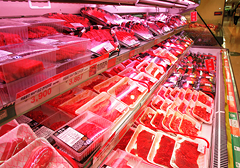
WASHINGTON: The United States will press China to drop its 5-year-old ban on US beef and take a tougher stand against piracy and counterfeiting of US goods when top officials from both countries meet this week at the Richard Nixon presidential library in Yorba Linda, California.
"It's really too early to say what progress we will have in the area of beef. But ag issues are on the agenda," US Commerce Secretary Carlos Gutierrez said in an interview ahead of the talks that begin on Monday. Like many countries, China closed its market to US beef after the first case of mad cow disease was found in the United States in December 2003.
The Bush administration hailed China's conditional agreement in April 2006 to reopen its market but more than two years later, that still hasn't happened. A second US trade official, speaking on condition he not be identified, said that conditions probably still are not right to resolve the beef spat. The US-China Joint Commission on Commerce and Trade is holding its 25th anniversary meeting in Nixon's hometown to capture the symbolism of the late president's historic 1972 trip to China to reopen relations, Gutierrez said.
He and US Trade Representative Susan Schwab lead the talks for the United States and Vice Premier Wang Qishan for China. US Agriculture Secretary Ed Schafer and Chinese Commerce Minister Chen Deming will also attend. The United States will be pressing China on "three big buckets" of concerns, Gutierrez said. Those include China's high rates of piracy and counterfeiting, a number of specific obstacles to imports of US agricultural and manufacturing goods and opaque regulations that are a barrier to trade, he said.
Wang and Chen are expected to complain about the United States' increasing use of anti-dumping and countervailing duties to block Chinese goods and to press Washington to ease restrictions on exports of sensitive high-technology products that have commercial and military applications. China also wants the United States to lower barriers blocking some of its agricultural products and to make it easier for its business people to get US visas.
THIRD LARGEST US EXPORT MARKET
The Bush administration helped shepherd China into the World Trade Organization in December 2001, completing work begun under former President Bill Clinton. Since then, China has become the third largest export market for US goods, taking in a record $65.2 billion last year. But imports from China skyrocketed to a record $321.5 billion over the same period, rattling US manufacturers and prompting calls from Congress for the White House to take tougher action to stop "unfair" China trade.
In a speech to machinist and aerospace workers on Friday, Democratic presidential candidate Barack Obama vowed he "would end China's manipulation of its currency" if elected president. Many lawmakers accuse China of undervaluing its currency to give its companies a trade advantage. Meanwhile, US movie, music, software and book industry groups estimate they lost $3.5 billion in China due to piracy last year, compared to about $1.1 billion annually when President George W. Bush took office in 2001.
The United States hopes for progress this week on piracy concerns even though WTO is set to rule soon on US cases challenging China's "inadequate" protection of intellectual property rights and its market access barriers to legitimate movies, music and other copyright-protected goods. There is no chance this week of a big deal that would change overall trade flows, but certain industries could see significant benefits, the second US trade official said. Telecommunications and medical devices are two sectors where progress could be made in opening China's market, the official said.
"It's really too early to say what progress we will have in the area of beef. But ag issues are on the agenda," US Commerce Secretary Carlos Gutierrez said in an interview ahead of the talks that begin on Monday. Like many countries, China closed its market to US beef after the first case of mad cow disease was found in the United States in December 2003.
The Bush administration hailed China's conditional agreement in April 2006 to reopen its market but more than two years later, that still hasn't happened. A second US trade official, speaking on condition he not be identified, said that conditions probably still are not right to resolve the beef spat. The US-China Joint Commission on Commerce and Trade is holding its 25th anniversary meeting in Nixon's hometown to capture the symbolism of the late president's historic 1972 trip to China to reopen relations, Gutierrez said.
He and US Trade Representative Susan Schwab lead the talks for the United States and Vice Premier Wang Qishan for China. US Agriculture Secretary Ed Schafer and Chinese Commerce Minister Chen Deming will also attend. The United States will be pressing China on "three big buckets" of concerns, Gutierrez said. Those include China's high rates of piracy and counterfeiting, a number of specific obstacles to imports of US agricultural and manufacturing goods and opaque regulations that are a barrier to trade, he said.
Wang and Chen are expected to complain about the United States' increasing use of anti-dumping and countervailing duties to block Chinese goods and to press Washington to ease restrictions on exports of sensitive high-technology products that have commercial and military applications. China also wants the United States to lower barriers blocking some of its agricultural products and to make it easier for its business people to get US visas.
THIRD LARGEST US EXPORT MARKET
The Bush administration helped shepherd China into the World Trade Organization in December 2001, completing work begun under former President Bill Clinton. Since then, China has become the third largest export market for US goods, taking in a record $65.2 billion last year. But imports from China skyrocketed to a record $321.5 billion over the same period, rattling US manufacturers and prompting calls from Congress for the White House to take tougher action to stop "unfair" China trade.
In a speech to machinist and aerospace workers on Friday, Democratic presidential candidate Barack Obama vowed he "would end China's manipulation of its currency" if elected president. Many lawmakers accuse China of undervaluing its currency to give its companies a trade advantage. Meanwhile, US movie, music, software and book industry groups estimate they lost $3.5 billion in China due to piracy last year, compared to about $1.1 billion annually when President George W. Bush took office in 2001.
The United States hopes for progress this week on piracy concerns even though WTO is set to rule soon on US cases challenging China's "inadequate" protection of intellectual property rights and its market access barriers to legitimate movies, music and other copyright-protected goods. There is no chance this week of a big deal that would change overall trade flows, but certain industries could see significant benefits, the second US trade official said. Telecommunications and medical devices are two sectors where progress could be made in opening China's market, the official said.
14 Sep, 2008, 2015 hrs IST, REUTERS
Source: economictimes.indiatimes.com
Source: economictimes.indiatimes.com
Các tin khác
- Following the imposition of the highest tariff of 37.13%, the Ministry of Industry and Trade is reviewing galvanized steel from China (19/06/2026)
- Official tariffs have been imposed on colorless float glass imported from Indonesia and Malaysia (19/06/2026)
- India seeks to continue anti-dumping duties on Bangladesh’s jute products (19/06/2026)
- Turkey Initiates Anti-Dumping Investigation into Polyester Cord Fabric from Viet Nam (19/06/2026)
- Chinese dumping in Brazil affected the entire garlic supply chain (19/06/2026)