Home
Home
 About Us



Australia Governing Party Backs End to India Uranium Export Ban
06/12/2011 12:00
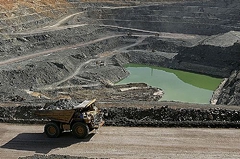
SYDNEY—Australia's governing party Sunday backed a push for the country to end its ban on selling uranium to India, in a move that could further the opening up of trade in fissile materials with the nuclear-armed power at a time of fast-rising energy demand.
A total of 206 delegates to the Labor party's national conference in Sydney voted in favor of the motion, which is backed by the party's leadership, while 185 opposed the measure.
But the move has evoked strong emotions in the Pacific nation, where opposition to nuclear energy is strong despite the country's holding around a third of the world's uranium reserves.
A Roy Morgan poll in March found that 50% of the population oppose exporting uranium for nuclear power, with 44% supporting the practice.
Protesters were ejected from the conference hall while the measure was being debated, and even members of Labor's cabinet spoke against the shift.
"It is the case that nine months after the Fukushima nuclear disaster is not the time to be expanding our uranium exports," Anthony Albanese, the country's infrastructure minister, told the conference.
The decision is particularly controversial because India is not a signatory to the Non-Proliferation Treaty, the 1968 United Nations agreement that largely restricted nuclear-weapons technology to the countries then in possession of atomic bombs. Nuclear-armed India, Pakistan and Israel never signed the accord, and North Korea withdrew from it during the 2000s as it developed its own atomic program.
However, since an agreement on nuclear power cooperation with the U.S. in 2005, India's nuclear relations have been increasingly normalized.
Canada—which hosts the world's largest uranium mine, Cameco Corp.-operated McArthur River—is looking at making similar moves to Australia.
The world's largest uranium deposit, the BHP Billiton-owned Olympic Dam mine in South Australia state, is in the process of receiving final approvals for a major expansion, which could cost as much as US$30 billion.
Prime Minister Julia Gillard supported the measure, which she has backed on the basis that it will create jobs in Australia and improve relations with the country expected to overtake China as the world's most populous by 2030.
"We are at the right time in the history of the world to seize a new era of opportunity in this, the Asian century," she said. "We need to make sure that across our regions we have the strongest possible relationships we can, including with the world's largest democracy, India."
By David Fickling
Source: online.wsj.com
Các tin khác
- Following the imposition of the highest tariff of 37.13%, the Ministry of Industry and Trade is reviewing galvanized steel from China (19/06/2026)
- Official tariffs have been imposed on colorless float glass imported from Indonesia and Malaysia (19/06/2026)
- India seeks to continue anti-dumping duties on Bangladesh’s jute products (19/06/2026)
- Turkey Initiates Anti-Dumping Investigation into Polyester Cord Fabric from Viet Nam (19/06/2026)
- Chinese dumping in Brazil affected the entire garlic supply chain (19/06/2026)