Home
Home
 About Us


Africa urged to use trade law, duties against China
27/09/2012 12:00
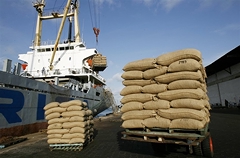
George Geringer, senior manager at PwC tax services, says the only effective way for Africa to deal with cheap imports from Asian economies is to adopt unfair trade remedies including antidumping and safeguard duties
THE only effective way for Africa to deal with cheap imports from Asian economies, especially China, is to adopt unfair trade remedies including antidumping and safeguard duties, says George Geringer, senior manager at PwC tax services.
He made the statement at a PwC tax and business symposium held in Mozambique last week.
There had been a clear shift in the use of trade remedies from developed countries to developing ones. "Today developing countries represent collectively more than 60% of global trade remedy actions," Geringer said. "China has become the single biggest target of antidumping actions in the world."
SA alone had already lost 77,000 jobs because of cheap imports from China, he said.
In the next decade China would be Africa’s biggest investor, but also its biggest competitor. The only way African economies would grow was by reindustrialising themselves, Mr Geringer said.
But without the help of unfair trade remedies this would be difficult. "If Africa does not have a mechanism to combat unfair trade it will be difficult to re-energise its economies," Mr Geringer said.
China started its reindustrialisation 30 years ago and India 20 years ago. Africa would have to do the same, but at a much lower production price than that enjoyed by China and India.
According to Herman Fourie, an associate director at PwC’s tax services division, China’s trade with Africa had increased ten times in 12 years to $129bn. It was predicted that China’s trade with Africa would increase to $400bn by 2015.
China’s largest trading partners in Africa are SA at 25%, Nigeria 11%, Zambia 9% and Sudan 6%.
Mr Fourie referred to a $5bn loan China recently gave to the Mozambican government. The loan agreements came with the provision that the country had to use Chinese contractors and it had to import at least 50% of the equipment needed in the projects for which the money was to be used from China.
When SA joined the international trade arena after 1994 it had fully embraced free market ideas.
"But that can only work if the playing fields are more or less level," Mr Geringer said.
"Africa will experience the playing fields as not being level."
But Tim Schweikert, CEO of General Electric in Southern Africa, disagreed, saying protectionism and the use of unfair trade remedies were counterproductive.
"A country becomes competitive through technology, cost and service, and not by protecting its industries with high tariffs."
25-09-2012
By Amanda Visser
Source: bdlive.co.za
By Amanda Visser
Source: bdlive.co.za
Các tin khác
- Following the imposition of the highest tariff of 37.13%, the Ministry of Industry and Trade is reviewing galvanized steel from China (19/06/2026)
- Official tariffs have been imposed on colorless float glass imported from Indonesia and Malaysia (19/06/2026)
- India seeks to continue anti-dumping duties on Bangladesh’s jute products (19/06/2026)
- Turkey Initiates Anti-Dumping Investigation into Polyester Cord Fabric from Viet Nam (19/06/2026)
- Chinese dumping in Brazil affected the entire garlic supply chain (19/06/2026)