Home
Home
 About Us


Viet Nam's textile and garment industry surpasses China in exports to the US, moving deeper into the value chain
04/04/2026 04:23
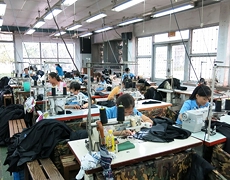
Viet Nam's textile and garment industry is undergoing a strong shift from contract manufacturing to an FOB export model and sustainable production, surpassing China in the US market for the first time in early 2024.
The Viet Namese textile and garment industry is at a historic turning point, transforming from a traditional processing role to a crucial link, participating more deeply in the global value chain. According to recorded data, in the first five months of 2024, Viet Nam officially surpassed China to become the largest exporter of textiles and garments to the US market.
The structural shift from processing to FOB export.
At the 28th Annual Meeting of the International Federation of Fashion Institutes of Technology (IFFTI), experts noted that Viet Nam is no longer simply a large-scale manufacturing hub but is becoming a center for the convergence of knowledge and new design practices. This change is evidenced by the shift in business models.
Mr. Haluk Demirtel, Vice President of Operations at Li & Fung, analyzed that the Viet Namese textile and garment industry has shifted from a purely cut-and-sewn (CMT) model to a free-on-the-job (FOB) export model. With this method, domestic businesses have complete control over everything from sourcing raw materials and organizing production to delivery. This is a result of free trade agreements and market trends favoring flexible production models.
Raw material barriers and the challenge of green production.
Despite achieving impressive export milestones, the textile and garment industry still faces significant challenges regarding self-reliance. Currently, approximately 70% of raw materials are still imported, primarily from China. To address this issue, foreign investment is playing a crucial role in supporting businesses in transforming their models and improving cash flow.
Furthermore, pressure to adopt green production is becoming a mandatory standard in the future. However, experts acknowledge a gap between sustainability commitments and commercial realities. In many markets, price remains a more dominant factor in consumer purchasing decisions than environmental criteria.
Defining value through identity and sustainable fashion.
Another notable trend is the leveraging of local cultural values to create a competitive advantage. Ms. Nguyen Lien Chi, Content Director of ELLE Viet Nam magazine, noted a mismatch between export production standards and the capabilities of domestic brands. The majority of domestic brands still rely on cheap imported raw materials and lack responsible production processes.
To bridge this gap, designers like Vu Thao (founder of Kilomet109) are promoting the "slow fashion" model. By collaborating directly with ethnic minority communities and using natural dyes, these businesses not only preserve traditional techniques but also improve local livelihoods.
Overall, the challenges facing Viet Nam's textile and garment industry are systemic. The transition from a "manufacturing hub" to a "shaper" in the global supply chain requires a coordinated effort encompassing technological investment, innovative design thinking, and long-term sustainable development support policies.
Source: NgheAnNews
Các tin khác
- U.S. to Impose Duties on Mexican, Thai, Vietnamese Chassis (03/06/2026)
- Mexican sugar producers push to scrap U.S. import quotas (03/06/2026)
- Japan launched an anti-dumping investigation into flat steel imports from three countries (03/06/2026)
- Eurochem challenges anti-dumping duties in the EU (03/06/2026)
- Pangasius prices in Viet Nam surge due to high export demand (03/06/2026)