Home
Home
 About Us



Viet Nam is expected to export 7.73 million tons of rice in 2026
21/01/2026 04:04
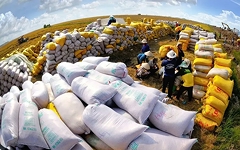
The Ministry of Agriculture and Environment announced that in 2026, approximately 7.73 million tons of commercial rice are expected to be available for export.
According to the Ministry of Agriculture and Environment , the total rice cultivation area nationwide in 2026 is estimated at 7.09 million hectares, a decrease of 36,000 hectares; the average yield is estimated at 61.4 quintals/hectare, an increase of 0.3 quintals/hectare compared to the same period in 2025. Thus, the rice production in 2026 is estimated at 43.552 million tons, an increase of 12,000 tons compared to 2025.
The majority of rice production for export is concentrated in the Mekong Delta provinces; other regions mainly serve domestic consumption. Estimated annual rice production in the Mekong Delta and parts of Tay Ninh province (formerly Long An) reached 3.84 million hectares, with an estimated output of 24.34 million tons. Total domestic rice consumption in the Mekong Delta, Ho Chi Minh City, and for use as seeds, animal feed, etc., is approximately 8.9 million tons.
Thus, the estimated amount of paddy rice is approximately 15.46 million tons, equivalent to 7.73 million tons of rice for export. The structure includes: high-quality rice and fragrant rice at approximately 5.798 million tons, equivalent to 75%; glutinous rice at approximately 773,000 tons, equivalent to about 10%; and rice of processing quality at nearly 1.16 million tons, accounting for about 15%. The amount of rice for export in the first six months of the year is estimated at 4.014 million tons; and in the last six months at 3.716 million tons.
The Ministry of Agriculture and Environment has requested the Ministry of Industry and Trade to focus on boosting rice exports during months with high harvest yields.
Based on the projected rice volume, the Ministry of Agriculture and Environment proposes that the Ministry of Industry and Trade focus on boosting rice exports during months with high harvest yields, including January, March, April, July, August, and September in 2026, while ensuring: maintaining the minimum circulating reserve level as stipulated; implementing inventory reporting to provide the managing agency with data for monitoring and early warning. In addition, gradually developing a digital platform for monitoring and early warning of rice supply and demand risks, supporting flexible export management, and ensuring domestic food security. Being ready to supply the domestic market when directed for price stabilization.
At the same time, it is necessary to strengthen trade promotion; diversify export markets and product segments; and enhance the application of digital transformation in building operational and management scenarios for rice import and export that are consistent with developments in the global and domestic trade markets.
Regarding the mechanism for organizing the procurement of commercial rice for export, the Ministry of Agriculture and Environment proposes that the Ministry of Industry and Trade coordinate with the People's Committees of the provinces to research and implement solutions to standardize procurement activities, involving entities (traders, purchasing agents) in the supply chain linked with export traders and processing facilities through procurement/procurement agency contracts; traders must be registered businesses and comply with the law on trade.
Businesses and processing facilities must publicly disclose their procurement point systems and list purchase prices according to type, quality, and season to ensure transparency of information. The Ministry will strengthen inspection and supervision of the procurement market, strictly handling acts of commercial fraud, price manipulation, speculation, etc., ensuring a balance of interests between producers and businesses.
In addition, the Ministry of Agriculture and Environment has provided input on several policies for managing the rice market in the coming period, such as: submitting a draft decree amending Decree 107/2018/ND-CP on rice export business; developing a mechanism for managing rice imports to protect domestic production and the rice production value chain, especially in the context of major rice importing markets around the world increasing investment to achieve food self-sufficiency…
Source: VTV
Các tin khác
- U.S. to Impose Duties on Mexican, Thai, Vietnamese Chassis (03/06/2026)
- Mexican sugar producers push to scrap U.S. import quotas (03/06/2026)
- Japan launched an anti-dumping investigation into flat steel imports from three countries (03/06/2026)
- Eurochem challenges anti-dumping duties in the EU (03/06/2026)
- Pangasius prices in Viet Nam surge due to high export demand (03/06/2026)