Home
Home
 About Us


Trump plans to raise import taxes by up to 200%, risking increased drug prices and shortages in the US.
03/09/2025 04:56
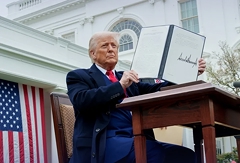
Trump plans to impose a tariff of up to 200% on imported drugs from non-European countries, risking a rise in drug prices. Experts warn this could drive up drug prices, create drug shortages, and worsen the situation for low-income and elderly people.
On September 1, 2568, at 15.28:XNUMX p.m., Yahoo Finance reported that US President Donald Trump is escalating the trade war by targeting imported medical supplies and drugs. Previously, it was hardly ever subject to tariffs. The latest trade deal between the US and Europe was announced, which includes a 15% import tax on certain products, such as medicines, while Trump threatened tariffs of up to 200% on drugs produced outside Europe.
PwC experts explain that This measure is a shock and awe for the pharmaceutical industry, which used to pay zero taxes but is now facing a risk of a 200% tax increase. Which could have a severe impact on consumers.
Trump has vowed to lower drug prices for Americans, but experts warn that high taxes could backfire, leading to drug shortages, soaring prices and higher insurance premiums, particularly for low-income people and seniors.
Although Trump has stated that he will delay the tariffs for 1-1.5 years to allow pharmaceutical companies to restock and relocate production to the US, if the measures are implemented, analysts expect the impact on consumers to become clear around 2570-2571.
Most analysts believe Trump could negotiate a tariff reduction from 200%, but even a 25% cut could ultimately lead to a 10–14% increase in drug prices in the US.
The US currently has a nearly $150,000 billion annual pharmaceutical trade deficit. More than 97% of antibiotics, 92% of antivirals and 83% of popular generic drugs contain ingredients produced overseas, particularly in China and India. Building new pharmaceutical factories in the US is time-consuming and expensive.
Experts warn that if manufacturers of low-margin generic drugs can't absorb the tax costs, they could withdraw from the US market, potentially leading to severe drug shortages, as generics currently account for more than 92% of all prescriptions in the US.
Some major pharmaceutical companies have already begun investing in the US, including Switzerland's Roche, which is investing $50,000 billion to expand its US operations, and Johnson & Johnson, which has announced a $55,000 billion investment over the next four years.
However, analysts point out that relocating entire manufacturing operations back to the US will not be easy and may require government subsidies to encourage generic drug manufacturers to invest.
Source: Money and Banking
Các tin khác
- U.S. to Impose Duties on Mexican, Thai, Vietnamese Chassis (03/06/2026)
- Mexican sugar producers push to scrap U.S. import quotas (03/06/2026)
- Japan launched an anti-dumping investigation into flat steel imports from three countries (03/06/2026)
- Eurochem challenges anti-dumping duties in the EU (03/06/2026)
- Pangasius prices in Viet Nam surge due to high export demand (03/06/2026)