Home
Home
 About Us



The truth about the information that Hoa Phat Steel and Formosa Steel were subjected to anti-dumping duties by Mexico.
30/03/2026 05:44
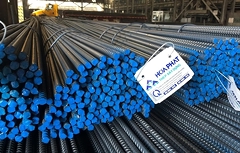
The Mexican Ministry of Economy's imposition of preliminary anti-dumping duties of nearly $200 per ton on hot-rolled coil (HRC) steel from Vietnam is causing a stir in public opinion. However, behind this seemingly "staggering" tax figure lies a completely different reality regarding the market strategy of Hoa Phat Group, the "king of steel."
On March 23, 2026, the Mexican Ministry of Economy officially announced provisional anti-dumping duties on HRC steel imported from China and Vietnam. The two largest representatives of the Vietnamese steel industry, Hoa Phat Group (Hose: HPG) and Formosa Ha Tinh, were subject to duties of US$0.1960/kg and US$0.1969/kg, respectively.
Converted to tons, this tax is approximately $200 per ton – a figure sufficient to deter any exporting business. However, the market and analytical organizations have reacted quite calmly. Why this contradiction?
Looking closely at the actual figures, Mexico's imposition of tariffs is like "shooting into thin air." This is because export volumes had already dropped to zero beforehand; according to data from Kafi Research, HRC exports from Vietnam to Mexico in 2025 had already fallen by a record 99% , leaving only a few thousand tons.
For Hoa Phat, a company that recently set a record for selling over 10 million tons of steel in 2025, the few thousand tons exported to Mexico are truly just a drop in the ocean.
Furthermore, Hoa Phat didn't wait until tariffs were imposed to withdraw. From the moment Mexico initiated its investigation in March 2025, Vietnamese businesses proactively adjusted their supply chains. Instead of stubbornly trying to compete in the Latin American market, which is rife with protectionist barriers, Hoa Phat quietly implemented a strategic "pivot."
On the other hand, while facing difficulties in Mexico, Hoa Phat has been receiving good news from larger markets. In July 2025, the EU announced that it would not impose anti-dumping duties on Hoa Phat's HRC (while other competitors faced a rate of 12.1%).
Previously, the Indian market also made a similar decision. This shows that Hoa Phat's data governance and transparency system has met international standards, helping them confidently overcome the strictest legal hurdles.
The story in Mexico also reveals a larger scheme by billionaire Tran Dinh Long. In the context of countries increasing protectionism through tariffs, owning a huge domestic market is the strongest shield.
Currently, domestic HRC demand remains in a state of "supply not meeting demand". With the Dung Quat 2 project expected to operate at full capacity of 12 million tons of steel per year by the end of 2026, Hoa Phat is aiming to completely dominate the domestic market. The imposition of tariffs in a distant and small market like Mexico inadvertently accelerates the "counterattack" process, allowing the company to focus its resources on replacing imports right in its own backyard.
Mexico's imposition of tariffs on Vietnamese steel may be an unwelcome signal of global protectionist trends, but for Hoa Phat, it's not a financial shock. On the contrary, it demonstrates the acumen of a leading corporation: knowing when to withdraw from risky markets to focus resources on more strategic fronts.
The truth behind the tariff increase, therefore, needs to be seen as an inevitable shift in the process of Vietnam's steel industry reaching global prominence – where transparency and internal capabilities are the ultimate weapons, not a race for the cheapest prices.
Source: VietNam.vn
Dịch từ bài gốc: DaiBieuNhanDan
Các tin khác
- U.S. to Impose Duties on Mexican, Thai, Vietnamese Chassis (03/06/2026)
- Mexican sugar producers push to scrap U.S. import quotas (03/06/2026)
- Japan launched an anti-dumping investigation into flat steel imports from three countries (03/06/2026)
- Eurochem challenges anti-dumping duties in the EU (03/06/2026)
- Pangasius prices in Viet Nam surge due to high export demand (03/06/2026)