Home
Home
 About Us



The footwear industry overcomes challenges and maintains export momentum
02/02/2026 04:40
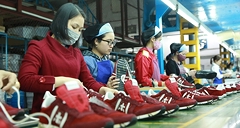
In 2025, despite the strong impact of tariff policies and global instability, the footwear industry maintained positive growth momentum with export turnover reaching US$28.8 billion. Entering 2026, the prospect of recovery is accompanied by many challenges related to competition, transformation of growth models, and the need for sustainable development.
The localization rate of the footwear industry has exceeded 50%.
At the closing ceremony of Viet Nam's leather, footwear, and handbag industry in 2025, held on the morning of January 28th, Mr. Quach Quang Dong, Deputy Director of the Industry Department ( Ministry of Industry and Trade ), stated that leather and footwear export turnover last year reached 28.8 billion USD, an increase of 6.5% compared to 2024, continuing to make a significant contribution to the overall export growth of the country.
The footwear industry achieved this result amidst US tariff policies and global geopolitical shifts directly impacting the supply chain and export orders. This is a positive sign, reflecting the adaptation efforts and resilience of Viet Nam's footwear business community.
The export structure in 2025 continues to show the dominant role of the foreign direct investment (FDI) sector. This sector's export turnover reached US$22.82 billion, accounting for approximately 80% of the total export turnover of the entire industry and increasing by 17% compared to the previous year. Meanwhile, domestic enterprises achieved a turnover of US$5.84 billion, a significant increase of 29%, reflecting efforts to expand market share and capitalize on market opportunities amidst shifting order trends.
In terms of markets, Viet Nam's footwear exports remain focused on traditional markets. The United States continues to be the largest market with a turnover of $11.01 billion, followed by the EU with nearly $6.88 billion – a region known for its stringent requirements regarding environment, labor, and social responsibility. Asian markets such as China, Japan, and South Korea also maintain an important role, creating relative diversification for product output.
Conversely, the domestic market is emerging as a significant growth area. By 2025, the size of the domestic footwear market is projected to reach approximately US$1.05 billion, with consumption of around 155 million pairs per year. By 2033, the market size is expected to reach US$1.544 billion, with an average growth rate of nearly 5% per year. However, domestically produced products currently only account for nearly 40% of the market share, while imports, mainly from China, account for nearly 30%, indicating increasing competitive pressure even in the domestic market.
According to Mr. Nguyen Duc Thuan, Chairman of the Viet Nam Leather and Footwear Association, the leather and footwear industry will continue to hold the second position in the world in exports (after China) and third in production (after China and India) in 2025. Notably, the localization rate of the industry has exceeded 50%, helping the industry achieve a significant trade surplus. Currently, the entire industry has about 30,000 enterprises, of which nearly 9,000 are producing final products and about 21,000 are operating in the upstream sector, creating a foundation for the development of the domestic supply chain.
2026: Opportunities for recovery coupled with the pressure for transformation.
Entering 2026, the outlook for the footwear industry is considered relatively positive, with many businesses already having orders booked until the end of the second quarter. According to Ms. Phan Thi Thanh Xuan, Vice President of the Viet Nam Leather and Footwear Association, the recovery of purchasing power from the US and Europe, along with the trend of shifting orders from some countries in the region, is creating a certain advantage for Viet Nam.
However, numerous challenges remain. Price competition from cheap imports and major international brands is increasingly fierce. The export processing model still accounts for a large proportion, limiting the added value of domestic businesses. Furthermore, the domestic distribution system is not yet widespread, and counterfeit goods are still prevalent, affecting consumer confidence and the reputation of Vietnamese brands.
Given this situation, the Viet Nam Leather and Footwear Association believes that to achieve export targets in 2026 and subsequent years, comprehensive solutions are needed from both the government and the business community. Regarding policy, it is necessary to finalize the industry's development orientation towards stability and sustainability; reform administrative procedures to suit the specific characteristics of chain production; and support the development of supporting industries to increase the localization rate and the ability to meet rules of origin.
One issue particularly emphasized by the Association is the early establishment of a fashion raw materials and accessories trading center, creating a foundation for the sustainable development of the footwear industry, reducing dependence on external supply sources, and increasing the proactive role of domestic businesses.
From the business perspective, the need to transform the growth model is becoming increasingly urgent. Promoting green production, meeting environmental standards, ensuring traceability; diversifying export markets; and gradually investing in building and developing Vietnamese footwear brands are directions that cannot be delayed. Shifting from purely processing to a model with higher added value is not only a requirement of the international market, but also an inevitable path for the Vietnamese footwear industry to enhance its competitiveness and achieve sustainable development in the coming period.
Source: People's Deputies News
Các tin khác
- U.S. to Impose Duties on Mexican, Thai, Vietnamese Chassis (03/06/2026)
- Mexican sugar producers push to scrap U.S. import quotas (03/06/2026)
- Japan launched an anti-dumping investigation into flat steel imports from three countries (03/06/2026)
- Eurochem challenges anti-dumping duties in the EU (03/06/2026)
- Pangasius prices in Viet Nam surge due to high export demand (03/06/2026)