Home
Home
 About Us


Shrimp Exports: Need to Build Brand Linked to Quality
28/04/2025 10:42
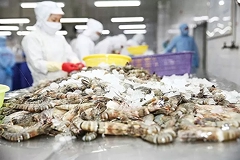
In Q1 2025, shrimp exports surpassed the USD 900 million mark. With productivity reaching its limits, building a brand associated with quality is expected to increase export turnover.
China - The Brightest Spot for Vietnamese Shrimp Exports
According to a report by the Vietnam Association of Seafood Exporters and Producers (VASEP), shrimp exports reached USD 939 million in Q1 2025, an increase of over 37% compared to the same period in 2024. This impressive growth stems from the recovery in demand across many major markets, particularly China, the US, Japan, and the CPTPP bloc.
Among these, China and Hong Kong (China) represent the largest bright spot in Vietnam's shrimp export landscape, with a total turnover of USD 288 million, a surge of 125%. Notably, lobster exports to this market continue to rise sharply. The export price of Vietnamese black tiger shrimp to China remained at USD 9.6/kg in March, a slight increase compared to January. However, the price of whiteleg shrimp remains low (USD 6.6/kg), indicating that competitive pressure from Ecuador and India persists.
Alongside the Chinese market, Vietnam's shrimp exports to the US reached USD 134 million in Q1 2025, up 11% year-on-year.
Shrimp exports to the EU in the first quarter of this year reached USD 107 million, recording positive growth of 33%. Exports to Japan hit USD 124 million, up 20%, and exports to the South Korean market reached USD 77 million, an increase of 16% compared to the same period last year. For the CPTPP market bloc, the export value reached USD 269 million, an increase of 40%, but the market remains heavily dependent on Japan and Canada.
Enhancing Capacity, Need to "Green" the Shrimp Industry
According to a report from the Department of Fisheries and Fishery Surveillance (Ministry of Agriculture and Environment), seafood export turnover in Q1 2025 reached USD 2.29 billion, an increase of 18.1% compared to the same period in 2024.
Mr. Tran Dinh Luan - Director General of the Department of Fisheries and Fishery Surveillance - stated that shrimp and pangasius currently remain the industry's key export products. Notably, in Q1 2025, shrimp exports recorded impressive growth of over 37.8% year-on-year. Despite this, the Vietnamese shrimp industry faces significant challenges.
To overcome these challenges amidst the risk of trade barriers, seafood exporting enterprises need to focus on investing in deep processing and building the "Viet Shrimp" brand linked to quality, sustainability, and transparency.
Furthermore, businesses are actively leveraging Free Trade Agreements (FTAs) such as EVFTA, CPTPP, RCEP, etc. Simultaneously, they are expanding into potential markets with high shrimp consumption demand, including Japan, South Korea, Canada, Europe, and the promising Halal market.
Along with market diversification, enhancing the competitiveness of Vietnam's shrimp industry is an urgent requirement. Speaking to the Industry and Trade Newspaper reporter, Dr. Ho Quoc Luc - former VASEP Chairman and Chairman of the Board of FIMEX Vietnam - explained that for seafood products to penetrate high-end retail shelves, companies must convince partners about their implementation of processes that create products meeting the partners' required criteria.
Besides the advantage of low prices, Ecuador's shrimp industry benefits from having about 30% of its farming area ASC certified, facilitating sales into the EU and the United States. This percentage is extremely modest within Vietnam's shrimp farming industry. The reason is that the vast majority of farming areas are small-scale, making implementation difficult and prohibitively expensive if attempted. This should be considered a "bottleneck" that needs addressing for the shrimp industry to further expand its reach.
The market is currently facing major fluctuations. Experts suggest that Vietnam's shrimp industry is confronting difficulties and requires flexible and timely strategies and tactics. This will help mitigate new challenges and elevate the sector. Among these strategies, "greening" the shrimp industry is a necessary step.
Regarding this, Ms. Le Hang - Deputy Secretary General of VASEP - mentioned that according to Decision 3444/QD-BNN-KH dated September 12, 2023, from the Ministry of Agriculture and Rural Development (now the Ministry of Agriculture and Environment), the National Strategy on Green Growth sets specific tasks for aquaculture.
The shrimp industry is guided towards adopting new, highly effective farming species with good resilience and adaptability to changing climate conditions. Concurrently, disease control, reducing antibiotic use, and ensuring food safety are top priorities. Decision 4441/QD-BNN-KHCN dated December 13, 2024, further promotes the circular economy, utilization of agricultural by-products, and development of biological products for treating the farming environment, paving a sustainable path for the industry.
Accordingly, the shrimp industry has promoted recirculating aquaculture technology (RAS) and by-product recycling, aimed at reducing pollution and optimizing nutrition. Efficient energy use is another pillar of green development. Integrated farming models such as shrimp-mangrove and shrimp-rice are also encouraged. These models are not only environmentally friendly but also contribute to product diversification and increased economic value.
Traceability is an essential requirement to meet international standards. Applying quality management systems like ASC, BRC, and GlobalGAP not only enhances the reputation of Vietnamese shrimp products but also builds consumer trust in the products' green and clean origins.
According to Ms. Le Hang, the green development of Vietnam's shrimp industry represents a comprehensive approach, combining advanced technology, effective waste management, and sustainable farming practices. These efforts not only protect the environment and improve shrimp quality but also reduce costs and increase competitiveness in the global market.
Currently, Vietnam's shrimp industry has an annual output of 1.3 million tons, generating USD 4.3 billion in export revenue.
Source:Congthuong.vn
Các tin khác
- U.S. to Impose Duties on Mexican, Thai, Vietnamese Chassis (03/06/2026)
- Mexican sugar producers push to scrap U.S. import quotas (03/06/2026)
- Japan launched an anti-dumping investigation into flat steel imports from three countries (03/06/2026)
- Eurochem challenges anti-dumping duties in the EU (03/06/2026)
- Pangasius prices in Viet Nam surge due to high export demand (03/06/2026)