Home
Home
 About Us


Shrimp exports in 2026: An opportunity for a breakthrough in the global "race"
27/02/2026 04:47
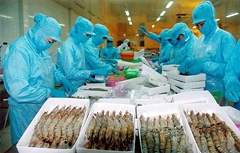
The results of the US tax review, the strong increase in lobster demand in China, and positive signals from the EU open up opportunities for Vietnamese shrimp in 2026. However, fierce competition and higher standards require businesses to improve quality, transparency, and restructure their supply chains.
Positive signals from key markets
2025 concluded with a record-breaking milestone as Viet Nam's shrimp exports reached US$4.6 billion, a 19% increase compared to 2024 – the highest level ever. Within the overall US$11.3 billion of the entire fisheries sector, shrimp continues to play a pivotal role.
Entering 2026, the growth momentum was maintained right from the first month of the year. In January 2026, shrimp exports reached $331 million, an increase of 6.4% compared to the same period, accounting for 39% of the total seafood export value.
In the US market, according to information from the Viet Nam Association of Seafood Processing and Export (VASEP), on February 17, 2026, the US Department of Commerce (DOC) announced the final results of the 19th administrative review (POR19) of the anti-dumping duty order on frozen warmwater shrimp from Viet Nam.
Notably, businesses eligible for the separate tax rate are subject to a margin requirement of 4.28%, significantly lower than the previous preliminary level. This sharp reduction in margin helps to mitigate contract risks, allowing businesses to proactively offer competitive pricing and maintain stable supply.
In 2025, shrimp exports to the United States reached $796 million, accounting for 17.2% of total export value. However, trade protectionist pressures remain as the US strengthens its food safety and traceability oversight.
According to the U.S. Food and Drug Administration (FDA), the 2026 priority program for food for human consumption emphasizes enhanced sampling, expanded regulatory cooperation, and the application of gene sequencing technology for traceability. This means an increasing demand for transparency in the supply chain.
Meanwhile, the Chinese market offers strong growth potential, particularly for lobster. By 2025, lobster exports to China and Hong Kong are projected to reach US$1.3 billion, a 55% increase. Exports of green lobster alone are expected to reach US$840 million, a 131% increase.
Viet Nam has risen to the top of the lobster market in China with over 24,000 tons, accounting for approximately 34.5%, amidst the imposition of an additional 25% tariff on Canadian lobsters. Its geographical proximity, fast delivery times, and ability to supply live lobsters are key factors contributing to this breakthrough for Vietnamese businesses.
However, from March 2026, when tariffs on Canadian lobster are removed, competition will enter a new phase. This will require Vietnamese businesses to standardize their specifications, optimize logistics, and increase direct connections with modern distribution systems.
Mr. Tran Dinh Luan, Director of the Fisheries Department, Ministry of Agriculture and Environment, said that this group is one of the main factors helping to increase export value, contributing to Viet Nam's impressive growth in the fisheries sector last year.
Regarding the 2026 plan, Mr. Luan stated that the industry aims for an export turnover of approximately US$11.5 billion, while continuing to maintain growth in key products such as shrimp. He emphasized that despite facing numerous challenges (such as the IUU yellow card, climate change, and aquaculture environment issues), the Fisheries Department will coordinate with localities to discuss solutions to stabilize production and raw material sources, ensuring sustainable growth in 2026.
Restructuring, value enhancement, and green standards.
In the EU, Vietnamese shrimp currently ranks third after Ecuador and India. However, competition is increasing as Ecuador maintains its position as the world's number one exporter with $7.47 billion in 2025, an increase of over 23%. India is also accelerating its efforts and has completed FTA negotiations with the EU by early 2026, opening up new tariff advantages.
The EU is a leading market for sustainable supply chains. Businesses must not only comply with labor regulations but also meet high requirements regarding animal welfare, the environment, the circular economy , and recycled packaging rates.
One notable bottleneck is that the percentage of ASC-certified shrimp from Viet Nam is still low compared to Ecuador (30–40%). This is a "bottleneck" in accessing high-end distribution systems in Europe.
Globally, the shrimp industry is becoming increasingly competitive. Ecuador and India have advantages in terms of large scale, low costs, and well-established international certification systems. Meanwhile, rising input costs for domestic shrimp farming are eroding farmers' profits.
Therefore, the future of Vietnamese shrimp cannot rely solely on price, but must depend on quality, advanced processing, and branding. Strong investment in traceability systems, standardization of farming areas to achieve international certification, and the application of digital technology in production management are crucial factors for survival.
According to VASEP, the most important thing is for businesses to improve their adaptability and proactively secure raw materials to be ready when the market recovers. At the same time, they need to control costs effectively, increase farming efficiency, and optimize logistics.
Deputy Minister of Agriculture and Environment Phung Duc Tien emphasized that the target of achieving $11.5 billion in seafood exports by 2026 is challenging but achievable if the entire industry strongly shifts to a growth model based on quality, deep processing, and sustainable development.
Leaders of the Ministry of Agriculture and Environment have requested the shrimp industry to focus on three pillars: proactively securing raw materials and reducing dependence on imports; promoting deep processing and increasing the proportion of high-value products; and standardizing traceability to meet ESG requirements and reduce emissions.
According to the Ministry's leadership, 2026 will be a year of accelerated green transformation in aquaculture, promoting recirculating aquaculture models, saving water, and reducing greenhouse gas emissions. Approximately 1 million tons of aquaculture by-products per year will be efficiently utilized in a circular economy approach, creating additional added value.
Industry leaders also emphasized the need to strengthen the supply chain from farming areas – processing plants – logistics – markets, ensuring stable delivery and transparent traceability, thereby enhancing the reputation of Vietnamese shrimp brands.
Positive signals from the POR19 results in the US, the strong growth in lobster sales in China, and opportunities in the EU suggest that the market remains wide open. However, pressure regarding trade protection measures, food safety, green standards, and price competition is increasing.
2026 will not only be about increasing export turnover, but also a test of the Vietnamese shrimp industry's transformation capacity – from raw material production to a high-value chain, from competing on price to competing on quality and transparency.
If Viet Nam effectively capitalizes on market opportunities, strengthens its supply chain, and remains steadfast in its greening, digitalization, and deep processing orientation, Vietnamese shrimp can absolutely continue to maintain its pivotal position, making a significant contribution to the target of $11.5 billion in seafood exports by 2026 and beyond, building a sustainable national shrimp brand on the world map.
Source: Viet Nam Government News
Các tin khác
- U.S. to Impose Duties on Mexican, Thai, Vietnamese Chassis (03/06/2026)
- Mexican sugar producers push to scrap U.S. import quotas (03/06/2026)
- Japan launched an anti-dumping investigation into flat steel imports from three countries (03/06/2026)
- Eurochem challenges anti-dumping duties in the EU (03/06/2026)
- Pangasius prices in Viet Nam surge due to high export demand (03/06/2026)