Home
Home
 About Us


Seafood exports in the long term after a record $11.3 billion
19/01/2026 04:45
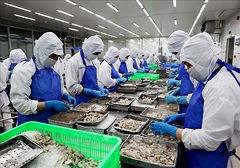
Seafood exports have made a spectacular comeback, setting a new record of $11.3 billion.
However, the year 2026 is projected to present many challenges, requiring the business community to have a long-term strategy for sustainable development. This was the main point shared by businesses and associations at the Viet Nam Association of Seafood Processing and Export (VASEP) conference summarizing seafood exports in 2025 and outlining tasks for 2026, held on the evening of January 17th in Ho Chi Minh City.
Deputy Minister Phung Duc Tien noted that, in response to the fluctuations caused by US tax policies, Viet Nam has proactively adjusted its strategy and accelerated market restructuring. Many businesses have proactively shifted orders and partners to markets outside the US, such as China, Africa, and Europe. Simultaneously, the industry has focused on expanding the range of farmed species and export products such as tilapia and seaweed, promoting high-tech aquaculture to reduce production costs and enhance competitiveness. Despite remaining challenges, with the foundations already laid, seafood exports are projected to see positive developments in the near future.
Ms. Le Hang, Deputy Secretary General of the Viet Nam Association of Seafood Processing and Export (VASEP), stated: 2026 is predicted to be a challenging year for the seafood industry. Many difficulties have already emerged from the beginning of the year, especially from the US market. The results of the anti-dumping duty review on shrimp, expected to be announced in February 2026, may not be favorable for businesses, causing shrimp exports to this market to stagnate or decline in the early months of the year. For the seafood industry, in addition to the EU's (EU) IUU yellow card still being in effect, the US regulations prohibiting imports from 12 unrecognized fishing methods are creating further significant obstacles. Shifting exports to other species is also difficult due to procedural hurdles in the initial stages.
These factors directly impact exports to the US market and have a ripple effect on supply chains in other markets. Furthermore, increased exports in 2025 could lead to higher inventories in 2026. Consequently, importers may reduce their purchases or pressure for lower prices, thereby impacting the overall export revenue of the industry.
Therefore, export results in 2026 are projected to stagnate after peaking in 2025 and may struggle to maintain the previous year's figure above $11 billion. The most important thing for the business community is to continue improving its adaptability and proactively preparing raw material supplies to seize opportunities when the market recovers. VASEP will always support businesses in resolving obstacles in the domestic market, while coordinating with state management agencies to find solutions to address barriers from international markets, aiming to create the most favorable conditions for seafood exports.
From a business perspective, Ms. Nguyen Kim Hau, General Director of Seaspimex Viet Nam Seafood Joint Stock Company, believes it is difficult to make a definitive assessment of the market in 2026 given the current context. In the short term, businesses entering the US market must accept very strict requirements. Some goods intended for export to this market must fully comply with regulations on origin of goods, along with necessary certificates such as Certificates of Accreditation (COA). Only when these conditions are met can goods be cleared through customs at US ports. Furthermore, some Vietnamese products are already completely banned from import into this market.
"The inconsistent application of regulations across product groups creates many difficulties for businesses in the export process. Therefore, one of the important solutions is to proactively shift markets. When unable to access the US market, businesses need to boost exports to Europe or other potential markets. In addition, returning to exploiting the domestic market is also a direction that should be focused on to reduce dependence on a few large export markets," Ms. Nguyen Kim Hau shared.
Vietnamese seafood businesses expect that 2026, while potentially not as favorable as 2025, will still maintain the necessary stability. The key is to proactively adapt to market fluctuations and simultaneously develop a strategy that balances exports and domestic consumption. Balancing these two markets will provide businesses with a solid foundation, enhancing their resilience against unpredictable changes in international trade.
Ms. Le Hang stated: The export target of 11.3 billion USD in 2025 is the result of the collective efforts of the entire fisheries sector, encompassing the entire supply chain from farmers and fishermen to the business community, along with the active support of state management agencies. It is especially important to emphasize the crucial role of flexibility and proactive adaptation from businesses in the face of so many fluctuations.
Seafood businesses have seized the opportune moment to boost exports ahead of tariff changes from the US market, especially new regulations on anti-dumping duties on shrimp and the US Marine Mammal Protection Program (MMPA). This acceleration in the final months of the year has helped achieve breakthrough growth in seafood export revenue in 2025. In addition, trade policy fluctuations have also prompted importers to increase their purchases for stockpiling and risk mitigation in subsequent years, contributing to increased import demand from many markets.
Mr. Phung Duc Tien, Deputy Minister of Agriculture and Environment, emphasized: 2025 is the year when the fisheries sector will experience impressive growth in both production and export value; continuing to affirm its role as an important driving force in Viet Nam's commodity production and exports for many years, not just in 2025. This result is the sum of decisive direction from the Government, close attention and management from the Ministry of Agriculture and Environment, and close coordination with localities. Simultaneously, the removal of many bottlenecks in mechanisms and policies, the sustainable development of fisheries, and the roadmap for lifting the IUU "yellow card" have also been implemented decisively. Many major projects on restructuring the industry, developing deep processing, and increasing added value have been approved and are being implemented synchronously.
Furthermore, green transformation and digital transformation in the fisheries sector are being strongly promoted. Industry databases are being gradually built, and modern, environmentally friendly production processes are being widely applied. The circular economy in fisheries, with a potential of approximately 1 million tons of by-products per year, is opening up an important source of raw materials for developing value-added products. These are key foundations for the sustainable long-term development of the industry.
Source: Tin Tuc News
Các tin khác
- U.S. to Impose Duties on Mexican, Thai, Vietnamese Chassis (03/06/2026)
- Mexican sugar producers push to scrap U.S. import quotas (03/06/2026)
- Japan launched an anti-dumping investigation into flat steel imports from three countries (03/06/2026)
- Eurochem challenges anti-dumping duties in the EU (03/06/2026)
- Pangasius prices in Viet Nam surge due to high export demand (03/06/2026)