Home
Home
 About Us



Relaxing rice export restrictions: Businesses that haven't exported yet praise the measure
06/05/2026 04:30
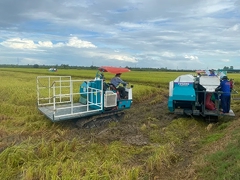
The Ministry of Finance is seeking feedback on a proposal to abolish rice export business licenses in a draft government resolution.
Businesses currently exporting rice are asked to reconsider, while those not directly involved in rice exports praise the approach as reasonable.
Rice should be treated like other agricultural products, and efforts should be made to increase its marketability.
On the afternoon of May 3rd, Mr. Vu Ngoc Dinh, General Director of Techpal Group, stated that the Ministry of Finance's draft proposal to abolish rice export business licenses is extremely urgent. According to him, the number of eligible rice export businesses is currently small, leading to centralized procurement.
"Because few businesses are qualified to export rice, and traders mostly buy up rice for these intermediaries, there is not much competition, leading to the possibility of price manipulation against rice farmers," Mr. Dinh commented.
Mr. Dinh suggested that businesses producing high-value commercial rice do not necessarily need excessively large production volumes. Furthermore, they do not need to invest heavily in factories, warehouses, machinery, etc.
"Currently, Techpal is pioneering in adhering to international standards such as Global Gap, BRC, and ISO, using premium rice varieties like ST25, with clear traceability. Although the quantity doesn't need to be large, we still create products with differentiated value, enhancing the value of Vietnamese rice," Mr. Dinh informed.
He suggested creating a healthy competitive market, treating rice like other exported agricultural products such as coffee and cashews. Eliminating licenses would help small and medium-sized enterprises penetrate more markets.
"When more businesses jump in to build the rice value chain, the rice produced by farmers will be guaranteed a market, making the rice market more vibrant, which benefits both farmers and the Vietnamese rice industry," Mr. Dinh said.
However, he noted that when abolishing rice export licenses, certain standards should also be stipulated for rice that is encouraged for export. Only then can the value of Vietnamese rice be enhanced in the international market.
Sharing the same view, Mr. Tram Du, General Director of TD Soc Trang Organic Rice Agriculture Joint Stock Company, believes that abolishing conditional business licenses is correct and appropriate. "This should be delegated to local authorities. As long as the local authorities confirm that the enterprise is registered to produce high-quality rice with traceability, it should be eligible for export; a license is not necessary," Mr. Du suggested.
Mr. Du stated that currently, ST25 rice and other high-yield, bumper rice varieties are experiencing price drops, causing hardship for farmers. "If more businesses were involved in consumption and export, the results would be much better," Mr. Du remarked.
According to Mr. Du, once regulations are in place, businesses that violate them will be held accountable. It's unacceptable to generalize and accuse all unqualified businesses of damaging the reputation of Vietnam's rice industry.
Just reduce administrative procedures.
Meanwhile, Mr. Pham Thai Binh, Chairman of the Board of Directors of Trung An High-Tech Agriculture Joint Stock Company, believes that reducing administrative procedures is necessary, but the conditions for exporting rice should not be abolished.
According to Mr. Binh, current regulations not only serve management purposes but also contribute to stabilizing the rice industry and ensuring national food security.
"Reducing administrative procedures is the right thing to do, but the conditions for exporting rice need to be retained, because they directly affect the entire industry and tens of millions of farmers," Mr. Binh said.
Mr. Binh analyzed that Vietnam's continued position as one of the world's leading rice exporting countries shows that current business conditions are not a barrier, but rather a tool to regulate the market and ensure quality.
"We are not having any difficulties exporting rice, and we remain among the world's top exporters, so there is no reason to abolish these conditions," he stated.
According to the draft, it will be proposed to abolish business licenses for 58 industries and professions across various sectors, including rice export.
If approved, businesses will no longer need to apply for permits as currently required by Decree 107 of 2018 and recent amendments such as Decree 01 of 2025.
Source: Vietnam.vn
Các tin khác
- U.S. to Impose Duties on Mexican, Thai, Vietnamese Chassis (03/06/2026)
- Mexican sugar producers push to scrap U.S. import quotas (03/06/2026)
- Japan launched an anti-dumping investigation into flat steel imports from three countries (03/06/2026)
- Eurochem challenges anti-dumping duties in the EU (03/06/2026)
- Pangasius prices in Viet Nam surge due to high export demand (03/06/2026)