Home
Home
 About Us



Maintaining the lychee brand through quality and professional export practices
22/05/2026 04:40
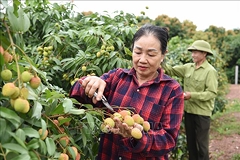
Despite a decrease in yield due to weather conditions, the 2026 lychee crop in Bac Ninh still shows positive signs, with high-quality fruit and a stable market.
From lychee growing areas meeting VietGAP and GlobalGAP standards to a system of registered growing areas and packaging facilities serving exports, lychee growers are strongly shifting towards a mindset of improving quality, building brands, and conquering demanding markets. This is also the direction for Bac Ninh lychees to increase their value and maintain their position in domestic and international markets.
Improving quality from areas where fabrics meet standards.
In late May, in the lychee-growing regions of Bac Ninh province, clusters of early-ripening lychees begin to paint the orchards red. The harvesting atmosphere is bustling from early morning as traders and transport vehicles constantly move in and out of the weighing stations. This year, although the yield has decreased due to weather conditions, the quality of the fruit is highly appreciated for its beautiful appearance, thick flesh, and sweet taste, resulting in a relatively favorable market.
In Quat Du 2 village, Phuc Hoa commune, many people enjoy visiting the lychee orchard of Mr. Ngo Van Cuong. This is a specialty lychee variety that he brought to cultivate more than 7 years ago and is now yielding high economic returns. The lychee clusters have large fruits with bright red skin, averaging only about 15-18 fruits per kilogram.
According to Mr. Cuong, this lychee variety not only has a beautiful appearance and high quality but also has a bitter stem, which helps to limit pests and diseases. From the beginning of the season, the entire yield has been purchased by traders at a price of about 150,000 VND/kg.
Besides developing high-quality lychee varieties, Phuc Hoa commune is also focusing on building production areas that meet export standards. By 2026, the entire commune will have 845 hectares of lychee orchards, with an estimated yield of about 7,500 tons, mainly early-ripening varieties. The locality maintains 25 export-oriented growing area codes along with a packaging facility serving markets such as China, Japan, the United States, Australia, and Thailand.
According to the leaders of Phuc Hoa commune, the locality has harvested approximately 2,506 tons of early-ripening lychees so far, reaching over 33% of the planned production. The majority of the product is consumed in the domestic market, while about 25 tons have been exported to Canada and other markets.
To meet the increasingly high demands of the market, people and cooperatives in the area are focusing on safe production, improving quality, and ensuring product traceability. Mr. Nguyen Van Thiet, Director of the Phuc Hoa Early Lychee Production and Consumption Cooperative, said that the cooperative currently maintains a concentrated production area of about 80-100 hectares, with an annual output of 800-1,000 tons. Many areas have adopted VietGAP standards, and some areas are gradually approaching GlobalGAP standards and organic production.
According to Mr. Thiet, households are increasingly paying attention to keeping production logs, controlling fertilizers and pesticides, and strictly adhering to care procedures to produce uniform and safe products. This is also an important factor in Phuc Hoa lychees maintaining their position in export markets.
Along with Phuc Hoa, Chu ward continues to affirm its position as a key lychee-growing area in Bac Ninh province. Currently, the ward has nearly 2,000 hectares of lychee orchards, of which more than 1,250 hectares are cultivated according to VietGAP standards. The locality maintains planting area codes on 1,968 hectares for export to the Chinese market; at the same time, it maintains 19 planting area codes for export to international markets and 14 packaging facilities that meet export requirements.
According to Mac Anh Tuan, Vice Chairman of the People's Committee of Chu Ward, although the flowering rate this year only reached about 30-35% due to weather conditions, thanks to the proactive application of technical measures, the fruit setting rate remained high. In particular, the quality of lychees this year is considered outstanding, with beautiful appearance and good sweetness, meeting the stringent requirements of the market.
To enhance the value of lychees, the locality is promoting the application of science and technology, expanding production according to VietGAP and GlobalGAP standards; strengthening traceability through electronic labels, planting area codes, and strictly managing the process from production to consumption. Along with that, it is boosting trade promotion, advertising products on digital platforms and e-commerce sites, and developing tourism experiences during the lychee ripening season.
Professional export, market diversification.
No longer a story of "bumper harvest, low prices," the 2026 lychee crop in Bac Ninh is showing a clear shift from a focus on quantity production to improving quality, organizing professional exports, and diversifying consumer markets.
This year, the province has approximately 29,800 hectares of lychee orchards, with an estimated yield of over 95,000 tons, nearly 60% of the planned target. Despite the decrease in production, this is seen as an opportunity for the locality to focus on the high-quality segment and increase the export value per unit of product.
For many years, Bac Ninh province has been gradually building a production system that meets the requirements for official export. Currently, the province manages 241 registered growing areas with an area of over 17,450 hectares serving exports to many markets such as China, the United States, Australia, Japan, and Thailand. Along with that, there are 42 packaging facilities that meet export requirements, creating an important foundation for lychees to meet international standards on traceability, food safety, and plant quarantine.
In early May, the first batch of early-ripening lychees from Phuc Hoa commune was exported to Canada, marking a promising start to the lychee season. In particular, the approval by the US authorities for the Hanoi Irradiation Center's irradiation facility to process fresh fruit for export to the US from mid-May 2026 is considered a significant step forward, helping to reduce logistics costs and expand export opportunities to North American markets.
However, along with the opportunities come increasingly stringent requirements from the international market. China remains the main export market for Bac Ninh lychees, but from June 1, 2026, the country will begin applying new regulations on the registration of food export businesses according to Order 280 of the General Administration of Customs of China, with stricter requirements on planting area codes, packaging facilities, and traceability.
According to Mr. Nguyen Duc Hung, Director of Global Food Import-Export Joint Stock Company, if localities, cooperatives, and businesses do not quickly standardize production processes, upgrade packaging facilities, and strictly control product quality, the risk of having their export codes temporarily suspended or revoked is entirely possible.
This is also the time for the lychee industry to shift strongly towards professional production, increasing value instead of relying on quantity. Besides traditional markets, many new markets such as North America, Europe, and Japan are opening up great opportunities for Vietnamese lychees, although requirements for quality and food safety are becoming increasingly stringent.
Besides focusing on fresh fruit consumption, Bac Ninh is also gradually expanding deep processing to increase the added value of lychees. Products such as frozen lychees, dried lychees, juices, and OCOP products made from lychees are encouraged to develop in order to reduce the pressure of consumption during the short main season.
One of the new features of this year's lychee season is the enhancement of logistics capacity to serve exports. A representative from Viettel Logistics stated that the company has added more than 120 refrigerated container trucks, bringing the total to over 300 to serve transportation during the peak season. Along with road transport to China, the company is also expanding exports using refrigerated containers and air freight to high-end markets such as Europe and the United States.
According to Pham Van Thinh, Vice Chairman of the People's Committee of Bac Ninh province, lychee is not only a key crop that brings high economic value but also a symbol of the province's high-quality agriculture, and is now present in many demanding markets such as Japan, the United States, the EU, and Australia.
To further enhance the lychee brand, Bac Ninh province has identified three key strategies. First, it focuses on developing production areas in a safe and sustainable manner, meeting export standards. The province continues to strictly manage planting area codes and packaging facilities, and strengthens quality control of exported products.
In addition, Bac Ninh is stepping up efforts to build brands and promote lychees associated with geographical indications and regional culture; while also promoting digital transformation in trade promotion and expanding consumption through e-commerce platforms and modern distribution systems.
The province also focuses on diversifying export markets, effectively exploiting free trade agreements, expanding into new markets in Europe, the Middle East, and South Asia; and developing deep processing and cold logistics to increase added value and extend the shelf life of lychees.
With a well-structured production plan, professional export practices, and a focus on quality, the 2026 harvest promises to be successful not only in terms of sales but also in achieving high export value per unit, further solidifying the brand of Bac Ninh lychees in both domestic and international markets.
Source: Vietnam.vn
Các tin khác
- U.S. to Impose Duties on Mexican, Thai, Vietnamese Chassis (03/06/2026)
- Mexican sugar producers push to scrap U.S. import quotas (03/06/2026)
- Japan launched an anti-dumping investigation into flat steel imports from three countries (03/06/2026)
- Eurochem challenges anti-dumping duties in the EU (03/06/2026)
- Pangasius prices in Viet Nam surge due to high export demand (03/06/2026)