Home
Home
 About Us


Is Vietnamese rice 'abandoning' the 0% tariff market?
17/04/2026 08:22
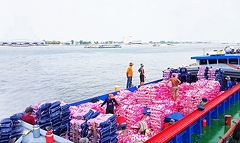
Viet Nam exports 8-9 million tons of rice annually, but primarily to markets with high tariffs, while many markets benefiting from 0% tariff rates under free trade agreements remain largely untapped. Why is this the case?
To date, Viet Nam has participated in approximately 20 Free Trade Agreements (FTAs), of which 16 have been in effect for a long time.
New-generation FTAs such as the CPTPP (Comprehensive and Progressive Trans- Pacific Partnership) and the EVFTA (Viet Nam-European Union Free Trade Agreement) open up great opportunities as many markets impose import tariffs on rice at 0% or very low levels.
60% of our rice exports go to countries that impose high taxes!
However, the reality shows that Viet Nam's rice exports are still mainly concentrated in traditional markets in the region such as the Philippines and Indonesia - countries that impose relatively high import tariffs - approximately 35% and 25% respectively.
Notably, within the framework of RCEP (Regional Comprehensive Economic Partnership Agreement), the Philippines did not liberalize its rice sector, while Indonesia maintained high tariffs. Despite this, these two markets at one point accounted for up to 60% of Viet Nam's total rice exports.
Meanwhile, CPTPP member markets such as Canada impose a 0% tariff on Vietnamese rice, Mexico imposes a 10% tariff on rice and a 0% tariff on rice products. Notably, under the EVFTA, the European Union allocates a tariff-free quota of 80,000 tons of rice per year, but Viet Nam has not yet fully utilized this opportunity.
Many believe that Vietnamese businesses prioritize easily accessible markets like the Philippines and Indonesia due to their close geographical proximity and simplified procedures. However, according to experts and businesses, the reasons go beyond simply "choosing the easiest option."
Mr. Pham Thai Binh, Chairman of the Board of Directors of Trung An High-Tech Agriculture Joint Stock Company (Can Tho City), believes that businesses are not unwilling to enter FTA markets, but mainly face a lack of orders and numerous technical barriers.
According to Mr. Binh, demanding markets like Europe or Japan require strict production processes, clear traceability, and consistent quality. Meanwhile, most domestic businesses still do not fully meet these standards, so they often choose traditional markets with easier import conditions.
"Furthermore, Viet Nam's rice industry remains fragmented, with dispersed production and a lack of supply chain linkages. Investment in branding, processing technology, and quality standards is limited, resulting in limited access to high-end markets, which is not commensurate with its potential," a rice industry enterprise acknowledged.
Businesses "follow market demand".
Despite their accessibility, traditional markets pose significant price risks. It has been noted that Vietnamese businesses have at times suffered losses exporting rice to the Philippines due to market fluctuations.
The leader of a rice export company acknowledged that demand from the Philippines and Indonesia is "real demand," making it easier for the company to sell its products. However, choosing these markets also means accepting low profit margins, or even the risk of losses, while price pressure is often shifted to farmers.
"In addition, rising logistics costs, fuel prices, and input materials also affect export efficiency. These factors make it difficult for businesses to expand into markets that require significant investment in production standards and processes," he said.
A leader of Tan Long Group also stated that rice export activities are proceeding normally and are not directly affected by import taxes in various markets. According to this leader, the company mainly exports under FOB (Free On Board) terms, so responsibility for taxes and import procedures rests with the foreign partner. Therefore, the company does not directly know the tax rates in each market, but primarily produces and sells goods according to customer demand.
"This shows that current rice export activities are still 'order-based,' heavily dependent on market demand, rather than proactively orienting strategies to exploit FTA markets," this person acknowledged.
Experts believe that to effectively leverage FTAs, Viet Nam's rice industry needs a strong shift towards large-scale production, improved quality, and brand building. Businesses need to invest systematically in the production-processing-export chain, meeting stringent standards for food safety and traceability.
At the same time, close coordination between management agencies and businesses is needed to exploit the benefits from FTAs, given that global rice demand remains high and market expansion opportunities are still significant. "Without a change in approach, the Vietnamese rice industry may continue to depend on 'easy' markets, with low added value and high risks," one expert warned.
Source: Vietnam.vn
Các tin khác
- U.S. to Impose Duties on Mexican, Thai, Vietnamese Chassis (03/06/2026)
- Mexican sugar producers push to scrap U.S. import quotas (03/06/2026)
- Japan launched an anti-dumping investigation into flat steel imports from three countries (03/06/2026)
- Eurochem challenges anti-dumping duties in the EU (03/06/2026)
- Pangasius prices in Viet Nam surge due to high export demand (03/06/2026)