Home
Home
 About Us


Fruit and vegetable exports rebound as China market recovers
24/12/2025 10:08
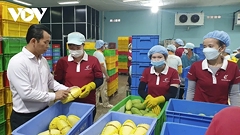
Viet Nam’s fruit and vegetable exports set a new record in 2025, driven by a strong recovery in the Chinese market, while packaging upgrades are emerging as a critical factor in raising value and ensuring sustainable growth.
According to the Ministry of Agriculture and Environment, export turnover reached an estimated US$7.8 billion during the past 11 months of 2025, up 18% year on year, with the full-year figure projected at around US$8.5 billion.
Key products such as durian, dragon fruit, pomelo, mango and passion fruit continued to expand their presence in the United States, the European Union, Japan, the Republic of Korea (RoK) and the Middle East.
China remains the sector’s largest export market. However, tighter controls on cadmium and auramine O, particularly for durian, led to a sharp decline in shipments in the early months of 2025. Exports to China recorded five consecutive months of negative growth year on year, with turnover in the first five months reaching just US$1.1 billion, down 35.3%, reducing China’s share of Viet Nam’s total fruit and vegetable exports to 47.8%.
Many exporters temporarily halted shipments to review and adjust production processes to meet stricter quality requirements. From June, as several technical barriers were eased and export protocols for products such as bananas, coconuts and passion fruit were signed, shipments to China began to recover.
A turning point came in September 2025, when exports to China reached nearly US$1.07 billion, lifting overall sector growth from contraction to a positive 1.6%. Momentum continued in October and November, with year-on-year growth doubling and then rising by nearly 93%, respectively.
Throughout the reviewed period, exports to China totalled US$4.98 billion, surpassing the full-year 2024 record of US$4.63 billion and making a remarkable contribution to the sector’s overall performance. For 2025 as a whole, shipments to the Chinese market are forecast to reach about US$5.5 billion.
In the US, fruit and vegetable exports posted robust growth of 56% in the 11 month-period to about US$500 million, despite the impact of tariff policies. Exports to the EU also rose by around 50%, with turnover estimated at US$350-400 million. The Netherlands and Germany continued to serve as the main gateways to the EU market, each recording export values of more than US$100 million.
Growth in the EU has been supported by tariff preferences under the EU-Viet Nam Free Trade Agreement (EVFTA)and notable improvements in product quality, reflected in a roughly 50% reduction in EU food safety alerts compared with the same period last year. Alongside the US, the EU has emerged as a key bright spot, helping the sector gradually reduce its reliance on a limited number of traditional markets.
According to the Viet Nam Fruit and Vegetable Association, China remains a high-potential market thanks to geographical proximity and convenient logistics links by road, rail and sea. At the same time, rising requirements for traceability, quality and, in particular, packaging are forcing Vietnamese exporters to continuously upgrade if they are to maintain market share.
Experts note that for sustainable growth, especially in distant and demanding markets, packaging improvements are no longer optional but mandatory. Beyond reducing post-harvest losses, packaging must meet standards on food safety, sustainability and information transparency.
At a recent seminar on improving export fruit packaging, Peter Johnson, an international expert on tropical fruit value chains with UNIDO’s GQSP programme in Viet Nam, said local packaging still faces shortcomings, including low carton durability and designs ill-suited to cold storage, pre-cooling and long-haul transport. He added that packaging choices often remain overly cost-focused, without fully accounting for associated losses.
From a sustainability perspective, Le Thi Thanh Thao, UNIDO’s national representative in Viet Nam, stressed that packaging should be viewed as a technological solution rather than merely an outer layer, warning that inappropriate packaging can increase emissions and food waste.
The fact shows that advanced technologies such as modified atmosphere packaging (MAP), natural compound coatings and integrated cold-chain management are extending shelf life and reducing losses during long-distance transport. Trials have shown that lychees exported to the US can be stored for up to 35 days, while passion fruit treated with MAP and coatings retains freshness for more than a month.
According to the Viet Nam Packaging Association, the adoption of smart packaging, optimised carton designs for cold storage, and sustainable, recyclable materials that meet extended producer responsibility (EPR) requirements and new import-market regulations will provide a major competitive edge.
As fruit and vegetable exports continue to recover, particularly in the Chinese market, sustained investment in packaging, design and preservation technologies is seen as a key lever to lift export earnings and move Vietnamese fruit further up the global value chain.
Source: VOV
Các tin khác
- U.S. to Impose Duties on Mexican, Thai, Vietnamese Chassis (03/06/2026)
- Mexican sugar producers push to scrap U.S. import quotas (03/06/2026)
- Japan launched an anti-dumping investigation into flat steel imports from three countries (03/06/2026)
- Eurochem challenges anti-dumping duties in the EU (03/06/2026)
- Pangasius prices in Viet Nam surge due to high export demand (03/06/2026)