Home
Home
 About Us



China to restart Aussie lobster trade in major breakthrough
11/10/2024 06:21
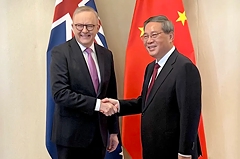
Australia has cleared the final hurdle in its $20 billion trade dispute with China, with Beijing moving to lift import restrictions on rock lobsters in a major foreign policy victory for Anthony Albanese.
Chinese Premier Li Qiang confirmed the decision in talks with the prime minister on the sidelines of the ASEAN summit in Laos on Thursday, ending four years of coercive trade restrictions that affected Australian agricultural exports including of barley, wine and beef.
The bans were imposed by China after the Morrison government pushed for an independent inquiry into the source of the coronavirus pandemic. They have badly hurt producers and dogged Labor as it moved to stabilise relations with Beijing.
Rock lobster exports to China were worth about $800 million annually. About 3000 people work in the industry.
Mr Albanese said the timeline for imports to restart before the end of the year meant Australian rock lobsters – including from Western Australia, Tasmania and South Australia – would be on tables in time for Chinese New Year celebrations in late January.
“We have continued to stabilise the relationship without compromising on any of Australia’s national interests,” he said after frank but warm talks with Mr Li. “With our patient, calibrated and deliberate approach we’ve restored Australian trade with our largest export market.”
Tensions remain
Despite the progress, major points of tension remain in the bilateral relationship, including Beijing’s aggression in the South China Sea. The ASEAN talks and Friday’s East Asia Summit will also consider the deteriorating security situation in the Middle East.
Mr Albanese used the talks to outline all Australia’s concerns about China’s behaviour, including a recent ballistic missile test in international waters in the South Pacific and the continued detention of writer Yang Hengjun.
“Continued dialogue provides the best pathway for Australia to advance our national interest, but also to advance peace and security in our region,” he said before talks with Canadian Prime Minister Justin Trudeau and New Zealand’s Christopher Luxon.
China is Australia’s largest trading partner. Two-way trade accounts for 27 per cent of Australia’s total goods and services trade.
The trade impediments imposed by China resulted in a $20.6 billion reduction in the total value of targeted exports, compared with 2019.
As well as lobsters, the Chinese market is once again open to Australian coal, cotton, copper ores and concentrates, timber logs, oaten hay, barley and wine.
After Mr Li greeted Mr Albanese as an “old friend”, the pair discussed China’s expansionist activities in the Indo-Pacific region.
He welcomed relations with Australia moving forward, saying both sides wanted to foster “a more mature, stable and productive” partnership.
Before the trip, Mr Albanese likened ongoing contact with China to engagement between Washington and Moscow at the height of the Cold War. On Thursday, he said Australia was a facing a period “of strategic competition in our region”.
“We need to have military to military engagement and co-operation and dialogue to avoid any misadventure. I put forward our view about the importance of those international rules being upheld.”
West Australian Premier Roger Cook said rock lobsters from his state were the best in the world, and welcomed renewed sales to China.
“Programs to grow local sales and other overseas markets have supported the fishery through the sanction period, and the resumption of sales will build on this success,” he said.
Australia China Business Council president David Olsson said the breakthrough was significant.
“This is not just about lobsters; this development signals a positive trend in the broader Australia-China trade relationship. It signals positive momentum for resolving trade issues and sets the stage for broader economic collaboration going forward.”
Mr Albanese was due to see Philippines President Ferdinand Marcos jnr and to meet new Japanese Prime Minister Shigeru Ishiba.
Mr Marcos, whose country is facing growing antagonism from China, called on nations to reduce tensions in the South China Sea.
“We continue to be subjected to harassment and intimidation,” he said. “Parties must be earnestly open to seriously managing the differences and to reduce tensions.”
US Secretary of State Antony Blinken will discuss the Middle East crisis and regional tensions with leaders at Friday’s talks.
In April 2020, China’s envoy to Canberra used an interview with The Australian Financial Review to warn China could halt sales of popular agricultural exports if relations soured.
Source: Financial Review
Các tin khác
- U.S. to Impose Duties on Mexican, Thai, Vietnamese Chassis (03/06/2026)
- Mexican sugar producers push to scrap U.S. import quotas (03/06/2026)
- Japan launched an anti-dumping investigation into flat steel imports from three countries (03/06/2026)
- Eurochem challenges anti-dumping duties in the EU (03/06/2026)
- Pangasius prices in Viet Nam surge due to high export demand (03/06/2026)