Home
Home
 About Us


Cashew paradox: Viet Nam exports soar, but imports hit record high
16/01/2026 04:28
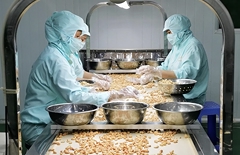
While cashew exports topped $5.2 billion in 2025, experts warn that Viet Nam is increasingly dependent on imported raw materials and risks becoming a mere processor.
In 2025, Viet Nam’s cashew industry hit historic highs - and raised historic alarms.
According to preliminary data from the General Department of Customs, Viet Nam exported nearly 766,600 tons of cashew nuts last year, bringing in a record $5.23 billion. While export volume rose just 5.7% compared to 2024, revenue surged 20.4%, thanks to rising prices.
The average export price of Vietnamese cashews in 2025 reached approximately $6,817 per ton - up 13.9% year over year.
Viet Nam’s cashew kernels are now sold in over 90 countries and territories. For nearly two decades, the country has remained the world’s top exporter of processed cashews. In 2025, China, the United States, and the Netherlands were Viet Nam’s largest export markets.
Behind the record: a growing dependence on imports
Yet beneath the impressive figures lies an unsettling truth: Viet Nam’s cashew sector - a billion-dollar industry - is increasingly reliant on imported raw materials.
In 2025 alone, Vietnamese firms spent nearly $4.5 billion to import around 3 million tons of raw cashew nuts - another record-breaking figure. Compared to 2024, raw cashew imports rose 17.7% in volume and soared 39.3% in value.
This surpassed the previous import peak of $4.18 billion set in 2021.
The average import price of raw cashews reached $1,525.2 per ton in 2025, marking an 18.2% increase over the prior year.
Cambodia emerged as Viet Nam’s largest raw cashew supplier, accounting for 32.9% of total import value. It was followed by Ivory Coast (25.3%), Nigeria (9.3%), and Ghana (7.7%).
Compared to 2024, imports from all four countries grew significantly: up 38.7% from Cambodia, 47.6% from Ivory Coast, 42% from Nigeria, and 12% from Ghana.
Viet Nam: the new cashew processing plant for Africa?
At a recent economic forum, Bach Khanh Nhut, Vice President of the Viet Nam Cashew Association (VINACAS), warned that despite its export successes, Viet Nam is losing its grip on the cashew value chain.
“Domestic raw materials only meet about 10% of demand. The remaining 90% comes from imports - mainly from African countries and Cambodia,” he said.
This dependence isn’t new, but it’s becoming increasingly problematic. Over the past five years, African countries have learned from Viet Nam’s model: buying raw nuts, processing them into kernels, and exporting the value-added product. They’re now investing in machinery to handle 70% of the processing work.
However, the final 30% - involving delicate, manual handling - still requires the dexterity and precision of Vietnamese workers. African producers, unable to replicate this level of craftsmanship, are exporting semi-processed cashews to Viet Nam, where the final touches are completed.
“As a result, Viet Nam has unintentionally become the processing plant for African cashews,” said Nhựt. “We’re taking in semi-finished products, completing them, and then exporting.”
Statistics back up the shift. In 2020, Viet Nam imported only a few tens of thousands of tons of semi-processed cashew kernels. By 2025, that number skyrocketed to 150,000 tons in just 11 months - the equivalent of 700,000 tons of raw cashews.
“At this rate, once Africa builds out its full processing capacity, Viet Nam’s cashew industry could be left behind,” Nhựt warned.
An unfair trade landscape
According to VINACAS, the playing field is far from level. Many African countries have adopted policies that ban raw cashew exports early in the season, ensuring domestic processors get first access to the highest-quality nuts. Only after domestic needs are met do they allow exports - meaning Vietnamese firms often import second- or third-tier raw materials.
Meanwhile, African nations impose export taxes of 7–10% on raw cashews and offer subsidies for processed kernel exports - a double advantage for local processors and investors.
“In contrast, Viet Nam imposes no taxes on either raw cashew imports or kernel exports,” Nhựt noted.
Policy changes urgently needed
To protect the industry, VINACAS has urged Vietnamese authorities to reconsider tax and import policies.
One proposed solution: follow India’s model by applying a minimum import price or a 25% tariff on semi-processed kernels. This would support local processors and protect domestic value creation.
Additionally, Viet Nam could enforce stricter technical standards for imported cashew products - particularly on food safety and quality - to prevent the influx of subpar goods and maintain high international standards.
As Viet Nam’s cashew industry continues to lead the world in exports, industry leaders say it must also lead in protecting its own future.
Source: Vietnamnet
Các tin khác
- U.S. to Impose Duties on Mexican, Thai, Vietnamese Chassis (03/06/2026)
- Mexican sugar producers push to scrap U.S. import quotas (03/06/2026)
- Japan launched an anti-dumping investigation into flat steel imports from three countries (03/06/2026)
- Eurochem challenges anti-dumping duties in the EU (03/06/2026)
- Pangasius prices in Viet Nam surge due to high export demand (03/06/2026)