Home
Home
 About Us



A new turning point for Viet Nam's rice exports
13/05/2026 11:00
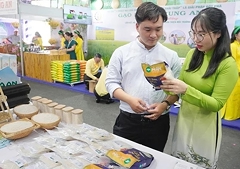
The Ministry of Finance's proposal to abolish rice export business licenses, one of 58 sectors slated for reduced requirements, is attracting significant attention from businesses, managers, and experts. This is seen as a major shift in how Viet Nam's rice market is managed, aiming for increased competitiveness and sustainable development.
Relaxing regulations will stimulate the market.
According to the draft proposal from the Ministry of Finance , if approved, rice exporting businesses will no longer have to apply for licenses with requirements for storage facilities, milling facilities, or maintaining business conditions as currently stipulated in Decree 107/2018/ND-CP and recent amendments such as Decree 01/2025/ND-CP.
This proposal comes amidst increasing competitive pressure on rice exports, with average export prices in the first few months of 2026 decreasing by 9.3% compared to the same period in 2025. This forces regulatory authorities to consider "loosening" regulations to create more incentives for the market.
Surveys show that many representatives of small and medium-sized enterprises (SMEs) agree that abolishing licensing requirements will significantly expand the number of businesses participating in the market. With SMEs having access to the market, outlets will be expanded, thereby contributing to improving rice prices – a factor currently under downward pressure.
However, some large businesses are concerned about the long-term consequences of completely abolishing the conditions for rice export business. Mr. Pham Thai Binh, Chairman of the Board of Directors of Trung An High-Tech Agriculture Joint Stock Company, expressed that although this proposal is timely in the current context, in the long term, this policy is unlikely to strongly develop the rice industry.
According to Mr. Pham Thai Binh's explanation, rice is not an ordinary commodity but a special one, linked to the livelihoods of nearly 20 million farmers and directly related to national food security. When barriers to market entry are removed, businesses can participate in exports without investing in milling plants, raw material areas, or even without considering the rice farmers.
“This will create unfair competition among businesses. Businesses that invest systematically, build value chains, and connect with farmers will have to compete with ‘amateur’ exporters who lack the same foundation. Therefore, I propose that we should not completely abolish licenses, but instead focus on cutting unnecessary administrative procedures while establishing a sufficiently strong control system to protect the industry,” Mr. Pham Thai Binh emphasized.
Businesses must optimize costs and improve product quality.
Expressing his views on this proposal, Associate Professor Dr. Dinh Trong Thinh, a senior lecturer at the Academy of Finance, assessed that this is a step in line with the general trend of reducing barriers to market entry, simplifying administrative procedures, and creating conditions for all economic sectors to participate equally.
The abolition of export licenses is expected to bring about positive changes to the rice market. With more businesses participating, competition will increase, forcing entities in the value chain to innovate, optimize costs, and improve product quality. At the same time, the market will have better access to international consumer trends, thereby diversifying products and expanding market segments.
“Under current conditions, with improved production capacity and a growing private sector, expanding export participation is in line with the trend of integration. This is not only an opportunity to take advantage of the market, but also a driving force for the entire chain to innovate and develop together,” Associate Professor Dr. Dinh Trong Thinh observed.
While agreeing with the Ministry of Finance's proposal, Associate Professor Dr. Nguyen Thuong Lang, senior lecturer at the Institute of International Trade and Economics, National Economics University, believes that in the long term, a rice exchange should be established – where transactions are transparent in terms of price, production volume, and standards. When information is made transparent, the possibility of price manipulation or unfair competition will be significantly reduced. At the same time, this would provide a basis for regulatory agencies to monitor the market in real time, thereby enabling timely policy decisions.
Simultaneously, it is necessary to improve the legal framework on anti-dumping measures in rice exports. In the context of increasingly fierce competition, businesses engaging in price wars to gain market share not only affects business efficiency but also risks diminishing the value of the national brand.
On its part, the Ministry of Industry and Trade pointed out the potential consequences of abolishing business conditions in rice exports, including the risk of impacting food security, competitive buying and selling, and the risk of foreign capital manipulating the market.
Meanwhile, the Ministry of Agriculture and Environment believes that the proposal to abolish rice export licenses will present a dilemma of balancing administrative procedure reform with ensuring sustainable development of the industry. As market doors open wider, the big question is not just whether or not to abolish them, but how to do so without creating long-term risks for both businesses and farmers.
According to data from the Import-Export Department (Ministry of Industry and Trade), there are currently 152 traders nationwide who have been granted certificates of eligibility to conduct rice export business.
Source: Vietnam.vn
Các tin khác
- U.S. to Impose Duties on Mexican, Thai, Vietnamese Chassis (03/06/2026)
- Mexican sugar producers push to scrap U.S. import quotas (03/06/2026)
- Japan launched an anti-dumping investigation into flat steel imports from three countries (03/06/2026)
- Eurochem challenges anti-dumping duties in the EU (03/06/2026)
- Pangasius prices in Viet Nam surge due to high export demand (03/06/2026)